THE CLASSIC COLLECTION✦An outlaw’s diary: the CommuneCLASSIC FREE BOOKS
An outlaw’s diary: the Commune
Cécile Tormay
THE CLASSIC COLLECTION · 1920
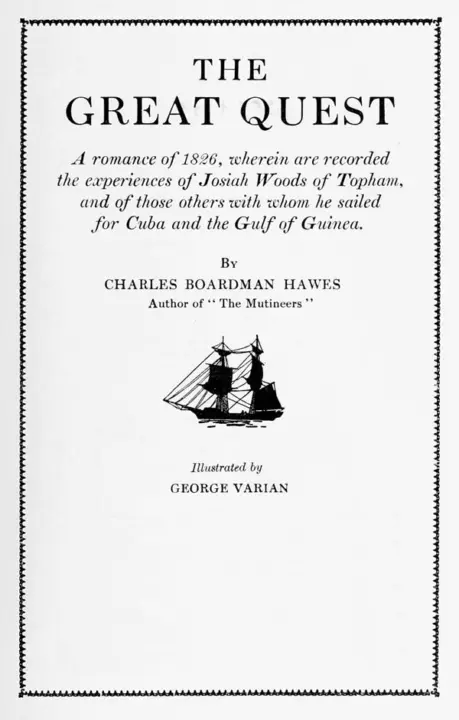
"The Great Quest" by Charles Boardman Hawes is a children's adventure novel published in 1921. When Cornelius Gleazen returns to 1826 Massachusetts, he persuades his friend Seth Woods and Seth's young nephew Joe to join a sea voyage supposedly seeking hidden treasure. But when the travelers reach Cuba, a darker purpose emerges: Gleazen's real plan involves the slave trade in Africa. Joe and his companions must find a way to wrest control of the expedition from Gleazen's dangerous scheme.
Introduction adapted from the source catalogue; source summaries may be automatically generated.
Free to read · English · 102,752 words · No account needed
MAKE TIME FOR A GOOD BOOK
On by default. Untick to stop anonymous reading totals. Each page counts after 10 seconds in view. How this works.
Anonymous counting is on unless you have switched it off.
There indeed was the house, on a low mound, which showed the marks of sacrilegious pick and shovel. The posts on which it stood were driven straight down into the hillock. But in reply to O'Hara's loud hail no answer came from that silent, apparently deserted dwelling.
O'Hara turned and, as if apologizing, said in a lower voice, but
still loud enough for us to hear, "Sure, now, and he must be out
somewhere."
Then he waited for us, and we gathered in a little group and looked at the wattled hut as if in apprehension, although of course there was no reason on earth why we should have been apprehensive.
"Well, gentlemen," said Arnold, very quietly, "why not go in?"
Not a man stirred.
O'Hara faced about with moodily clouded eyes. "Well, then," he gasped, "he would build it on the king's grave."
I am sure that my face, for one, told O'Hara that he only mystified
me.
"Sure, and he was like others I've seen. More than once I warned him, but he didn't believe in nigger gods. He didn't believe in nigger gods, and he built the house on the king's grave! On the king's grave, mind you! He was that set and reckless."
"Gentlemen," said Arnold, again, very quietly, very precisely, "why
not go in?"
All this time my uncle, as was his way except in those rare moments when he made a pitiful show of regaining his old peremptory manner, had been standing by in silence, looking from one to another of our company. But now he hesitantly spoke up.
"He has not been here for some time," he said.
Gleazen turned with a scornful grunt. "Much you know whether he has
or not," he retorted.
"See!" My uncle pointed at the door. "Vines have grown across the
top of it."
Gleazen softly swore, and Matterson said, "For once, Neil, he's
right."
Why we had not noticed it before, I cannot say; probably we were too much excited. But we all saw it now, and Gleazen, staring at the dark shadow of the leaves on the door, stepped back a pace.
"By Heaven," he whispered, "I don't like to go in."
"Gentlemen," said Arnold, speaking for the third time, ever quietly and precisely, "I am not afraid to go in."
When he boldly went up to the house ahead of us, we, ashamed to hang
back, reluctantly followed.
Your reading position is saved on this browser. Take it to another device with a library code. Reading pages adapt to text, rather than matching a printed edition.
BEHIND THE BOOK
This eBook is for the use of anyone anywhere in the United States and most other parts of the world at no cost and with almost no restrictions whatsoever. You may copy it, give it away or re-use it under the terms of the Project Gutenberg License included with this eBook or online at www.gutenberg.org. If you are not located in the United States, you will have to check the laws of the country where you are located before using this eBook. Read the source licence.
The original source file, including credits and licence, is retained by this library. Request an original-format copy at no charge. Please include the book title and Project Gutenberg identifier #40265.
KEEP YOUR CURIOSITY GOING
Cécile Tormay

Moritz Busch
Coulson Kernahan
John L. Ransom

Maurice Baring
Frances Wright