THE CLASSIC COLLECTION✦An outlaw’s diary: the CommuneCLASSIC FREE BOOKS
An outlaw’s diary: the Commune
Cécile Tormay
THE CLASSIC COLLECTION · 1920
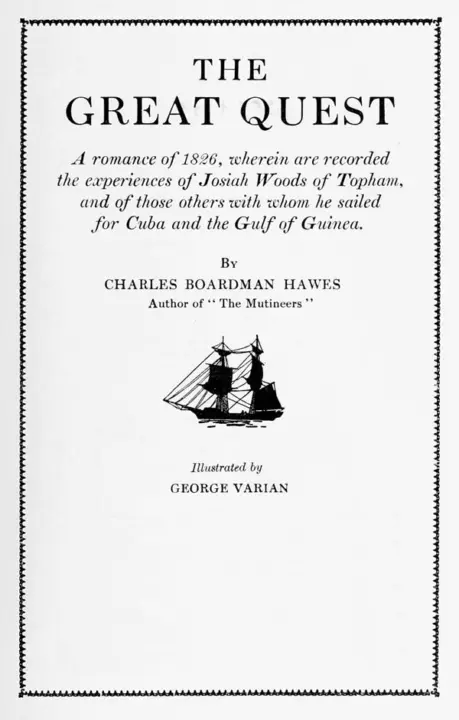
"The Great Quest" by Charles Boardman Hawes is a children's adventure novel published in 1921. When Cornelius Gleazen returns to 1826 Massachusetts, he persuades his friend Seth Woods and Seth's young nephew Joe to join a sea voyage supposedly seeking hidden treasure. But when the travelers reach Cuba, a darker purpose emerges: Gleazen's real plan involves the slave trade in Africa. Joe and his companions must find a way to wrest control of the expedition from Gleazen's dangerous scheme.
Introduction adapted from the source catalogue; source summaries may be automatically generated.
Free to read · English · 102,752 words · No account needed
MAKE TIME FOR A GOOD BOOK
On by default. Untick to stop anonymous reading totals. Each page counts after 10 seconds in view. How this works.
Anonymous counting is on unless you have switched it off.
"Your leaders who were here a little while ago," our host replied, "tried their best to prove it--and failed. Indeed, had I not seen them, I should more readily believe you. It is not the first time that I have seen some of them, you must remember."
Gideon North bit his lip. "Have you considered," he asked, "that we may not be in accord with them?"
"A man must be known by the company he keeps."
"We are in neither sympathy nor accord with them."
"It is a virtue, sir, no matter what your circumstances, to be at least loyal to your associates. If you so glibly repudiate your friends, on what grounds should a stranger trust you?"
At that Gideon North got up all hot with temper. "Sir," he cried, "I will not stay to be insulted."
"Sir," the man returned, "I have insulted, and would insult, no
one."
"Of that, sir," Gideon North responded, "I will be my own judge."
"Captain North," said Arnold, "have patience. One moment and we--"
Turning in the door, which he had reached in two strides, our captain cried hotly, "Come, men, come! I tell you, come!"
Mr. Severance followed him in silence; Arnold stepped forward as if to restrain him, and I, left for a moment with the missionary, turned and faced him with all the dignity of which I was master.
"I am sorry that you think so ill of us," I said.
"I am sorry," he replied, "to see a youth with an honest face in
such a band as that."
I could think of no response and was about to turn and go, when I suddenly remembered our lost cabin boy.
"Can you, in any case," I asked, "tell me what has become of our
cabin boy, Willie MacDougald?"
"Of whom?"
"Of Willie MacDougald--the little fellow that came ashore to-day?"
"Did he not return to the brig?"
"No."
The man stepped forward.
"No," I repeated, "I have not seen him since."
"Then," he returned, "you are not likely ever to see him again."
"What do you mean?" I demanded. "What has happened? Where is he?"
Getting no answer, I looked around the room at the chairs and tables and pictures,--they had an air of comfort that made me miserably homesick,--and at the well-trimmed lamp from which the light fell on the Bible. Then I turned and went out into the darkness.
Your reading position is saved on this browser. Take it to another device with a library code. Reading pages adapt to text, rather than matching a printed edition.
BEHIND THE BOOK
This eBook is for the use of anyone anywhere in the United States and most other parts of the world at no cost and with almost no restrictions whatsoever. You may copy it, give it away or re-use it under the terms of the Project Gutenberg License included with this eBook or online at www.gutenberg.org. If you are not located in the United States, you will have to check the laws of the country where you are located before using this eBook. Read the source licence.
The original source file, including credits and licence, is retained by this library. Request an original-format copy at no charge. Please include the book title and Project Gutenberg identifier #40265.
KEEP YOUR CURIOSITY GOING
Cécile Tormay

Moritz Busch
Coulson Kernahan
John L. Ransom

Maurice Baring
Frances Wright