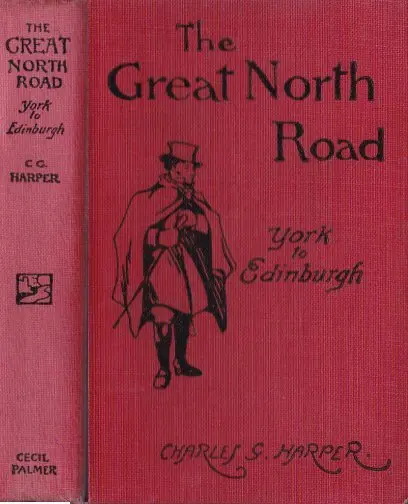
The Great North Road, the Old Mail Road to Scotland: York to Edinburgh
Charles G. (Charles George) Harper
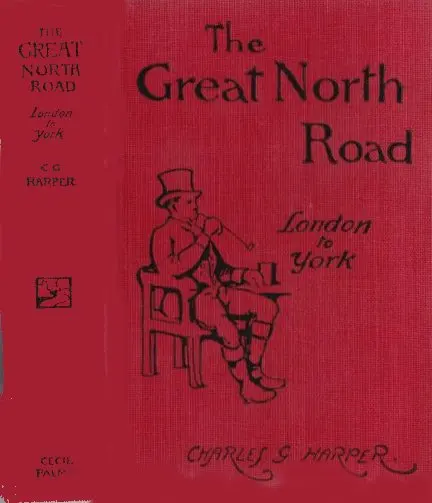
THE CLASSIC COLLECTION · 1901
"The Great North Road, the Old Mail Road to Scotland: London to York" by Charles G. Harper is a historical account written in the early 20th century. This work explores the significance, history, and evolution of the Great North Road, which served as a vital travel route between London and Edinburgh, focusing particularly on its role during the coaching era and its transformation with the advent of motor travel. The opening of the book provides a rich historical context for the Great North Road, highlighting its importance as a thoroughfare and the changes it underwent from a solitary highway to a bustling route frequented by motorists. Harper discusses the original state of travel, emphasizing the dangers and discomforts faced by travelers in earlier centuries. He introduces notable milestones, such as the establishment of mail-coach services and the gradual transition to modern transportation, while also reflecting on the nostalgia surrounding traditional inns and coaching houses that once thrived along the route. This sets the stage for deeper explorations into the evolution of road travel throughout the book.
Introduction adapted from the source catalogue; source summaries may be automatically generated.
Free to read · English · 64,867 words · No account needed
MAKE TIME FOR A GOOD BOOK
On by default. Untick to stop anonymous reading totals. Each page counts after 10 seconds in view. How this works.
Anonymous counting is on unless you have switched it off.
In 1750 things were no better, but eight years later an Edinburgh merchant, George Chalmers, procured an improvement. Before 1758 the Great North Mail set out three times a week and took eighty-seven hours in going north, and not fewer than one hundred and thirty-one from Edinburgh to London. This last itinerary was lengthened so greatly in time on account of stoppages made at Berwick and at Newcastle, ranging from three hours at one to twenty-four at the other. These delays Chalmers, in corresponding with the officials, proved to be quite needless. He also induced them to avoid the old and longer route through Thorne and York and to take the alternative road by Boroughbridge, thus shortening the journey by twelve miles. The times were then fixed at eighty-two hours for the northward-bound mail, and eighty-five for the south. For his services the Government made Chalmers a grant of £600. Some years afterwards he induced the Post Office to run the mails six days a week.
But a greater than Chalmers was at hand in Palmer, the organiser of the mail-coach service. Palmer accomplished, according to De Quincey, “two things very hard to do on our little planet, the earth, however cheap they may be held by eccentric people in comets: he had invented mail-coaches, and he had married the daughter of a duke. He was therefore just twice as great a man as Galileo, who did certainly invent (or, which is the same thing, discover) the satellites of Jupiter, those very next things extant to mail-coaches in the two capital pretensions of speed and keeping time; but, on the other hand, who did not marry the daughter of a duke.” Palmer married, in point of fact, Lady Madeline Gordon, daughter of the Duke of Richmond, but De Quincey does not lay the stress he should have done on his having fought his postal scheme to success against the obstinacy and red-tapeism of the Post Office officials, itself an enterprise sufficient to daunt any but the stoutest heart. Government officials have a wonderful power of passive resistance and an insensibility to argument and proof which might be envied by a lamp-post. It was thought a brilliant rejoinder when one of these Post Office dunderheads replied to Palmer’s scheme for supplanting the slow and uncertain post-boys by fast coaches with the observation that there was no reason why the post should be the swiftest conveyance in England! No doubt this witty gentleman resigned in an access of mortification when Palmer actually succeeded in being appointed Controller-General of the Post Office, with a salary of £1,500 a year and a two and a-half per cent. commission on a rise of the income above the £240,000 at which it stood when he was placed at the head of affairs. The first mail-coach was put upon the Bath Road on the 8th of August 1784, and its success was so great and immediate that the chief towns of the kingdom presently began to petition for similar facilities to be accorded them. York was the first successful applicant, and a mail was put on the road between London, York, and Edinburgh in October of the same year, taking three nights and two days to perform the journey. This was not a very remarkable rate of speed, to be sure, but the times were not so hurried then. A greater speed was attained when the roads began to be reorganised by Telford and Macadam. Macadam’s method of metalling the existing roads and Telford’s reconstruction of steep and winding highways produced great results. To Macadam was due the greater speeds attained at last on the mail route between London and Edinburgh; for, although Telford’s improved road was begun in 1824, it was never completed owing to the introduction of railways. Government had, in fact, by this time recognised the necessity of good roads, and, fresh from the reorganisation of the mail route between London and Holyhead, had determined on an improved communication between England and Scotland. This road, already referred to, was to be straight and as flat as engineering science could contrive it, and a portion—that between Edinburgh and Morpeth—was constructed about 1824, going by way of Soutra Hill, Lauderdale, Coldstream, and Wooler. The route between London and Morpeth was also surveyed and authorised, and portions between London and York actually begun, when the opening of the Stockton and Darlington Railway in 1825 convinced the authorities that the days of the road were numbered.
Your reading position is saved on this browser. Take it to another device with a library code. Reading pages adapt to text, rather than matching a printed edition.
Charles G. (Charles George) Harper
Charles G. (Charles George) Harper
Charles G. (Charles George) Harper
BEHIND THE BOOK
This eBook is for the use of anyone anywhere in the United States and most other parts of the world at no cost and with almost no restrictions whatsoever. You may copy it, give it away or re-use it under the terms of the Project Gutenberg License included with this eBook or online at www.gutenberg.org. If you are not located in the United States, you will have to check the laws of the country where you are located before using this eBook. Read the source licence.
The original source file, including credits and licence, is retained by this library. Request an original-format copy at no charge. Please include the book title and Project Gutenberg identifier #46716.
KEEP YOUR CURIOSITY GOING
Wilfrid Scawen Blunt
Wilfrid Scawen Blunt

E. W. (Edgar Watson) Howe
Cécile Tormay

Moritz Busch
John L. Ransom