
Lucinda
Anthony Hope
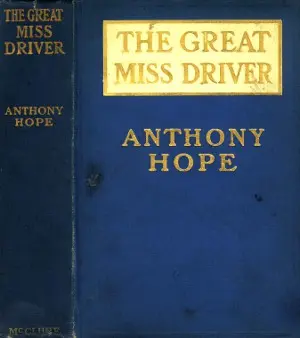
THE CLASSIC COLLECTION · 1908
"The Great Miss Driver" by Anthony Hope is a novel written in the early 20th century. The story revolves around the character Jenny Driver, the daughter of a wealthy man who had a complex relationship with his daughter and the world around him. As she inherits his fortune after his death, Jenny navigates her newfound position in society, amidst various interactions with men who have their sights on her and her wealth. The opening of the novel establishes the backdrop of Jenny's life post her father's death, detailing not only her transition into wealth but also her complicated feelings regarding her father and her past. Personal anecdotes and discussions among characters about her father’s legacy set the stage for her challenges ahead. We see her confronted with the responsibilities of wealth and societal expectations, while also encountering Mr. Nelson Powers, a character tied to a troublesome part of her past. Jenny’s dynamic with those around her, particularly her relationship with her father's solicitor and a rising figure of concern, sets the tone for her journey of self-discovery and agency in a world that expects her to play various roles.
Introduction adapted from the source catalogue; source summaries may be automatically generated.
Free to read · English · 105,357 words · No account needed
MAKE TIME FOR A GOOD BOOK
On by default. Untick to stop anonymous reading totals. Each page counts after 10 seconds in view. How this works.
Anonymous counting is on unless you have switched it off.
According to Bindlecombe the only possible site for the visible realization of this splendid idea--the only site which the congested condition of the center of the borough allowed, and also the only one worthy of the great Institute--was the garden and grounds of Hatcham Ford. The beautiful old house itself was to be preserved as the center of an imposing group of handsome buildings; the old gardens need not be materially spoiled--so Bindlecombe unplausibly maintained. The flavor of antiquity and aristocracy thus imparted to the Institute would, Bindlecombe declared, give it a charm and a dignity beyond those possessed by any other Institute the world over. I was there when he first made this suggestion to Jenny. She looked at him in silence, smiled, and glanced quickly at me. The look, though quick, was audacious--under the circumstances.
"But what will Mr. Octon say to that?"
Bindlecombe deferentially hinted that he understood that Mr. Octon's lease of Hatcham Ford expired, or could be broken, in two or three years. He understood--perhaps he was wrong--that Mr. Driver usually reserved a power to break leases at the end of seven years? Mr. Cartmell would, of course, know all about that.
"Oh, if that's so," said Jenny, "of course it would be quite simple.
Wouldn't it, Mr. Austin?"
"As simple as drawing a badger," I replied--and Bindlecombe looked surprised to hear such a sporting simile pass my lips. It was by no means a bad one, though, and Jenny rewarded it with a merry little nod.
At this point, then, her public project touched her private relations--and her relations with Octon had been close ever since her return from Paris. He had been a constant visitor at Breysgate, and my belief was that within a very few weeks of her arrival he had made a direct attack--had confronted her with a downright proposal--demand is a word which suits his method better--for her hand. I did not think that she had refused, I was sure that she had not accepted. She was fond of referring, in his presence, to the recent date of her father's death, to her own immersion in business, to the "strangeness" of her new life and the necessity of "finding her feet" before doing much. These references--rather pathetic and almost apologetic--Octon would receive with a frown of impatience--sometimes even of incredulity; but he did not make them an occasion of quarrel. He continued to come constantly to the Priory--certainly three or four times a week. There is no doubt that he was, in his way, very much in love with Jenny. It was an overbearing sort of way--but it had two great merits: it was resolute and it was disinterested. He was quite clear that he wanted her; it was quite clear that he did not care about her money, though he might envy her power. And if he tried to dominate her, he had to submit to constant proofs of her domination also. She could, and did, make him furiously angry; he was often undisguisedly impatient of her coynesses and her hesitations: but he could not leave her nor the hopes he had of her. And she, on her side, could not--at least did not--send him away. For that matter she never liked sending anybody away--not even Powers; it seemed to make her kingdom less by one--a change in quite the wrong direction. Octon would have been a great loss, for he had, without doubt, a strong, and an increasingly strong, attraction for her. She liked at least to play at being subjugated by his masculine force; she did, in fact, to a great extent approve and admire his semi-barbaric way (for her often mitigated by a humor which he kept for the people he liked) of speaking of and dealing with women. Down in her heart she thought that attitude rather the right thing in a man, and liked to think of it as a power before which she might yield. At the theater she was always delighted when the rebellious maiden or the charming spitfire of a wife, at last, in the third act, hailed the hero as her "master." So far she was primitive amidst all her subtlety. But to Jenny's mind it was by no means the third act yet; even the plot of the play was not laid out so far ahead as that. If this masterful, quick, assertive way of wooing were proper to man, woman had her weapons; she had her natural weapons, she had the weapons a civilized state of society gave her, and she had those which casual chance might add to her arsenal. Under the last of these three categories fell the project of the Driver Institute, to be established at Mr. Octon's present residence, Hatcham Ford.
Your reading position is saved on this browser. Take it to another device with a library code. Reading pages adapt to text, rather than matching a printed edition.
Anthony Hope

Anthony Hope

Anthony Hope

Anthony Hope
BEHIND THE BOOK
This eBook is for the use of anyone anywhere in the United States and most other parts of the world at no cost and with almost no restrictions whatsoever. You may copy it, give it away or re-use it under the terms of the Project Gutenberg License included with this eBook or online at www.gutenberg.org. If you are not located in the United States, you will have to check the laws of the country where you are located before using this eBook. Read the source licence.
The original source file, including credits and licence, is retained by this library. Request an original-format copy at no charge. Please include the book title and Project Gutenberg identifier #33293.
KEEP YOUR CURIOSITY GOING
Coulson Kernahan

Maurice Baring
Frances Wright
Cécile Tormay

Frederic Jesup Stimson

W. H. P. (William Henry Pope) Jarvis