
Lucinda
Anthony Hope
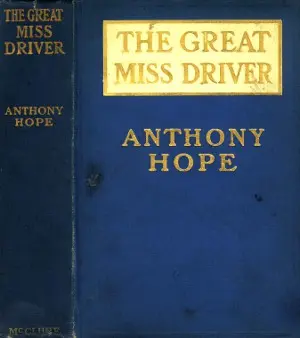
THE CLASSIC COLLECTION · 1908
"The Great Miss Driver" by Anthony Hope is a novel written in the early 20th century. The story revolves around the character Jenny Driver, the daughter of a wealthy man who had a complex relationship with his daughter and the world around him. As she inherits his fortune after his death, Jenny navigates her newfound position in society, amidst various interactions with men who have their sights on her and her wealth. The opening of the novel establishes the backdrop of Jenny's life post her father's death, detailing not only her transition into wealth but also her complicated feelings regarding her father and her past. Personal anecdotes and discussions among characters about her father’s legacy set the stage for her challenges ahead. We see her confronted with the responsibilities of wealth and societal expectations, while also encountering Mr. Nelson Powers, a character tied to a troublesome part of her past. Jenny’s dynamic with those around her, particularly her relationship with her father's solicitor and a rising figure of concern, sets the tone for her journey of self-discovery and agency in a world that expects her to play various roles.
Introduction adapted from the source catalogue; source summaries may be automatically generated.
Free to read · English · 105,357 words · No account needed
MAKE TIME FOR A GOOD BOOK
On by default. Untick to stop anonymous reading totals. Each page counts after 10 seconds in view. How this works.
Anonymous counting is on unless you have switched it off.
"I don't know about women--but if that form of flattery were brought to bear on any man, I don't see how he could possibly resist."
"It's quite natural; it's not put on in the least."
"I'm sure of it. That's what would make it so dangerous. To have that beautiful little creature treating one as a god--who could refuse the incense, or not become devoted to the worshiper?"
Jenny nodded. "You understand it, I see. Men would feel that way, would
they?"
"Rather!" I answered, with a laugh. Jenny was leaning her head on her elbow, and looked across the table at me with a satisfied mocking smile. I could see that I had given an answer that pleased her--but she was not minded to tell me why she was pleased.
Half chaffing her, half really wondering what she would be at, I asked, "Do you want Oxley Lodge for Margaret?"
"For her?" exclaimed Jenny, smiling still. "Why? Isn't this house big
enough for the mite?"
"Suppose you both marry--or either? You're both eminently marriageable
young women."
"Are we? Eminently marriageable? Well, I suppose so." She laughed. "Even if one doesn't marry, it's something to be marriageable, isn't it?"
"A most valuable asset," said I. "Then you'd want two houses."
"I suppose we should. But how far you look ahead, Austin!"
"If that isn't Satan reproving sin--!" I cried.
"What do you suspect me of now?" she asked, still mocking, but genuinely curious, I think, to fathom my thoughts.
"No, no! You'll be off on another tack if you think you've been
sighted."
She laughed as she rose from the table. "Oh, come out and walk! At any rate, my getting Oxley would annoy Lady Sarah, wouldn't it?"
"You can annoy her cheaper than that!"
"There's plenty of money, Mr. Cartmell says," she answered, smiling over her shoulder as she led the way.
I had a talk with Margaret, too, a little later on. Jenny sent us for a moonlight stroll together. Young as the child was, she was good company, independently of her place in Jenny's mind, which for me gave her an adventitious interest. But what a contrast to Jenny, no less than to Octon--and perhaps a more profound one! The fine new surroundings, the enlarged horizon which Jenny's friendship opened to her, were still a delightful bewilderment; she enjoyed actively, but she accepted passively; she applauded the entertainment, but never thought of arranging the bill of the play. Jenny could not have been like that--even at seventeen; she would have itched to write some lines in the book, to have a word to say to the scenes. Margaret's simplicity of grateful responsiveness was untouched by any calculation.
Your reading position is saved on this browser. Take it to another device with a library code. Reading pages adapt to text, rather than matching a printed edition.
Anthony Hope

Anthony Hope

Anthony Hope

Anthony Hope
BEHIND THE BOOK
This eBook is for the use of anyone anywhere in the United States and most other parts of the world at no cost and with almost no restrictions whatsoever. You may copy it, give it away or re-use it under the terms of the Project Gutenberg License included with this eBook or online at www.gutenberg.org. If you are not located in the United States, you will have to check the laws of the country where you are located before using this eBook. Read the source licence.
The original source file, including credits and licence, is retained by this library. Request an original-format copy at no charge. Please include the book title and Project Gutenberg identifier #33293.
KEEP YOUR CURIOSITY GOING
Coulson Kernahan

Maurice Baring
Frances Wright
Cécile Tormay

Frederic Jesup Stimson

W. H. P. (William Henry Pope) Jarvis