THE CLASSIC COLLECTION✦Tattle-tales of CupidCLASSIC FREE BOOKS
Tattle-tales of Cupid
Paul Leicester Ford
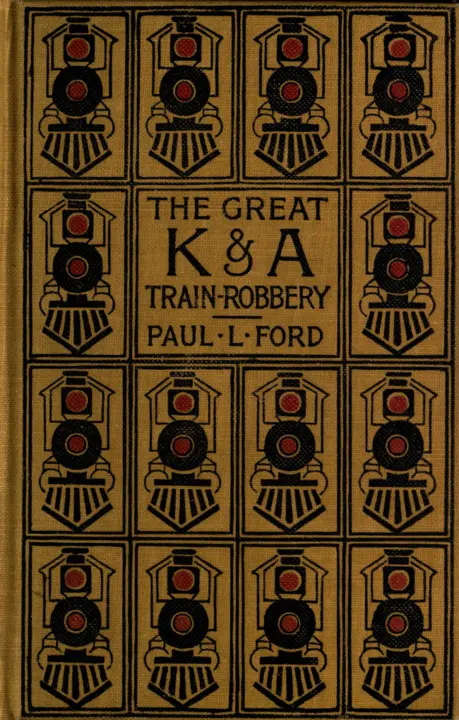
THE CLASSIC COLLECTION · 1896
"The Great K. & A. Robbery" by Paul Leicester Ford is a novel written in the late 19th century. The book revolves around the character of Dick Gordon, a railroad superintendent, and his involvement in a train robbery plot that intertwines with themes of adventure and corporate intrigue. The story promises a mix of suspense and character-driven narrative, as it delves into the complexities of love, loyalty, and betrayal within the context of a train heist. At the start of the narrative, we are introduced to Dick Gordon during a seemingly routine interaction on a train carrying notable passengers, including the charming Miss Cullen, whose interest in train robberies becomes a focal point. The atmosphere turns tense as Dick recounts various tales surrounding the infamous K. & A. train robbery, emphasizing his skepticism about the exaggerated accounts of heroism that have emerged since the robbery. The story sets up the characters and their dynamics while hinting at an impending hold-up, particularly as Miss Cullen expresses a longing for adventure. As we further delve into the opening chapters, it becomes clear that the ensuing events will challenge Gordon personally and professionally as he navigates the unexpected consequences of the robbery and its deeper implications for his life and the people involved.
Introduction adapted from the source catalogue; source summaries may be automatically generated.
Free to read · English · 33,211 words · No account needed
MAKE TIME FOR A GOOD BOOK
On by default. Untick to stop anonymous reading totals. Each page counts after 10 seconds in view. How this works.
Anonymous counting is on unless you have switched it off.
"I should like to think that, but I can't," she said. "I know we all tried to do something dishonest, and while you didn't do any real wrong, yet I don't think you would have acted as you did except for our sake. And I'm afraid you may some day regret--"
"I sha'n't," I cried; "and, so far from meaning that I had lost my self-respect, I was alluding to quite another thing."
"Time?" she asked.
"No."
"What?"
"Something else you have stolen."
"I haven't," she denied.
"You have," I affirmed.
"You mean the novel?" she asked; "because I sent it in to 97
to-night."
"I don't mean the novel."
"I can't think of anything more but those pieces of petrified wood, and those you gave me," she said demurely. "I am sure that whatever else I have of yours you have given me without even my asking, and if you want it back you've only got to say so."
"I suppose that would be my very best course," I groaned.
"I hate people who force a present on one," she continued, "and then, just as one begins to like it, want it back."
Before I could speak, she asked hurriedly, "How often do you come
to Chicago?"
I took that to be a sort of command that I was to wait, and though longing to have it settled then and there, I braked myself up and answered her question. Now I see what a duffer I was--Madge told me afterwards that she asked only because she was so frightened and confused that she felt she must stop my speaking for a moment.
I did my best till I heard the whistle the locomotive gives as it runs into yard limits, and then rose. "Good-by, Miss Cullen," I said, properly enough, though no death-bed farewell was ever more gloomily spoken; and she responded, "Good-by, Mr. Gordon," with equal propriety.
I held her hand, hating to let her go, and the first thing I knew, I blurted out, "I wish I had the brass of Lord Ralles!"
"I don't," she laughed, "because, if you had, I shouldn't be
willing to let you--"
And what she was going to say, and why she didn't say it, is the concern of no one but Mr. and Mrs. Richard Gordon.
Transcriber's Note:
The discrepancies of four or seven "years of Western life" on Pages 7, 15 and 26 have been retained as in the original.
The oe ligature in the Latin-1 and text versions of this book
have been changed to "oe".
Your reading position is saved on this browser. Take it to another device with a library code. Reading pages adapt to text, rather than matching a printed edition.
Paul Leicester Ford
Paul Leicester Ford
Paul Leicester Ford
Paul Leicester Ford
BEHIND THE BOOK
This eBook is for the use of anyone anywhere in the United States and most other parts of the world at no cost and with almost no restrictions whatsoever. You may copy it, give it away or re-use it under the terms of the Project Gutenberg License included with this eBook or online at www.gutenberg.org. If you are not located in the United States, you will have to check the laws of the country where you are located before using this eBook. Read the source licence.
The original source file, including credits and licence, is retained by this library. Request an original-format copy at no charge. Please include the book title and Project Gutenberg identifier #25333.
KEEP YOUR CURIOSITY GOING
Coulson Kernahan

Maurice Baring
Frances Wright
Cécile Tormay

Frederic Jesup Stimson

W. H. P. (William Henry Pope) Jarvis