
The Drunkard
Guy Thorne
THE CLASSIC COLLECTION · 1913
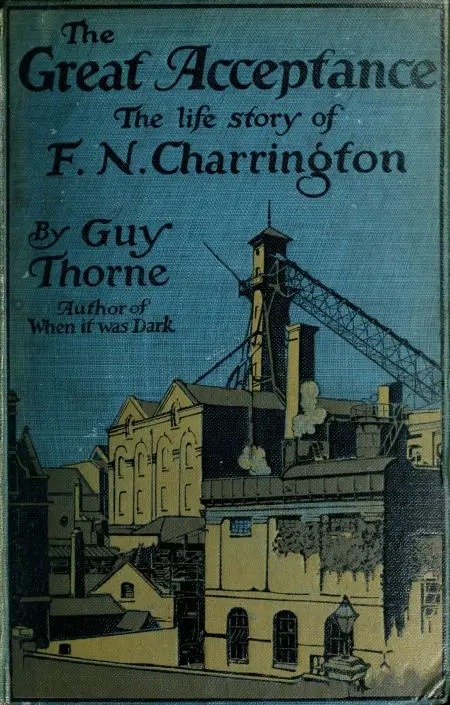
"The Great Acceptance: The Life Story of F. N. Charrington" by Guy Thorne is a historical account written in the early 20th century. The book chronicles the life and transformative work of Frederick Nicholas Charrington, a wealthy British brewer who devoted his life to various charitable efforts in London's East End, particularly focusing on temperance and helping the impoverished. The text provides insight into his motivations and the social conditions of the time that influenced his decisions. At the start of the biography, the author introduces Charrington and the East End of London—depicted as a neglected area in dire need of attention. The narrative outlines Charrington's early life, including his privileged upbringing and education, before detailing a pivotal moment when he witnesses domestic violence connected to alcohol abuse at a public house bearing his family's name. This shocking event leads him to reject his inheritance and dedicate himself to a life of service, ultimately becoming a significant figure in the temperance movement. The opening sets the stage for a deeper exploration of his humanitarian efforts and their impacts on the community he served.
Introduction adapted from the source catalogue; source summaries may be automatically generated.
Free to read · English · 75,558 words · No account needed
MAKE TIME FOR A GOOD BOOK
On by default. Untick to stop anonymous reading totals. Each page counts after 10 seconds in view. How this works.
Anonymous counting is on unless you have switched it off.
"Oh, Prince of torment! if thou hast transforming power, give some relief to this once innocent child, whom another has corrupted! Let thy deepest damnation seize him who brought her hither! Let his coronation be upon the very mount of torment, and the rain of fiery hail be his salutation! He shall be crowned by thorns poisoned and anguish-bearing; and every woe beat upon him, and every wave of hell roll over the first risings of baffled hope. Thy guilty thoughts and guilty deeds shall flit after thee with bows which never break, and quivers for ever emptying but never exhausted. If Satan hath one dart more poisoned than another; if God hath one bolt more transfixing and blasting than another; if there be one hideous spirit more unrelenting than others; they shall be thine, most execrable wretch, 'who led her to forsake the guide of her youth, and to abandon the covenant of her God.'"
I think I cannot do better now than give my readers the evidence Mr. Charrington gave before Mr. Justice Chitty during the case.
"I am the Hon. Superintendent of the Tower Hamlets Mission, Mile End Road. The Mission-house is about twenty or thirty houses off the music hall. I am a guardian of the poor, and also a vestryman. I have been Hon. Superintendent since the year 1869, and have devoted the whole of that time to missionary work in the East End. I made considerable sacrifices on leaving the brewery, in order to devote myself to the work of the Mission. Since 1880 I have, amongst other things, distributed tracts, etc., and endeavoured to persuade people not to go to the music halls, and have also endeavoured to rescue prostitutes from their evil courses. My efforts have not been solely confined to the music halls. The three tracts produced were amongst others I have given away. My ground for persuading people not to go to the music hall was because I found it was the nightly resort of prostitutes. I have watched the hall from the year 1880 up to the time of the fire, and also to a certain extent since the fire. I used to go down night after night as a rule, from about eleven o'clock till nearly one o'clock in the morning. I occasionally went earlier in the evening when the people were going into the hall. I used especially to speak to and remonstrate with prostitutes who used to go in and out of the house. I used to use an expression when I first went there, that the place literally swarmed with prostitutes. Numbers of prostitutes went into the hall unattended by men. I have seen brothel-keepers going night after night into the house with their women with them. I may mention especially a woman named Becky Hart. I have seen her with two and three poor young girls. She was a most notorious brothel-keeper, living in the Canal Road, Mile End Road. Another well-known brothel-keeper with her girls was also there nightly. She was known by the name of Fraser; no one could mistake her, she being excessively stout. There were also two or three other brothel-keepers, whom I knew very well by sight, who used to go to the hall regularly, and also take their girls with them. Two of these brothel-keepers, a man and his wife, kept a house in Cleveland Street, the very next turning to the music hall. They used to go backwards and forwards continually during the evening, from the brothel in Cleveland Street. This brothel-keeper was thrown out of the hall one night, very drunk, and I caught him in my arms to prevent him from falling on the pavement. He then said to me, 'It's a great shame to treat me in this way, for I bring my girls here constantly.' I used to see him and his girls going into the hall night after night, and the girls leaving it after with men. I persuaded the man and his wife to give up the brothel. I have been requested by the man to visit one of the girls when she was dying. I have seen them night after night go out from the music hall with customers, sometimes with respectable-looking, well-dressed men, apparently from the West End of London, the girls having previously gone into the hall with their keepers. I have seen them go to the cabs that usually stand in a rank outside the hall. I have heard them tell the cabmen to drive to well-known brothel-houses. I have sent messengers to follow them to the houses for my own satisfaction, because I wanted to know positively if they did drive to the brothels. I have seen a girl do this kind of thing twice during a night. I have seen that on more than one occasion. I have seen them get into cabs; I have heard the cabmen ask them where to drive to. I have said to the cabmen, 'You know where you are going to drive them to. You know perfectly well, cabman, the brothel to which they are attached. You live by these wretched women's trade.' I have seen numbers of women come out of the halls drunk. I have seen them when they have been drunk behaving in a most disgraceful way, and using the foulest language. On one occasion I saw three prostitutes take away with them from the hall three seafaring men, apparently captains or mates of vessels. They tried to get into a four-wheeled cab--all six of them. While they were getting into the cab I remonstrated with them, and told them they were ruining themselves, body and soul, going with such women to such places. I made use of the words, 'her house is the way to Hell, going down to the chambers of death.' One of the three men said, 'I think I will be out of this.' Another one said, 'It is getting rather hot for us.' They seemed to agree that what I said was true, and the result was that they got out of the cab. The three women, when the men walked away, turned round on one another, and fought together on the pavement, in front of the hall. I went into the midst of them, separated them, and persuaded them to leave off fighting. They were using all the time most filthy language, and causing a crowd to assemble. On another occasion I saw four prostitutes bringing down from the hall a particularly gentlemanly-looking young man, not only evidently a gentleman, but a well-bred one. He undoubtedly belonged to a good family in the West End. He was a little drunk. Those four prostitutes were half pulling and half dragging him from the hall to one of the cabs standing, as usual, in front of the hall. He struggled and tried to release himself from the grasp of the women. I appealed to a policeman to rescue the man. I said to the policeman, 'This is simply highway robbery,' the man being taken off by force. I tried my best to rescue him when the police declined to interfere. There were plenty of prostitutes' bullies about the hall. These bullies used to frequent the hall nightly. They were unfortunately too strong for me, and the result was that the women took the young man off with them in a cab. I could multiply these instances, which were constantly occurring night after night. I have seen brothel-keepers come out with gentlemen, they having gone in alone. I have seen them standing on a pavement persuading men to go home with girls, and at the same time I have been persuading them not to do so. On one occasion a seafaring man, apparently a captain or mate of a vessel, came out of the hall so very drunk that he was incapable of taking care of himself. Two prostitutes came out with him partly holding him up and partly dragging him along. They got him half-way across the pavement towards the cabs in front of the hall. The cabmen, I found, as a rule, were only too anxious to help the prostitutes and their customers. The cabman, in this instance, came and helped the prostitutes, partly by pushing and partly by persuasion, to get the man near the cab. I managed to stop him just before he got to the cab, and endeavoured to persuade him not to go with the women. The cabman and the women tried in the meantime to persuade the man to go with them, the man hesitating. I then appealed to a policeman who was standing near apparently on duty, to interfere. I called his attention to the fact that the man was helplessly drunk, wearing a gold chain, and no doubt having money in his pocket. I said to the policeman, 'This is simply highway robbery.' The policeman refused to interfere at all, and the result was that the two women, aided by the cabman, took the man away. I said to the women and the cabman, 'I'll run after you and get two policemen who will do their duty.' The cabman drove his horse as fast as he could. I ran after him till I came up to two policemen on duty a little farther up the road. I appealed to them, and they did their duty, saying to the women, 'You get out of this or we'll give you a night's lodging.' They said to the cabman, 'You had better mind what you are about.' Signals were then passed between the prostitutes and the cabman, which proved to me that the cabman was only going round another street to meet them again. I pursued the cab, followed by bullies from the hall. I outran the bullies, overtook the cab, and succeeded in getting the man out of the cab. I have seen prostitutes stopped going into the hall, but that was not during the first eighteen months or two years I worked outside the hall. After about that time a number of prostitutes came round me one night outside the hall and said I was stopping them from getting a living. I have seen prostitutes turned back from the hall on one occasion, after about eighteen months from the time I had commenced working. The prostitutes said to me, 'It is through you we are being turned out of the hall, and are prevented from getting our living in consequence, and you know we are getting our living there.' Great disorder arose outside the hall when prostitutes came out drunk; upon several occasions disorder took place. On one particular occasion a prostitute came out drunk, marched up and down in front of the house, shouting and causing a great disturbance. She said, 'It is by the likes of us that Crowder and Payne get their living.' After the time I have spoken of the prostitutes seemed to go in and out of the hall as they liked. I used to take a number of tracts with me when I went outside the hall. I used to offer them to people going in and out of the hall and to passers-by on the pavement. If people refused to take the tract offered I allowed them to pass on. Sometimes, however, they would enter into conversation with me. I then used to draw them aside to the waste ground between the road and the pavement. My doing this did not cause a disturbance nor a mob to assemble. There were occasions, however, on which disturbances took place; one occasion when flour was thrown over me by some person from the direction of the hall; on another occasion human filth was thrown on me from an upper window of the hall. I have been assaulted on a great many occasions by roughs from the music hall, prostitutes' bullies being amongst them. On one occasion one of the roughs followed me and assaulted me. I gave him into custody and he was sentenced to three weeks' imprisonment. That was in June, 1883. I did not know the man who assaulted me. These assaults caused mobs to assemble. I remember in October, 1883, I was assaulted and driven across the road. The disturbance arose from an angry mob of roughs coming out of the hall and surrounding me. They asked me what I meant by trying to ruin the music hall, by taking away its licence. That, of course, caused a large number of people to crowd together and look on. I appealed in vain to the police who were there for protection, but I did not get it. They said, 'If you like it you can get mobbed.' I walked across the road and asked for protection at the station house. I did nothing on that occasion to cause the disturbance. It is not true that whenever I was in front of the hall disturbances took place. I have been there scores and scores of nights alone distributing tracts, and no disturbance has taken place. Disturbances have not been caused by my missionary work. The largest number of friends who ever accompanied me was eighteen, and out of that number there would be two or three ladies. All these friends used to be engaged in the missionary work. The average number accompanying me was about three or four. Only on about twelve to twenty occasions a dozen or more persons were with me. In one year I went to the hall about a hundred nights. I have rescued several of the prostitutes who used to regularly frequent the hall. It is not true that I and my friends have ever tried to form a barrier round the door of the hall to prevent people from going into it. It was in consequence of the manager of the hall inciting the mob to assault me that a barrier was formed round the door of the hall. I have never stopped any person going into the hall by physical force. I have never followed a person across the threshold of the hall. I have seen officials connected with the hall incite people to attack me. A door-keeper named Young has done so. The manager, Mr. Friend, on one particular occasion said to the mob, 'Halloa, boys, make a row,' but they did not appear to be very responsive. He has incited the people to attack me on more than one occasion. He often stood in the entrance hall cursing and swearing at me, and at times he would address the people from the hall. On one occasion he said to a man, 'He is a very good advertisement for the house.' He has used very foul and abusive language towards me. On one occasion he so lost control of himself that the passers-by stood still and looked at him in amazement. The wife of the shop-keeper next door has also used foul language towards me. Mr. Friend's action has caused great crowds to assemble. I am bound to say I have, as a rule, had great sympathy from the crowd. Working men would say, 'Go it, Charrington, and put an end to that den of iniquity.' Mr. Crowder has assaulted me, and has also incited others to assault me. Mr. Crowder used to walk beside me pushing me about, and causing a crowd to assemble. On one occasion he stood on the box-seat of a carriage and incited a mob against me, and on another he used a most horrible and foul expression towards me, which I would not like to repeat. On a Monday night in particular the roughs did rush out of the hall at a signal from Mr. Crowder, and surrounded me. Crowder then said, 'Police, take him up for obstructing the thoroughfare.' I managed to get away from the roughs on to the waste ground near the pavement. I said to the police, 'I am not obstructing the thoroughfare.' Crowder, however, gave me into custody, and Mr. Friend signed the charge sheet. I was locked up all night, and the following morning the magistrate dismissed the charge, observing that an action would lie against the people who had given me into custody for false imprisonment. I have been frequently threatened by roughs. From the waste ground I have addressed people, but not from the pavement. None of these addresses caused the pavement to be blocked. I have spoken to a number of girls whom I have known to be prostitutes, urging them to abandon their course of life. I have never called them by such a name; I used to call them by their Christian names, because I knew most of them. I have never called a woman a ---- because she would not take a tract. I have never said that none but prostitutes went into the hall, but I said that numbers of them went there. I was here when Mr. Payne's father gave his evidence. I have said to him, 'You ought to be ashamed of yourself to bring a young girl to such a place,' or words to that effect. I meant just the opposite to what Mr. Payne implied, because I could see that the young girl was respectable. I said nothing on that occasion that could be construed into an imputation on the girl's character. I heard Piggott give his evidence. On several occasions he has threatened me. He seemed to be always at the hall; in fact, he made it a custom to be there. He told me he supplied plaintiff with wine and spirits. On one occasion he followed me about with an oak stick. He shook it in my face and swore he would do for me if he followed me all over London. He was so excited that I feared every moment he would drop down in a fit. I have said that the hall is the way to hell, because there were so many prostitutes attending it. I have never said that it was hell itself. I deny that anything I have done has caused a riot or disturbance. M----, H----, and C----are three girls who gave evidence for me on a motion for injunction: C---- is not now in this country. These girls used to attend the music hall; they were prostitutes. I rescued them from that life."
Your reading position is saved on this browser. Take it to another device with a library code. Reading pages adapt to text, rather than matching a printed edition.
Guy Thorne
Guy Thorne
Guy Thorne
Guy Thorne
BEHIND THE BOOK
This eBook is for the use of anyone anywhere in the United States and most other parts of the world at no cost and with almost no restrictions whatsoever. You may copy it, give it away or re-use it under the terms of the Project Gutenberg License included with this eBook or online at www.gutenberg.org. If you are not located in the United States, you will have to check the laws of the country where you are located before using this eBook. Read the source licence.
The original source file, including credits and licence, is retained by this library. Request an original-format copy at no charge. Please include the book title and Project Gutenberg identifier #39999.
KEEP YOUR CURIOSITY GOING
Cécile Tormay

Moritz Busch
John L. Ransom
Frances Wright
Cécile Tormay

Mabel Potter Daggett