
The Drunkard
Guy Thorne
THE CLASSIC COLLECTION · 1913
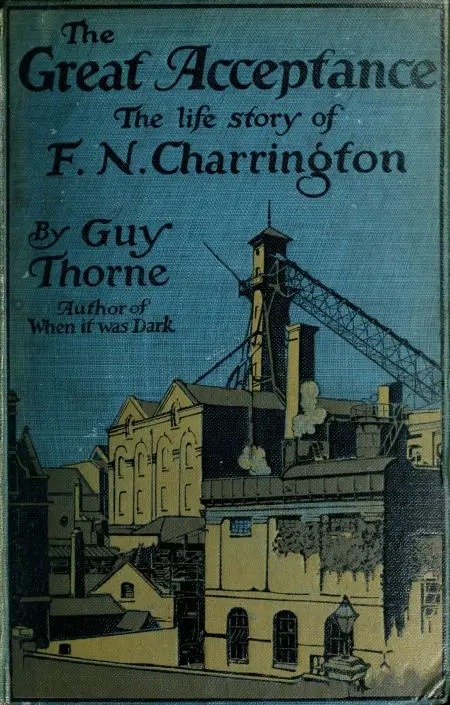
"The Great Acceptance: The Life Story of F. N. Charrington" by Guy Thorne is a historical account written in the early 20th century. The book chronicles the life and transformative work of Frederick Nicholas Charrington, a wealthy British brewer who devoted his life to various charitable efforts in London's East End, particularly focusing on temperance and helping the impoverished. The text provides insight into his motivations and the social conditions of the time that influenced his decisions. At the start of the biography, the author introduces Charrington and the East End of London—depicted as a neglected area in dire need of attention. The narrative outlines Charrington's early life, including his privileged upbringing and education, before detailing a pivotal moment when he witnesses domestic violence connected to alcohol abuse at a public house bearing his family's name. This shocking event leads him to reject his inheritance and dedicate himself to a life of service, ultimately becoming a significant figure in the temperance movement. The opening sets the stage for a deeper exploration of his humanitarian efforts and their impacts on the community he served.
Introduction adapted from the source catalogue; source summaries may be automatically generated.
Free to read · English · 75,558 words · No account needed
MAKE TIME FOR A GOOD BOOK
On by default. Untick to stop anonymous reading totals. Each page counts after 10 seconds in view. How this works.
Anonymous counting is on unless you have switched it off.
"It is necessary that if I should address you at all, I should do so at this moment, for I cannot stay with you much longer. I am afraid whatever I say will be scarcely audible. My voice is very weak to-night, and it is not in my power to throw it out to the end of the hall. I wish first to say that I feel very much the kind reception you give me, and to assure you that if I failed in my attendance two years ago, it was not on account of any frail and feeble excuse, because I have never, I think, broken an engagement, except on a really good excuse. And I confess I am more astonished at the assembly I see before me on such a night as this, than that I should have kept my engagement who had the advantage of coming here in a carriage. But the presence in such numbers, and the enthusiasm you manifest, show to me that the cause is in your hearts, and that by God's blessing you duly appreciate the kindness and the mercies here prepared for you. (Cheers.) For many years I have been in the habit of coming to Whitechapel, and many people say to me, 'Why do you go to Whitechapel so often?' My answer is, 'Because I always find very good people there; and if you knew Whitechapel as well as I know it, you would find there was a larger proportion of good people in Whitechapel than in an equal number of people in the West End of London.' I will tell you one thing which I like about Whitechapel people; I like their hearty, open manner, and the general enthusiasm of their demeanour; and I tell you fairly that you put me in mind of a large body of people with whom I was more conversant in earlier years than I am now, and my friend Bardsley here will bear testimony that the people of Whitechapel are, to my mind, more like the people of Lancashire than any other people in the metropolis. If you want to know what a Lancashire man is, look at our friend Bardsley on the right (laughter). He is descended from one of the noblest men I ever knew. His father was one of the grandest men I ever knew--a grand old patriarch, who has given some ten or eleven sons to the service of our Lord and Saviour Jesus Christ. I entirely concur with the sentiments of my friend Clifford, and I rejoice to see him here to-night, and may his life be long spared to appear on this platform. What you heard from your friend Mr. Charrington and from Mr. Clifford is quite enough, and constitutes the strongest appeal I could well imagine to the wealthy and the powerful. What a manifestation of work is going on here day by day, night by night, and hour by hour! See the effects made for great ends, and apparently for small ends too: What we call a small end, when we have to do with the working classes, often constitutes the very turning point in the man's existence. The only way to assist a working man is to enable him to assist himself. Let me press on you seriously the immense advantages you enjoy compared with your forefathers. Time was, and not very long ago, when such a meeting as this would have been impossible, and you could not make such a thing intelligible to men's minds. Remember how this mighty city has grown up; and all the Church of England, and all the denominations, if they could be brought to be of one mind would be wholly inadequate to the great spiritual work of this metropolis. Now I delight to see these lay agents come forward and, like your friend, Mr. Charrington, act as auxiliaries and subsidiaries to the efforts of the ordained ministers to preach the word of God. It is a great blessing when you see how hundreds and thousands are brought to come in the spirit of freedom and choice, to hear the Word of God, who could never have been coerced by any system of ecclesiastical discipline which even the Pope might endeavour to institute. All these considerations should impress on you a sense of the deep obligations under which you are: first to God, and then to these men whom God has raised up to conduct these various missions, and to sustain all these manifold efforts to propagate the Gospel. I am certain that I am within the limit when I say that there are at least 400,000 persons at the present time in this metropolis who would never have heard the Word of God but for the agency of such missions. Did these exist in former times? I recollect when we propounded nineteen years ago that the theatres should be opened for divine service on every successive Sunday, we were treated by some with scorn, by some with doubt (very sincere doubt), and by all with misgiving. What has been the result? Such gatherings as these. Thus the Gospel of God has been sounded out in the metropolis, and I, in going the rounds of our great cities in the dark hours of the night, have found that by such means as these many have come to know of the Gospel.
Your reading position is saved on this browser. Take it to another device with a library code. Reading pages adapt to text, rather than matching a printed edition.
Guy Thorne
Guy Thorne
Guy Thorne
Guy Thorne
BEHIND THE BOOK
This eBook is for the use of anyone anywhere in the United States and most other parts of the world at no cost and with almost no restrictions whatsoever. You may copy it, give it away or re-use it under the terms of the Project Gutenberg License included with this eBook or online at www.gutenberg.org. If you are not located in the United States, you will have to check the laws of the country where you are located before using this eBook. Read the source licence.
The original source file, including credits and licence, is retained by this library. Request an original-format copy at no charge. Please include the book title and Project Gutenberg identifier #39999.
KEEP YOUR CURIOSITY GOING
Cécile Tormay

Moritz Busch
John L. Ransom
Frances Wright
Cécile Tormay

Mabel Potter Daggett