
The Drunkard
Guy Thorne
THE CLASSIC COLLECTION · 1913
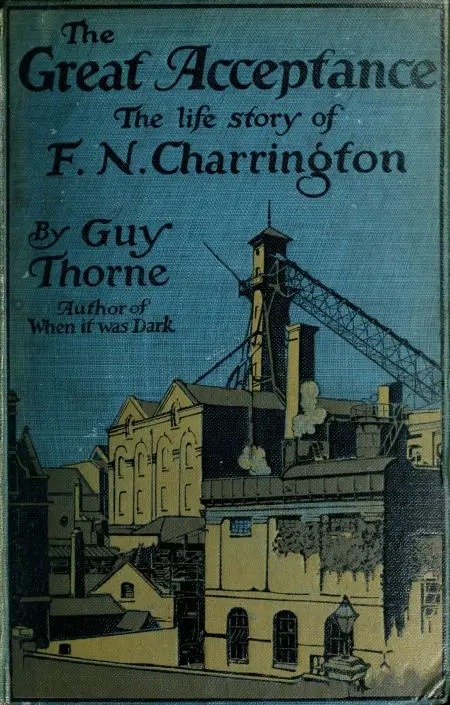
"The Great Acceptance: The Life Story of F. N. Charrington" by Guy Thorne is a historical account written in the early 20th century. The book chronicles the life and transformative work of Frederick Nicholas Charrington, a wealthy British brewer who devoted his life to various charitable efforts in London's East End, particularly focusing on temperance and helping the impoverished. The text provides insight into his motivations and the social conditions of the time that influenced his decisions. At the start of the biography, the author introduces Charrington and the East End of London—depicted as a neglected area in dire need of attention. The narrative outlines Charrington's early life, including his privileged upbringing and education, before detailing a pivotal moment when he witnesses domestic violence connected to alcohol abuse at a public house bearing his family's name. This shocking event leads him to reject his inheritance and dedicate himself to a life of service, ultimately becoming a significant figure in the temperance movement. The opening sets the stage for a deeper exploration of his humanitarian efforts and their impacts on the community he served.
Introduction adapted from the source catalogue; source summaries may be automatically generated.
Free to read · English · 75,558 words · No account needed
MAKE TIME FOR A GOOD BOOK
On by default. Untick to stop anonymous reading totals. Each page counts after 10 seconds in view. How this works.
Anonymous counting is on unless you have switched it off.
"In the meantime, Mr. Charrington, to show that he was actuated by no animosity towards the girls and women themselves, determined to give them a breakfast on Thursday at one o'clock--the usual hour of breakfasting with these women. No formal invitations were issued, but on Thursday morning Mr. Charrington, accompanied by one or two of his fellow-workers, went into the 'Grove' and personally invited the women and the girls there to the breakfast. The reception accorded Mr. Charrington and his colleagues was by no means flattering--on the contrary, it was in the highest degree threatening. The women standing on the steps openly laughed at him, while the bullies hanging about began to close round them in a decidedly 'ugly' manner.
"The discreet appearance of a policeman's helmet at the further end of the 'Grove,' however, induced the bullies to move away to a respectable distance, while Mr. Charrington proceeded from house to house, begging and entreating the women to come. The invitation was at first viewed with some amount of distrust, and open expressions of its being 'a plant' were frequently heard, but as Mr. Charrington proceeded to tell them that his only desire was to show that he was not their enemy, they began to get a little more confident, and finally, about twenty-five girls who had been plying their trade outside the four enclosed houses made their way to the hall--the majority of them confessing that their only object was 'to have a lark with Charrington.' Arrived at the small hall, they found two long tables laid out with piles of bread-and-butter and ham and beef, with two large coffee urns steaming at either end. Mr. Day-Winter was sitting at the organ at the time, and by a happy inspiration he proceeded to start the refrain 'For Auld Lang Syne.' The reception was somewhat different from what the women had expected, and after a brief pause of surprise they joined heartily in the refrain. And then they proceeded to attack the viands placed before them--an operation in which the latter suffered the greatest damage. It cannot honestly be said that the talk and the general remarks indulged in were of the most carefully chosen or elevating character, but, bad though it was, Mr. Charrington and his friends patiently bore it, nor ventured to protest when matters went considerably further, and the coarsest of jokes were cut. One satisfactory feature, however, there was, deserving of mention. The girls and women who had met Mr. Charrington that morning with expressions of open and undisguised hostility now began to see that he was sincerely anxious for their welfare, and treated him accordingly. It was, perhaps, a mistake--though a well-intentioned one--to start the singing of hymns at the close of the meal; Sankey's solos and a very recent connection with disorderly houses do not always agree, especially at such short notice. Mr. Charrington saw at once that the attempt at reformation was too premature, and proceeded accordingly. He asked the girls whether they had any objection to leaving their names and addresses for the purpose of ascertaining whether something might be done for them in the future, and the information was furnished to the best of their ability, considering that some of them had no other names than 'nick' names, such as 'Aunt Sally.' And then they were asked if they had any objection to their photographs being taken in groups--a request to which they assented with even more avidity after they had extracted from Mr. Charrington a promise that they each should have a copy. They were rather rough and very coarse-speaking groups that were formed before the photographer's lens--groups in which every colour under the sun might have been found in a proximity at utter variance with all the prevailing laws of fashion--but taken they were. Then, while the photographer examined his proofs, Mr. Charrington and others questioned the girls as far as possible as to their future prospects, and, without a word of rebuke, asked them whether they intended to continue their present lives, or whether they really wished to become a little better. These inquiries had to be conducted in the quietest possible manner, for there was, among the women present, one who owned a house in the 'Grove,' the girls in which had practically sold themselves to her, body and soul, and who seemed in no way disposed to allow them to be taken to a place where they were not likely to increase her shameful receipts. One such instance was that of a light-hearted Irish girl, who, on some pretext or other, ran round a corner to where a gentleman connected with one of the Refuges was standing, and, in a few excited words, told him that she was tired of the life she was leading; that she would see him a few days later, but that she must not be seen talking to him on any account. It was with sad hearts that the little party saw the girls troop out from the hall into their old haunts of vice."
Your reading position is saved on this browser. Take it to another device with a library code. Reading pages adapt to text, rather than matching a printed edition.
Guy Thorne
Guy Thorne
Guy Thorne
Guy Thorne
BEHIND THE BOOK
This eBook is for the use of anyone anywhere in the United States and most other parts of the world at no cost and with almost no restrictions whatsoever. You may copy it, give it away or re-use it under the terms of the Project Gutenberg License included with this eBook or online at www.gutenberg.org. If you are not located in the United States, you will have to check the laws of the country where you are located before using this eBook. Read the source licence.
The original source file, including credits and licence, is retained by this library. Request an original-format copy at no charge. Please include the book title and Project Gutenberg identifier #39999.
KEEP YOUR CURIOSITY GOING
Cécile Tormay

Moritz Busch
John L. Ransom
Frances Wright
Cécile Tormay

Mabel Potter Daggett