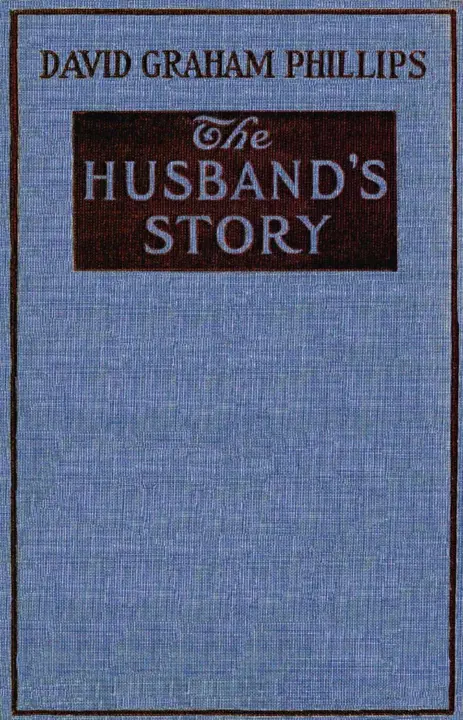
The Husband’s Story: A Novel
David Graham Phillips
THE CLASSIC COLLECTION · 1911
"The Grain of Dust: A Novel" by David Graham Phillips is a work of fiction written during the early 20th century. The novel introduces its readers to the contrasting lives of two characters: Miss Dorothea Hallowell, an unassuming young woman seeking employment, and Frederick Norman, a young and ambitious lawyer in a prestigious law firm. The narrative explores themes related to social class, ambition, and the complexities of human relationships. The opening of the novel presents the mundane circumstances under which Dorothea finds herself working at a large law firm in New York City. Her interactions are minimal, hinting at her self-effacing nature and the struggles she faces as a temporary employee. In contrast, Frederick Norman emerges as a dynamic character, displaying wit, ambition, and a certain ruthlessness in his professional ambitions. The reader witnesses their initial encounter, which is laden with an undercurrent of potential emotional complexity that might develop as the story unfolds. As Dorothea's character slowly reveals depth through her emotional struggles, Norman’s allure as both a charismatic leader and an enigmatic figure becomes apparent, setting the stage for their developing relationship.
Introduction adapted from the source catalogue; source summaries may be automatically generated.
Free to read · English · 97,453 words · No account needed
MAKE TIME FOR A GOOD BOOK
On by default. Untick to stop anonymous reading totals. Each page counts after 10 seconds in view. How this works.
Anonymous counting is on unless you have switched it off.
He and his sister went home together. Her first remark in the auto was: "What were you and Josie quarreling about?"
"Quarreling?" inquired he in honest surprise.
"I looked at her through my glasses and saw that the was all upset--and
you, too."
"This is too ridiculous," cried he.
"She looked--jealous."
"Nonsense! What an imagination you have!"
"I saw what I saw," Ursula maintained. "Well, I suppose she has heard something--something recent. I thought you had sworn off, Fred. But I might have known."
Norman was angry. He wondered at his own exasperation, out of all proportion to any apparent provoking cause. And it was most unusual for him to feel temper, all but unprecedented for him to show it, no matter how strong the temptation.
"It's a good idea, to make her jealous," pursued his sister. "Nothing like jealousy to stimulate interest."
"Josephine is not that sort of woman."
"You know better. All women are that sort. All men, too. Of course, some men and women grow angry and go away when they get jealous while others stick closer. So one has to be judicious."
"Josephine and I understand each other far too well for such pettiness."
"Try her. No, you needn't. You have."
"Didn't I tell you----"
"Then what was she questioning you about?"
"Just to show you how wrong you were, I'll tell you. She was asking me about a poor little girl down at the office--one she wants to help."
Ursula laughed. "To help out of your office, I guess. I thought you'd lived long enough, Fred, to learn that no woman trusts any man about any woman. Who is this 'poor little girl'?"
"I don't even know her name. One of the typewriters."
"What made Josephine jealous of her?"
"Haven't I told you Josephine was not----"
"But I saw. Who is this girl?--pretty?"
Norman pretended to stifle a yawn. "Josephine bored me half to death talking about her. Now it's you. I never heard so much about so little."
"Is there something up between you and the girl?" teased Ursula.
"Now, that's an outrage!" cried Norman. "She's got nothing but her reputation, poor child. Do leave her that."
"Is she very young?"
"How should I know?"
"Youth is a charm in itself."
"What sort of rot is this!" exclaimed he. "Do you think I'd drop down to anything of that kind--in any circumstances? A little working girl--and in my own office?"
"Why do you heat so, Fred?" teased the sister. "Really, I don't wonder
Josephine was torn up."
Your reading position is saved on this browser. Take it to another device with a library code. Reading pages adapt to text, rather than matching a printed edition.
David Graham Phillips
David Graham Phillips
David Graham Phillips
David Graham Phillips
BEHIND THE BOOK
This eBook is for the use of anyone anywhere in the United States and most other parts of the world at no cost and with almost no restrictions whatsoever. You may copy it, give it away or re-use it under the terms of the Project Gutenberg License included with this eBook or online at www.gutenberg.org. If you are not located in the United States, you will have to check the laws of the country where you are located before using this eBook. Read the source licence.
The original source file, including credits and licence, is retained by this library. Request an original-format copy at no charge. Please include the book title and Project Gutenberg identifier #430.
KEEP YOUR CURIOSITY GOING
Coulson Kernahan

Maurice Baring
Frances Wright
Cécile Tormay

Frederic Jesup Stimson

W. H. P. (William Henry Pope) Jarvis