The Conscript Mother
Robert Herrick
THE CLASSIC COLLECTION · 1898
"The Gospel of Freedom" by Robert Herrick is a novel written in the late 19th century. The story revolves around Simeon Erard, a struggling artist in Paris, and his interactions with his visitors, including the Anthon family. The themes of ambition, artistic integrity, and societal expectations are explored through Erard's relationships and the contrasting values of those around him. The opening of the novel introduces us to Simeon Erard as he shows his artwork to Mrs. Anthon and her family. Amid their bemused reactions to his paintings, especially a depiction of a woman in a bath, the narrative touches upon the dynamics of artistic expression and the differing perspectives of the characters on art and success. The descriptions are rich and provide insights into Erard's character—an artist who is both desperate for recognition and disdainful of typical societal judgments. The chapter establishes the backdrop of Paris as a place where artistic ambition and societal pressures collide, setting the stage for deeper explorations of identity, aspiration, and the quest for meaningful expression.
Introduction adapted from the source catalogue; source summaries may be automatically generated.
Free to read · English · 70,423 words · No account needed
MAKE TIME FOR A GOOD BOOK
On by default. Untick to stop anonymous reading totals. Each page counts after 10 seconds in view. How this works.
Anonymous counting is on unless you have switched it off.
He seemed to read her thoughts, to have accompanied her these past months, and now to say the fitting, final word.
“It would take a great deal--a catastrophe--to move me. Woman’s modesty is one-half inertia.”
“The catastrophe has come, perhaps.”
Mrs. Wilbur shook her head. “I don’t know. Yet sometimes I think so.”
They were silent until the carriage reached the boulevard where the Wilburs’ house was situated.
“You have given up painting!” Mrs. Wilbur exclaimed irrelevantly. “I am so sorry for that. Doing, even feeble doing, seems to me so much more real than all this criticism.”
“On the contrary,” Erard remarked, “the critic is the comprehensive, the understanding, the sensuous soul. The desire to ‘do,’ as you call it, is an egotistical conceit, and generally a desire for notoriety.”
“Perhaps in part,” Mrs. Wilbur admitted, thinking momentarily of her
husband.
“The one thing in life is to enjoy.” Erard watched her closely to observe how she would take this frank hedonism.
“No, not that,” she protested. “I cannot accept your view.”
“Make all the pretty phrases about it you can,”--Erard shrugged his shoulders,--“it comes to that. You know it.”
Mrs. Wilbur shook her head. “Then we are beasts!”
“Superior beasts, yes.”
The carriage drew up at the door of the great house. In the dazzling atmosphere of this June day the stone seemed whiter, harder than ever. It had taken on very little stain or age.
“I have brought you a mile beyond your destination. The man will drive
you back.”
“No!” Erard refused. “The air is really too fine.”
Mrs. Wilbur turned to mount the white steps, then lingered. She looked at Erard, her mind passing over his shambling figure and lustreless features on to the sweet garden of delights with which somehow she had, strangely enough, identified him. A rush of feeling, of longing unutterable for the beautiful, for the dream, surged through her heart. Oh! for one moment of escape from these endless avenues, from this flaunting city, from Wrightington and money, and, yes, her husband! To hold once more the holy peace of beauty and with it to still her rebellious heart.
Erard seemed to wait for something.
“You will call?” she asked at length.
He looked annoyed; he had expected a more significant result from their
talk.
“Yes, I think so, very soon. In a fortnight I shall be shaking the
dust--”
“I must see you again. It is all such a tangle!”
As Erard turned down the boulevard, he met Wilbur, and raised his hat,
rather vacantly.
Your reading position is saved on this browser. Take it to another device with a library code. Reading pages adapt to text, rather than matching a printed edition.
Robert Herrick
Robert Herrick
Robert Herrick
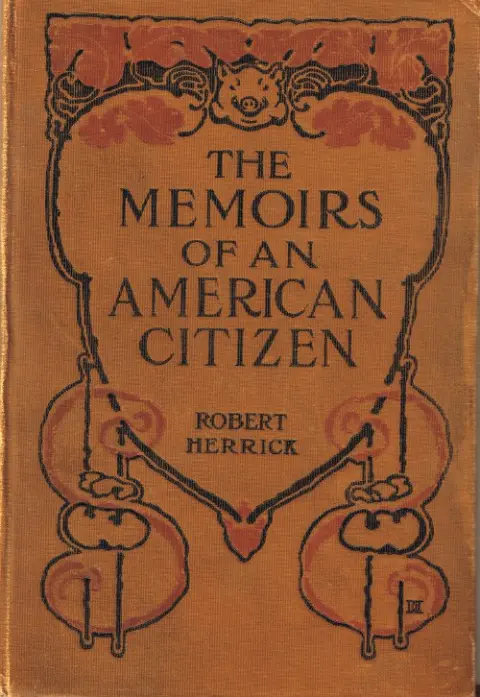
Robert Herrick
BEHIND THE BOOK
This eBook is for the use of anyone anywhere in the United States and most other parts of the world at no cost and with almost no restrictions whatsoever. You may copy it, give it away or re-use it under the terms of the Project Gutenberg License included with this eBook or online at www.gutenberg.org. If you are not located in the United States, you will have to check the laws of the country where you are located before using this eBook. Read the source licence.
The original source file, including credits and licence, is retained by this library. Request an original-format copy at no charge. Please include the book title and Project Gutenberg identifier #73056.
KEEP YOUR CURIOSITY GOING
Coulson Kernahan

Maurice Baring
Frances Wright
Cécile Tormay

Frederic Jesup Stimson

W. H. P. (William Henry Pope) Jarvis