The Bible object book
C. H. (Clarence Herbert) Woolston
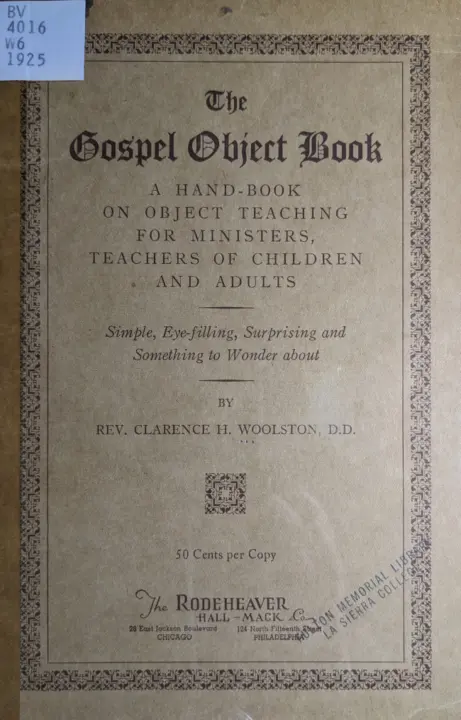
THE CLASSIC COLLECTION · 1925
"The Gospel Object Book" by Rev. Clarence H. Woolston, D.D. is a hand-book on object teaching for ministers, presumably written in the early 20th century. The book serves as a guide for teachers, especially in Sunday Schools, to effectively engage children in learning biblical truths through visual and tactile lessons. It emphasizes the importance of teaching children in a way that is visually stimulating, capturing their attention and fostering a deeper understanding of Christian principles. The opening portion of the book sets the stage for its practical approach to teaching, highlighting the author’s dedication to children and the significance of engaging them through object lessons. Woolston expresses a deep understanding of child psychology, emphasizing that children learn best through visual stimuli. He outlines ten guiding principles, or "Demandments," that teachers should follow when working with children, including the importance of love, brevity, and the use of familiar objects. This portion also includes anecdotes illustrating how effective object teaching can inspire and leave a lasting impression on children, reinforcing the book's aim to equip educators with tools to effectively convey spiritual truths.
Introduction adapted from the source catalogue; source summaries may be automatically generated.
Free to read · English · 24,011 words · No account needed
MAKE TIME FOR A GOOD BOOK
On by default. Untick to stop anonymous reading totals. Each page counts after 10 seconds in view. How this works.
Anonymous counting is on unless you have switched it off.
XV--Here pick up white cloth--the white stands for peace, which was now in the dear old home. Peace which we believe was also in the elder brother's heart. Peace which we know was in the Father's heart, and in the heart of the Prodigal, who had exchanged his rags for the glad robe of eternal salvation. As they all hang upon the line, remember the lesson, and ask the class to tell you what each rag stands for. You can, if you so desire, in place of hanging them on a line, place them on the furniture of the pulpit. The matter of using cloth, muslin or silk or any other substance, is left to the convenience and judgment of the teacher. Even colored papers can be used in place of the rags. In that case name the lesson "The Prodigal Son in Scraps of Paper." Place these scraps in a waste basket and from that place of cast-off things, produce them as you desire.
Objects used: Large transparent jar of clear water; a small quantity of oxalic acid; some powdered ox gall; a quantity of tincture of iron; a small cluster of flowers; a few coins; a dictionary, It is a lesson with chemical effects.
A Chemical Talk
PLACE on the table a large jar of plain untinted glass; fill it two-thirds full of water and before the class assembles drop in a few drops of tincture of iron. This receptacle we will call the Human Heart. Secure a two-ounce bottle, paint it red, in which you place a strong solution of oxalic acid. You cannot get this solution too strong. This represents the Blood. Secure a third bottle and paint it black. In this place some powdered nut galls. This represents Sin. On the table have,--a silver coin, a music box, a cup of pure water. These you will use in the body of the lesson later. Announce that you will choose a text for your talk this time and it will be found in I John 1:17. "The blood of Jesus Christ, His Son, cleanseth us from all sin." Call attention to the large jar which represents the Human Heart. To all appearance it looks as pure as a lily. There seems to be nothing in it to make it evil. It does not look like evil. So it often happens that the evil in us, does not always show on the surface, but is hidden away in our heart. It was born in us. All men are not born sinners, but born in sin, and later on, that sin manifests itself, and we begin to choose evil in preference to the right, and that makes us sinners. The seed of sin was hidden deep in the heart. The jar apparently pure has in it a hidden property no eye can see, but it is there and when evil gets in it finds a response from that hidden power and at once the apparently pure water has turned black with sin. I now pour a few drops from the black bottle, the evil bottle, into the jar. Even these few drops seem to be clear and white also, but when I drop them into the jar of water, all is blackened because the apparent cleanness was only on the surface. "There is a way that seemeth right in the eyes of men, but the ways thereof are the ways of death." You can now talk about things which men do which they say are not bad. They look all right, that is true, but when they enter the soul, they soil it, and sin is supreme. What shall I do to get rid of my sin? What can take away my sin? Can I purchase my salvation? Let us see. Now cast in the jar a number of silver coins, and say these will bring me the white again, but the blackness is yet there, showing that salvation cannot be bought with silver or gold. Can education or refinement take away sin? Let us see. Place over the top of the jar a number of school books to represent education. Of course you see the water is yet black, because you cannot make a black heart clean by learning. Will music take away my black sin? Let us see. Place a music box on top of the jar, and let the music sound forth, but you note the heart is still black and will remain black notwithstanding the finest music of the world. Shall I say the power of the mind can take the blackness away? Let us see. I will say to myself "There is no blackness in this jar. It is a mental delusion. I am mistaken. I don't see black, and if I continue so to do long enough the black will disappear to the eye for it was never there. It was a mental defect to say it was there." All of this sort of thinking would never change the contents of the jar. Can beauty take away the black? Let us see. Cast in now a few flowers. The most beautiful things God has made. Will the handful of beauty take the blackness away? This beauty can never do. What will do it? What is the soul's cry? What can take away my sins? Here produce the red bottle. "The blood of Jesus Christ, his son, cleanseth us from all sin." Pour a few drops or more from the red bottle into the jar. Continue to pour it in until the water is made white again. Behold! the blackness of despair has disappeared. The Blood has taken away the sin forever. Before you put the drops of black into the jar, take out a small glass full of the black water and place it down on the table and after the water has been cleared up say "When the blood of Christ takes away our sin, He keeps us when tempted to go black again." To illustrate that truth, pick up the small glass of black water, and say "This represents temptation, and it seeks to get back into the soul again and make it black with sin as before." Pour the contents into the jar but you notice that at once there is a power in the purified water in the jar to resist all temptation and the black does not blacken the water again. The effect of the illustration will be made more striking if you put two or more lighted candles back of the jar. By rehearsal in private, work out the necessary proportions of these chemicals so they will work out correctly when you use them before your audience. Be very careful and keep these chemicals away from the reach of the children as some of them are deadly poisons.
Your reading position is saved on this browser. Take it to another device with a library code. Reading pages adapt to text, rather than matching a printed edition.
C. H. (Clarence Herbert) Woolston
BEHIND THE BOOK
This eBook is for the use of anyone anywhere in the United States and most other parts of the world at no cost and with almost no restrictions whatsoever. You may copy it, give it away or re-use it under the terms of the Project Gutenberg License included with this eBook or online at www.gutenberg.org. If you are not located in the United States, you will have to check the laws of the country where you are located before using this eBook. Read the source licence.
The original source file, including credits and licence, is retained by this library. Request an original-format copy at no charge. Please include the book title and Project Gutenberg identifier #73388.
KEEP YOUR CURIOSITY GOING

David Patterson (Spirit) Hatch

David Patterson (Spirit) Hatch

David Patterson (Spirit) Hatch

Edwin Abbott Abbott

Richard Watson
T. G. (Theophilus Gould) Steward