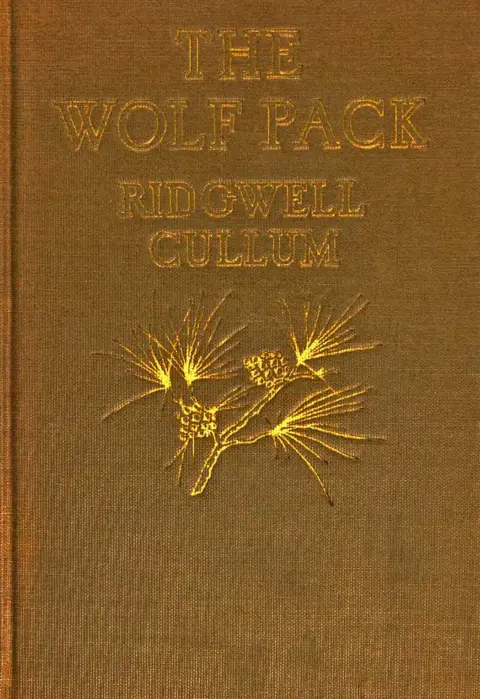
The wolf pack
Ridgwell Cullum
THE CLASSIC COLLECTION · 1913
"The Golden Woman: A Story of the Montana Hills" by Ridgwell Cullum is a novel likely written in the early 20th century. The story unfolds around the complex relationships between an elderly woman named Mercy Lascelles, a crystal-gazer with a harsh demeanor, and her niece Joan Stanmore, a beautiful and independent young woman. The narrative hints at themes of curse and destiny, as Mercy believes that Joan is a pariah whose very existence brings disaster to those around her. The opening portion of the book introduces us to Mercy Lascelles, who is portrayed as a cold and unyielding crystal-gazer, and her young niece, Joan, who has chosen to live with her aunt despite the latter's unpleasantness. As they converse, the tension between them escalates, particularly when Mercy reveals her harsh predictions about Joan's recent suitor, Dick Sorley. This exchange raises questions about the fate that has befallen Joan's past lovers, leading to a dire accusation that she is responsible for their misfortunes. The emotional weight of the aunt's bitterness and the niece's desperation sets the stage for a narrative that combines elements of tragedy, familial ties, and the quest for understanding amidst supernatural beliefs.
Introduction adapted from the source catalogue; source summaries may be automatically generated.
Free to read · English · 118,546 words · No account needed
MAKE TIME FOR A GOOD BOOK
On by default. Untick to stop anonymous reading totals. Each page counts after 10 seconds in view. How this works.
Anonymous counting is on unless you have switched it off.
The thought carried him back to days long gone by, to a time when a lad of something less than eight years, clad in the stained and worn garb of a prairie juvenile, his feet torn and bleeding, his large brown eyes staring out of gaunt, hungry sockets, his thin, pinched, sunburnt face drawn by the ravages of starvation, had cheerfully hailed him from beneath the shelter of a trail-side bush.
That was nearly twenty years ago, but every detail of the meeting was still fresh in his memory. His horse had shied at the sudden challenge. He remembered he had thrashed the creature with his spurs. And promptly had come the youthful protest.
"Say, you needn't to lick him, mister," the boy piped in his thin treble. "Guess he'll stand if you talk to him."
Strangely enough the man had almost unconsciously obeyed the mandate. And the memory of it made him smile now. Then had followed a dialogue, which even now had power to stir every sympathy of his heart. He started by casually questioning the starving apparition.
"Where you from, sonny?" he asked.
And with that unequivocal directness, which, after twenty years, still remained with him, the boy flung out a thin arm in the direction of the eastern horizon.
"Back ther', mister."
The natural sequence was to ask him whither he was bound, and his answer came with a similar gesture with his other hand westward.
"Yonder."
"But--but who're your folks? Where are they?" the Padre had next hazarded. And a world of desolation was contained in the lad's half-tearful reply--
"Guess I ain't got none. Pop an' ma's dead. Our farm was burnt right out. Y' see there was a prairie fire. It was at night, an' we was abed. Pop got me out, an' went back for ma. I never see him agin. I never see ma. An' ther' wa'an't no farm left. Guess they're sure dead."
He fought the tears back manfully, in a way that set the Padre
marveling at his courage.
After a moment he continued his interrogation.
"What's your name?" he asked.
"Buck," came the frank response.
"Buck--what?"
"Buck--jest plain, mister."
"But your father's name--what was that?"
"Pop."
"Yes, yes. That's what you called him. What did the folks call him?"
"Ther' wa'an't no folks. Jest pop, an' ma, an' me."
A great lump had risen in the man's throat as he looked down into those honest, hungry eyes. And for a moment he was at a loss. But the boy solved his dilemma in a way that proved the man in after-life.
"Say, you ain't a farmer?" he inquired, with a speculative glance over
his general outfit.
Your reading position is saved on this browser. Take it to another device with a library code. Reading pages adapt to text, rather than matching a printed edition.
Ridgwell Cullum
Ridgwell Cullum
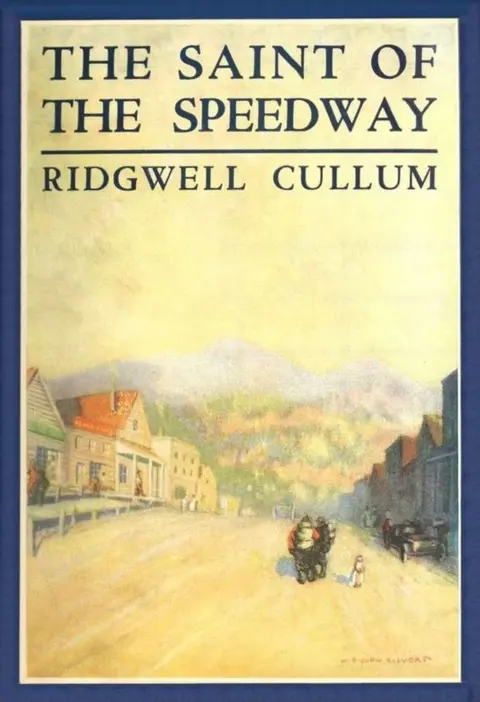
Ridgwell Cullum
Ridgwell Cullum
BEHIND THE BOOK
This eBook is for the use of anyone anywhere in the United States and most other parts of the world at no cost and with almost no restrictions whatsoever. You may copy it, give it away or re-use it under the terms of the Project Gutenberg License included with this eBook or online at www.gutenberg.org. If you are not located in the United States, you will have to check the laws of the country where you are located before using this eBook. Read the source licence.
The original source file, including credits and licence, is retained by this library. Request an original-format copy at no charge. Please include the book title and Project Gutenberg identifier #29628.
KEEP YOUR CURIOSITY GOING
Coulson Kernahan

Maurice Baring
Frances Wright
Cécile Tormay

Frederic Jesup Stimson

W. H. P. (William Henry Pope) Jarvis