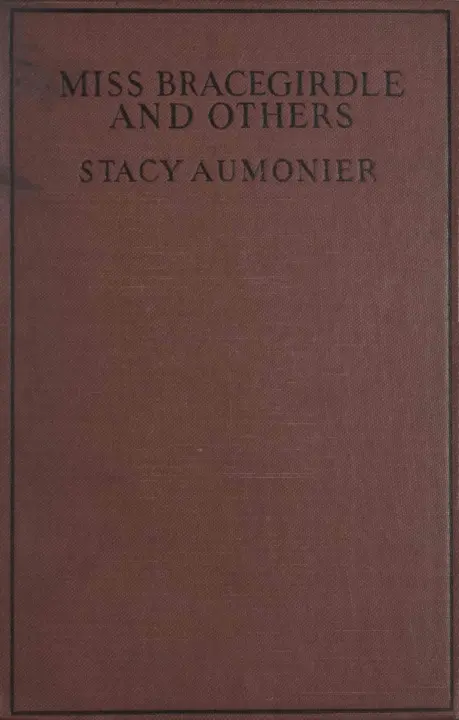
Miss Bracegirdle and others
Stacy Aumonier
THE CLASSIC COLLECTION · 1921
"The Golden Windmill and Other Stories" by Stacy Aumonier is a collection of short stories written in the early 20th century. The book explores various themes within human nature and relationships, providing glimpses into characters' lives and emotions, often with a blend of humor and poignancy. The opening story, “The Golden Windmill,” centers around Monsieur Roget, a middle-aged man enjoying a moment of reflection during a family picnic, which quickly spirals into memories of a youthful romance. At the start of “The Golden Windmill,” we meet Monsieur Roget and his family on a picnic in Fontainebleau, where he takes a moment to appreciate the beauty of the day. As he settles down, he is drawn into a wave of nostalgia, recalling a pivotal encounter from thirty-seven years ago with a girl named Diane. This reflection unveils his past, revealing his youthful innocence and the complexity of love, juxtaposed against his current life filled with family and success. Just as Roget begins to savor the simplicity of life, a sense of curiosity sparks as he recognizes familiar yet altered landscapes, prompting a deeper exploration of how time and choices shape one’s destiny.
Introduction adapted from the source catalogue; source summaries may be automatically generated.
Free to read · English · 55,954 words · No account needed
MAKE TIME FOR A GOOD BOOK
On by default. Untick to stop anonymous reading totals. Each page counts after 10 seconds in view. How this works.
Anonymous counting is on unless you have switched it off.
“My poor fellow, may I be of any assistance—?”
There was a disconcerting jar. The melancholy individual started and
turned on him angrily:
“Blast you! I’d nearly got it! What the devil are you doing here?”
And without waiting for an answer he darted away among the trees. At the same time a voice called over the park railings:
“Ho! you, there, what are you doing over there? You come back the way you
came. I saw yer.”
The burly figure of a park-keeper with gaiters and stout stick beckoned him. Edwin got up and clambered back again, scratching his arm.
“Now then,” said the keeper. “Name, address, age, and occupation, if
you please.”
“I was only—” began Edwin. But what was he only doing? Could he explain to a park-keeper that he was only about to do a kind action to a poor man? He spluttered and gave his name, address, age, and occupation.
“Oh,” exclaimed the keeper. “Fried fish, eh? And what were you trying to do? Get orders? Or were you begging from his lordship?”
“His lordship?”
“That man you was speaking to was Lord Budleigh-Salterton, the great scientist. He’s thinkin’ out ’is great invention, otherwise I’d go and ask ’im if ’e wanted to prosecute yer for being in ’is park on felonious intent or what.”
“I assure you—” stammered Mr. Pothecary.
The park-keeper saw him well off the premises, and gave him much gratuitous advice about his future behavior, darkened with melancholy prophecies regarding the would-be felon’s strength of character to live up to it.
Leaving the park he struck out towards the more rural neighborhood. He calculated that he must be somewhere in the neighborhood of Hendon. At the end of a lane he met a sallow-faced young man walking rapidly. His eyes were bloodshot and restless. He glanced at Edwin and stopped.
“Excuse me, sir,” he said.
Edwin drew himself to attention. The young man looked up and down nervously. He was obviously in a great state of distress.
“What can I do for you?”
“I—I—h-hardly like to ask you, sir, I—”
He stammered shockingly. Edwin turned on his most sympathetic manner.
“You are suffering. What is it?”
“Sh-Sh-Shell-shock, shir.”
“Ah!”
At last! Some heroic reflex of the war darted through Edwin’s mind. Here was his real chance at last. A poor fellow broken by the war and in need, neglected by an ungrateful country. Almost hidden by his outer coat he observed one of those little strips of colored ribbon, which implied more than one campaign.
“Where did you meet your trouble?” he asked.
Your reading position is saved on this browser. Take it to another device with a library code. Reading pages adapt to text, rather than matching a printed edition.
Stacy Aumonier
Stacy Aumonier
BEHIND THE BOOK
This eBook is for the use of anyone anywhere in the United States and most other parts of the world at no cost and with almost no restrictions whatsoever. You may copy it, give it away or re-use it under the terms of the Project Gutenberg License included with this eBook or online at www.gutenberg.org. If you are not located in the United States, you will have to check the laws of the country where you are located before using this eBook. Read the source licence.
The original source file, including credits and licence, is retained by this library. Request an original-format copy at no charge. Please include the book title and Project Gutenberg identifier #74926.
KEEP YOUR CURIOSITY GOING
Coulson Kernahan

Maurice Baring
Frances Wright
Cécile Tormay

Frederic Jesup Stimson

W. H. P. (William Henry Pope) Jarvis