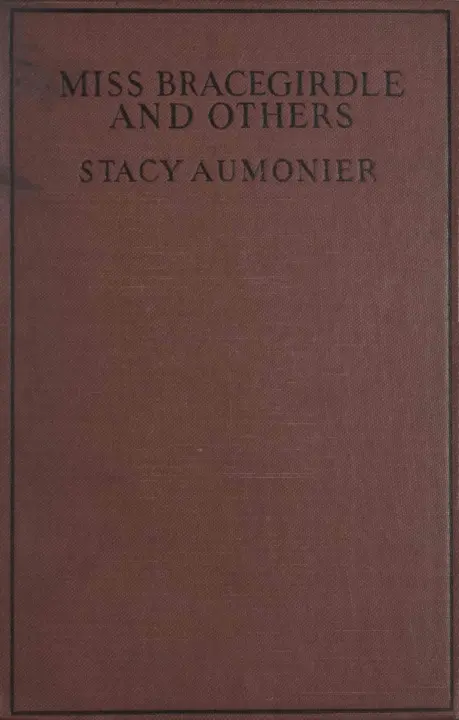
Miss Bracegirdle and others
Stacy Aumonier
THE CLASSIC COLLECTION · 1921
"The Golden Windmill and Other Stories" by Stacy Aumonier is a collection of short stories written in the early 20th century. The book explores various themes within human nature and relationships, providing glimpses into characters' lives and emotions, often with a blend of humor and poignancy. The opening story, “The Golden Windmill,” centers around Monsieur Roget, a middle-aged man enjoying a moment of reflection during a family picnic, which quickly spirals into memories of a youthful romance. At the start of “The Golden Windmill,” we meet Monsieur Roget and his family on a picnic in Fontainebleau, where he takes a moment to appreciate the beauty of the day. As he settles down, he is drawn into a wave of nostalgia, recalling a pivotal encounter from thirty-seven years ago with a girl named Diane. This reflection unveils his past, revealing his youthful innocence and the complexity of love, juxtaposed against his current life filled with family and success. Just as Roget begins to savor the simplicity of life, a sense of curiosity sparks as he recognizes familiar yet altered landscapes, prompting a deeper exploration of how time and choices shape one’s destiny.
Introduction adapted from the source catalogue; source summaries may be automatically generated.
Free to read · English · 55,954 words · No account needed
MAKE TIME FOR A GOOD BOOK
On by default. Untick to stop anonymous reading totals. Each page counts after 10 seconds in view. How this works.
Anonymous counting is on unless you have switched it off.
As a matter of fact, he was not thinking anything of the sort. He was in a fever. He was thinking how very beautiful, adorable, attractive this lovely wild creature was hanging round his neck. He had never before adventured such an experience. He had never kissed Lucile. Women were an unopened book to him, and lo! suddenly the most captivating of her sex was clinging to him. He felt the pressure of her soft brown forearm on the back of his neck. Her little teeth were parted with smiles, and she panted gently with the exertion of hopping. Her dark eyes searched his, and appeared to be slightly mocking, amused, interested.
“If only I might pick her up and carry her,” he thought, but he did not dare to make the suggestion.
Once she remarked:
“Oh, but I am tired,” and he thought she looked at him slyly.
The journey must have occupied half-an-hour, and she told him a little about herself. She lived with her father. Her mother had died when she was a baby. It was quite a small inn, frequented by charcoal-burners and woodmen, and occasionally by visitors from Paris. She liked the country very much, but sometimes it was dull—oh, dull, dull, dull!
“Ah, it is sometimes dull, even in Paris!” sighed Monsieur Roget.
“You must come and speak to my father, and take a glass of wine,” she
remarked.
In the forecourt of the inn the father appeared.
“Hullo!” he exclaimed. “What is all this?”
He was a rubicund, heavy-jowled gentleman, who by the wheezy exhalations coming from his chest gave the impression of being a chronic sufferer from asthma. Diane laughed.
“I have been through fire and water, my dear,” she said, “and this is my
deliverer.”
She explained the whole episode to the landlord, who shook hands with Paul, and they led the girl into a sitting-room at the back of the café. Paul was somewhat diffident about entering this private apartment, but the landlord wheezed:
“Come in, come in, monsieur.”
They sat Diane down on a sofa, and the landlord pulled off her stocking. In doing so he revealed his daughter’s leg as far as the knee. She had a very pretty leg, but the ankle was considerably swollen.
“The ankle is sprained,” said the landlord.
“Will you allow me to go and fetch a doctor?” asked Paul.
“It is not necessary,” replied the landlord. “I know all about sprained ankles. When I was in the army I served in the ambulance brigade. We will just bind it up very tight with cold linen bandages. Does it hurt, little one?”
Your reading position is saved on this browser. Take it to another device with a library code. Reading pages adapt to text, rather than matching a printed edition.
Stacy Aumonier
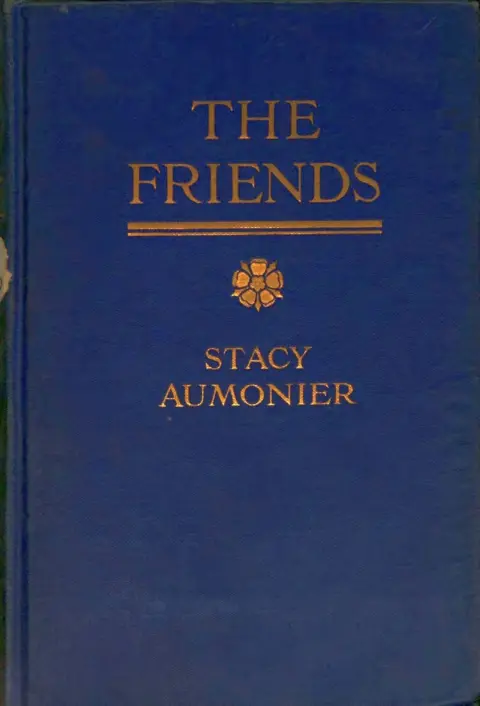
Stacy Aumonier
BEHIND THE BOOK
This eBook is for the use of anyone anywhere in the United States and most other parts of the world at no cost and with almost no restrictions whatsoever. You may copy it, give it away or re-use it under the terms of the Project Gutenberg License included with this eBook or online at www.gutenberg.org. If you are not located in the United States, you will have to check the laws of the country where you are located before using this eBook. Read the source licence.
The original source file, including credits and licence, is retained by this library. Request an original-format copy at no charge. Please include the book title and Project Gutenberg identifier #74926.
KEEP YOUR CURIOSITY GOING
Coulson Kernahan

Maurice Baring
Frances Wright
Cécile Tormay

Frederic Jesup Stimson

W. H. P. (William Henry Pope) Jarvis