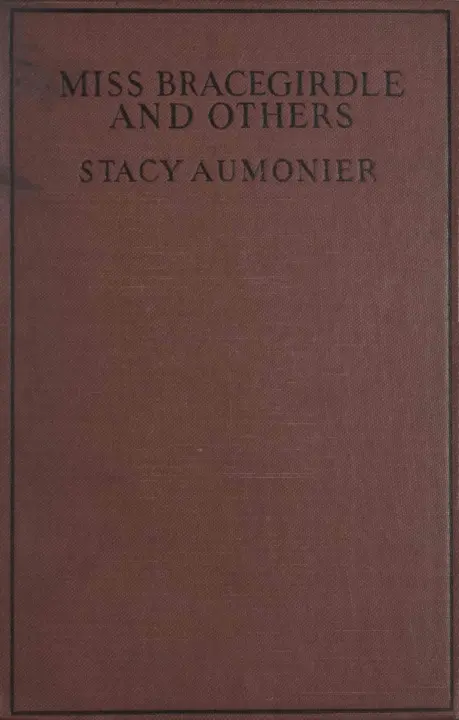
Miss Bracegirdle and others
Stacy Aumonier
THE CLASSIC COLLECTION · 1921
"The Golden Windmill and Other Stories" by Stacy Aumonier is a collection of short stories written in the early 20th century. The book explores various themes within human nature and relationships, providing glimpses into characters' lives and emotions, often with a blend of humor and poignancy. The opening story, “The Golden Windmill,” centers around Monsieur Roget, a middle-aged man enjoying a moment of reflection during a family picnic, which quickly spirals into memories of a youthful romance. At the start of “The Golden Windmill,” we meet Monsieur Roget and his family on a picnic in Fontainebleau, where he takes a moment to appreciate the beauty of the day. As he settles down, he is drawn into a wave of nostalgia, recalling a pivotal encounter from thirty-seven years ago with a girl named Diane. This reflection unveils his past, revealing his youthful innocence and the complexity of love, juxtaposed against his current life filled with family and success. Just as Roget begins to savor the simplicity of life, a sense of curiosity sparks as he recognizes familiar yet altered landscapes, prompting a deeper exploration of how time and choices shape one’s destiny.
Introduction adapted from the source catalogue; source summaries may be automatically generated.
Free to read · English · 55,954 words · No account needed
MAKE TIME FOR A GOOD BOOK
On by default. Untick to stop anonymous reading totals. Each page counts after 10 seconds in view. How this works.
Anonymous counting is on unless you have switched it off.
The two officers looked at each other, and the older one looked at Sam
more closely.
“It’s very extraordinary,” he remarked.
“Everybody knows Charlie Dodge,” added the younger officer.
It was at that moment that a wave of genius swept over old Sam. He put his hand to his head, and suddenly jerked out:
“What’s more, I can tell ’ee where this yere Paul is. He’s actin’ a gardener in a convent at—”
He puckered up his brow and fumbled with his hat, and then got out:
“Mighteno.”
The older officer gasped.
“Mailleton-en-haut! Good God! What makes you say that, old man?”
Sam tried to give an account of his experience, and the things he had heard said by the German officers. But he was getting tired, and he broke off in the middle to say:
“Ye haven’t a bite o’ somethin’ to eat, I suppose, mister, and a glass o’ beer? I usually ’as my dinner at twelve o’clock.”
Both the officers laughed, and the older said:
“Get him some food, Bradshaw, and a bottle of beer from the mess. We’ll keep this old man here. He interests me.”
While the younger man was doing this, the chief pressed a button and summoned another junior officer.
“Gateshead,” he remarked, “ring up G. H. Q. and instruct them to arrest the gardener in that convent at the top of the hill, and then to report.”
The officer saluted and went out, and in a few minutes a tray of hot food and a large bottle of beer was brought to the old man, and he was left alone in the corner of the room to negotiate this welcome compensation. And in the execution he did himself and his country credit. In the meanwhile the officers were very busy. People were coming and going and examining maps and telephone-bells were ringing furiously. They did not disturb old Sam’s gastronomic operations. He cleaned up the mess tins and finished the last drop of beer. The senior officer found time to offer him a cigarette, but he replied:
“Thank’ee kindly, but I’d rather smoke my pipe.”
The colonel smiled, and said:
“Oh, all right. Smoke away.”
He lighted up, and the fumes of the shag permeated the room. Some one opened another window, and the young officer who had addressed him at first suddenly looked at him and exclaimed:
“Innocent, by God! You couldn’t get shag like that anywhere but in
Norfolk.”
It must have been over an hour later when another officer entered, and
saluted.
“Message from G. H. Q., sir,” he said.
“Well?”
Your reading position is saved on this browser. Take it to another device with a library code. Reading pages adapt to text, rather than matching a printed edition.
Stacy Aumonier
Stacy Aumonier
BEHIND THE BOOK
This eBook is for the use of anyone anywhere in the United States and most other parts of the world at no cost and with almost no restrictions whatsoever. You may copy it, give it away or re-use it under the terms of the Project Gutenberg License included with this eBook or online at www.gutenberg.org. If you are not located in the United States, you will have to check the laws of the country where you are located before using this eBook. Read the source licence.
The original source file, including credits and licence, is retained by this library. Request an original-format copy at no charge. Please include the book title and Project Gutenberg identifier #74926.
KEEP YOUR CURIOSITY GOING
Coulson Kernahan

Maurice Baring
Frances Wright
Cécile Tormay

Frederic Jesup Stimson

W. H. P. (William Henry Pope) Jarvis