THE CLASSIC COLLECTION✦Psyche’s taskCLASSIC FREE BOOKS
Psyche’s task
James George Frazer
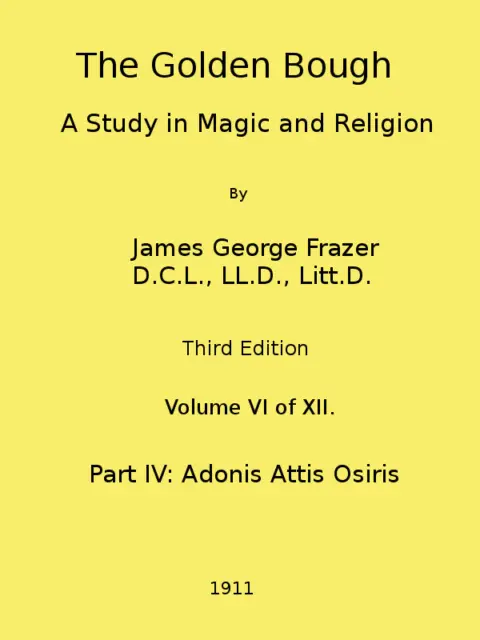
THE CLASSIC COLLECTION · 1890
"The Golden Bough: A Study in Magic and Religion (Third Edition, Vol. 06 of 12)" by Sir James George Frazer is a comparative study published between 1906-1915. This monumental work explores the common threads binding mythology and religion across cultures, examining fertility rites, human sacrifice, dying gods, and scapegoats. Frazer argues that humanity's understanding evolved from magic through religion to science, centered on ancient fertility cults and sacred kings sacrificed seasonally. Drawing from classical mythology to global traditions, it traces patterns of death and rebirth across world mythologies.
Introduction adapted from the source catalogue; source summaries may be automatically generated.
Free to read · English · 150,683 words · No account needed
MAKE TIME FOR A GOOD BOOK
On by default. Untick to stop anonymous reading totals. Each page counts after 10 seconds in view. How this works.
Anonymous counting is on unless you have switched it off.
(M158) The religion of the Ovambo, another Bantu tribe of German South-West Africa, is similar. They also recognize a great being named Kalunga, who created the world and man, but they neither fear nor worship him. A far greater part is played in the religion of the Ovambo by their belief in spirits, and amongst the worshipful spirits a conspicuous place is assigned to the souls of the dead. Every man leaves behind him at death a spirit, which continues to exist on earth and can influence the living; for example, it may enter into their bodies and thereby cause all sorts of sickness. However, the souls of ordinary dead men can exert their influence only on members of their own families; the souls of dead chiefs, on the other hand, have power over the rain, which they can either give or withhold. To these powerful spirits a portion of the new corn is offered at harvest as a thank-offering for their forbearance in not visiting the people with sickness, and above all for their bounty in sending down the fertilizing showers on the crops. The souls of dead magicians are particularly dreaded; and to prevent the multiplication of these dangerous spirits it is customary to dismember their bodies, severing the arms and legs from the trunk and cutting the tongue out of the mouth. If these precautions are taken immediately after death, the soul of the dead man cannot become a dangerous ghost; the mutilation of his body has practically disarmed his spirit.(483)
(M159) The Wahehe, a Bantu tribe of German East Africa, believe in a great invisible spirit named Nguruhi, who created the world and rules both human destiny and the elements. He it is who makes the rain to fall, the sun to shine, the wind to blow, the thunder to roll, and the crops to grow. “This god is accordingly conceived as all-powerful, yet with the limitation that he only exercises a general power of direction over the world, especially human fate, while the masoka, the spirits of the dead, wield a permanent and very considerable influence on the course of particular events. Nguruhi is lord also of all the spirits of the dead (masoka), but his relation to them has not been further thought out. With this Supreme Being the people hold no intercourse by means of prayer, sacrifice, or in any other way. He stands remote from the religious life of the Wahehe and really serves only as an explanation of all those things and events which are otherwise inexplicable. All religious intercourse, all worship centres alone on the spirits of the dead. Hence if we speak of a religion of the Wahehe, it must be described as a pure worship of ancestors.”(484) The human soul quits the body at death and at once becomes an ancestral spirit (m’soka), invisible and endowed with complete liberty of motion. Even the youngest children have souls which rank among the ancestral spirits at death. Hence the great multitude of the dead comprises spirits of all ages, from the infant one day old to the grey-haired patriarch. They are good or bad according as they were good or bad in life, and their social position also is unchanged. He who was powerful in life is powerful also in death; he who was a nobody among men is a nobody also among the spirits. Hence the ghost of a great man can do more for the living than the ghost of a common man; and the ghost of a man can do more than the ghost of a woman. Yet even the meanest ghost has power over the greatest living man, who can only defend himself by appealing for help to stronger ancestral spirits. Thus while the Supreme Being exercises a general superintendence over affairs, the real administration is in the hands of the ancestral spirits. While he, for example, regulates the weather as a whole, it is the ghosts who cause each particular shower to fall or the sun to break out in glory from the clouds. If he sends plagues on the whole people or stays the ravages of disease, it is the ghosts who make each individual sick or sound. These powerful spirits exert themselves especially to help their descendants, though they do not hesitate to plague their own kith and kin if they think themselves neglected. They flit freely through the air and perch on trees, mountains, and so forth, but they lodge by preference at their graves, and you are always sure of finding them there, if you wish to consult them.(485) That is why in the country of the Wahehe the only places of sacrifice are the graves; temples and altars are unknown.(486) However, it is only the bodies of considerable persons that are buried; the corpses of common folk are simply thrown away in the bush;(487) so that the number of graves and consequently of sacrificial places is strictly limited. The spirits of the dead appear to the living most commonly in dreams to give them information or warning, but oftener to chide and torment them. So the sleeper wakes in a fright and consults a diviner, who directs him what he must do in order to appease the angry ghost. Following the directions of his spiritual adviser the man sacrifices an ox, or it may be only a sheep or a fowl, at the tomb of one of his ancestors, prays to the ghost, and having scattered a few morsels of the victim’s flesh on the grave, and spat a mouthful of beer upon it, retires with his family to feast on the remainder of the carcase. Such sacrifices to the dead are offered on occasion of sickness, the lack of male heirs, a threatened war, an intended journey, in short, before any important undertaking of which the issue is doubtful; and, they are accompanied by prayers for health, victory, good harvests, and so forth.(488)
Your reading position is saved on this browser. Take it to another device with a library code. Reading pages adapt to text, rather than matching a printed edition.
James George Frazer

James George Frazer
James George Frazer

James George Frazer
BEHIND THE BOOK
This eBook is for the use of anyone anywhere in the United States and most other parts of the world at no cost and with almost no restrictions whatsoever. You may copy it, give it away or re-use it under the terms of the Project Gutenberg License included with this eBook or online at www.gutenberg.org. If you are not located in the United States, you will have to check the laws of the country where you are located before using this eBook. Read the source licence.
The original source file, including credits and licence, is retained by this library. Request an original-format copy at no charge. Please include the book title and Project Gutenberg identifier #41923.
KEEP YOUR CURIOSITY GOING

David Patterson (Spirit) Hatch

David Patterson (Spirit) Hatch

David Patterson (Spirit) Hatch

Maurice Baring
Francis Greenleaf Allinson & Anne C. E. (Anne Crosby Emery) Allinson

Edwin Abbott Abbott