THE CLASSIC COLLECTION✦Psyche’s taskCLASSIC FREE BOOKS
Psyche’s task
James George Frazer
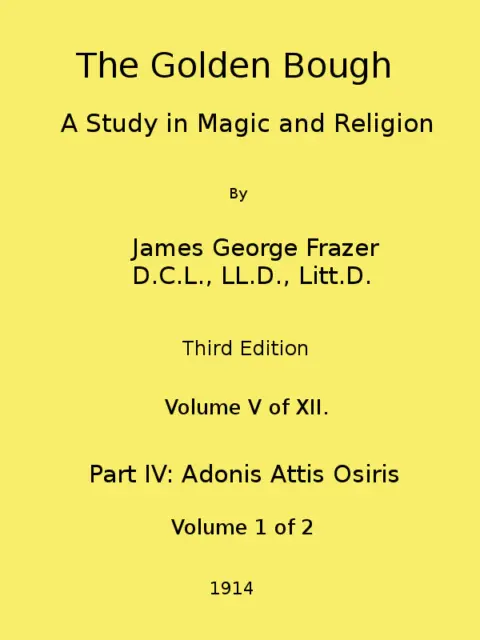
THE CLASSIC COLLECTION · 1890
"The Golden Bough: A Study in Magic and Religion (Third Edition, Vol. 05 of 12)" by Sir James George Frazer is a comparative study published between 1906-1915. This monumental work explores mythology and religion across cultures, tracing humanity's evolution from magical thinking through religious belief to scientific thought. Frazer examines fertility rites, dying gods, and sacred kingship, arguing that ancient religions centered on seasonal sacrifices. His controversial thesis scandalized Victorian Britain by treating all mythologies—including Christianity—as variations of universal patterns, forever changing how we understand belief systems.
Introduction adapted from the source catalogue; source summaries may be automatically generated.
Free to read · English · 138,970 words · No account needed
MAKE TIME FOR A GOOD BOOK
On by default. Untick to stop anonymous reading totals. Each page counts after 10 seconds in view. How this works.
Anonymous counting is on unless you have switched it off.
687 Bailly, Lettres sur l’Origine des Sciences (London and Paris, 1777), pp. 255 sq.; id., Lettres sur l’Atlantide de Platon (London and Paris, 1779), pp. 114-125. Carlyle has described how through the sleety drizzle of a dreary November day poor innocent Bailly was dragged to the scaffold amid the howls and curses of the Parisian mob (French Revolution, bk. v. ch. 2). My friend the late Professor C. Bendall showed me a book by a Hindoo gentleman in which it is seriously maintained that the primitive home of the Aryans was within the Arctic regions. See Bâl Gangâdhar Tilak, The Arctic Home in the Vedas (Poona and Bombay, 1903).
688 Cornutus, Theologiae Graecae Compendium, 28, pp. 54 sq., ed. C. Lang (Leipsic, 1881), τοιοῦτον γάρ τι καὶ παρ᾽ Αἰγυπτίοις ὁ ζητούμενος καὶ ἀνευρισκόμενος ὑπὸ τῆς Ἴσιδος Ὄσιρις ἐμφαίνει καὶ παρὰ Φοίνιξιν ὁ ἀνὰ μέρος παρ᾽ ἔξ μῆνας ὑπὲρ γῆν τε καὶ ὑπὸ γῆν γινόμενος Ἄδωνις, ἀπὸ τοῦ ἀδεῖν τοῖς ἀνθρώποις οὔτως ὠνομασμένου τοῦ Δημητριακοῦ καρποῦ. τοῦτον δὲ πλήξας κάπρος ἀνελεῖν λέγεται διὰ τὸ τὰς ὗς δοκεῖν ληιβότειρας εἶναι ἢ τὸν τῆς ὕνεως ὀδόντα αἰνιττομένων αὐτῶν, ὑφ᾽ οὖ κατὰ γῆς κρύπτεται τὸ σπέρμα. Scholiast on Theocritus, iii. 48, ὁ Ἄδωνις, ἤγουν ὁ σῖτος ὁ σπειρόμενος, ἔξ μῆνας ἐν τῇ γῇ ποιεῖ ἀπο τῆς σπορᾶς καὶ ἔξ μῆνας ἔχει αὐτὸν ἡ Ἀφροδίτη, τουτέστιν ἡ εὐκρασία τοῦ ἀέρος. καὶ ἐκτότε λαμβάνουσιν αὐτὸν οἱ ἄνθρωποι. Origen, Selecta in Ezechielem (Migne’s Patrologia Graeca, xiii. 800), οἱ δὲ περὶ τὴν ἀναγωγὴν τῶν Ἑλληνικῶν μύθων δεινοὶ καὶ μυθικῆς νομιζομένης θεολογίας, φασί τὸν Ἄδωνιν σύμβολον εἶναι τῶν τῆς γῆς καρπῶν, θρηνουμένων μὲν ὅτε σπείρονται, ἀνισταμένων δέ, καὶ διὰ τοῦτο χαίρειν ποιούντων τοὺς γεωργοὺς ὅτε φύονται. Jerome, Commentar. in Ezechielem, viii. 13, 14 (Migne’s Patrologia Latina, xxv. 83), “Eadem gentilitas hujuscemodi fabulas poetarum, quae habent turpitudinem, interpretatur subtiliter, interfectionem et resurrectionem Adonidis planctu et gaudio prosequens: quorum alterum in seminibus, quae moriuntur in terra, alterum in segetibus, quibus mortua semina renascuntur, ostendi putat.” Ammianus Marcellinus, xix. 1. 11, “in sollemnibus Adonidis sacris, quod simulacrum aliquod esse frugum adultarum religiones mysticae docent.” Id. xxii. 9. 15, “amato Veneris, ut fabulae fingunt, apri dente ferali deleto, quod in adulto flore sectarum est indicium frugum.” Clement of Alexandria, Hom. 6. 11 (quoted by W. Mannhardt, Antique Wald- und Feldkulte, p. 281), λαμβάνουσι δὲ καὶ Ἄδωνιν εἰς ὡραίους καρπούς. Etymologieum Magnum s.v. Ἄδωνις κύριον; δύναται καὶ ὁ καρπὸς εἶναι ἄδωνις; οἶον ἀδώνειος καρπός, ἀρέσκων. Eusebius, Praepar. Evang. iii. II. 9, Ἄδωνις τῆς τῶν τελείων καρπῶν ἐκτομῆς σύμβολον. Sallustius philosophus, “De diis et mundo,” iv. Fragmenta Philosophorum Graecorum, ed. F. G. A. Mullach, iii. 32, οἱ Αἰγύπτιοι ... αὐτὰ τὰ σώματα θεοὺς νομίσαντες ... Ἴσιν μὲν τὴν γῆν ... Ἄδωνιν δὲ καρπούς. Joannes Lydus, De mensibus, iv. 4, τῷ Ἀδώνιδι, τουτέστι τῷ Μαΐῳ ... ἢ ὡς ἄλλοις, δοκεῖ, Ἄδωνις μέν ἐστιν ὁ καρπός, κτλ. The view that Tammuz or Adonis is a personification of the dying and reviving vegetation is now accepted by many scholars. See P. Jensen, Kosmologie der Babylonier (Strasburg, 1890), p. 480; id., Assyrisch-babylonische Mythen und Epen, pp. 411, 560; H. Zimmern, in E. Schrader’s Keilinschriften und das Alte Testament,3 p. 397; A. Jeremias, s.v. “Nergal,” in W. H. Roscher’s Lexikon der griech. und röm. Mythologie, iii. 265; R. Wünsch, Das Frühlingsfest der Insel Malta (Leipsic, 1902), p. 21; M. J. Lagrange, Études sur les Religions Sémitiques,2 pp. 306 sqq.; W. W. Graf Baudissin, “Tammuz,” Realencyclopädie für protestantische Theologie und Kirchengeschichte; id., Esmun und Adonis, pp. 81, 141, 169, etc.; and Ed. Meyer, Geschichte des Altertums,2 i. 2. pp. 394, 427. Prof. Jastrow regards Tammuz as a god both of the sun and of vegetation (Religion of Babylonia and Assyria, pp. 547, 564, 574, 588). But such a combination of disparate qualities seems artificial and unlikely.
M176 Tammuz or Adonis as a corn-spirit bruised and ground in a mill.
689 D. Chwolsohn, Die Ssabier und der Ssabismus (St. Petersburg, 1856), ii. 27; id., Ueber Tammûz und die Menschenverehrung bei den alten Babylioniern (St. Petersburg, 1860), p. 38. Compare W. W. Graf Baudissin, Adonis und Esmun, pp. 111 sqq.
Your reading position is saved on this browser. Take it to another device with a library code. Reading pages adapt to text, rather than matching a printed edition.
James George Frazer

James George Frazer
James George Frazer

James George Frazer
BEHIND THE BOOK
This eBook is for the use of anyone anywhere in the United States and most other parts of the world at no cost and with almost no restrictions whatsoever. You may copy it, give it away or re-use it under the terms of the Project Gutenberg License included with this eBook or online at www.gutenberg.org. If you are not located in the United States, you will have to check the laws of the country where you are located before using this eBook. Read the source licence.
The original source file, including credits and licence, is retained by this library. Request an original-format copy at no charge. Please include the book title and Project Gutenberg identifier #43605.
KEEP YOUR CURIOSITY GOING

David Patterson (Spirit) Hatch

David Patterson (Spirit) Hatch

David Patterson (Spirit) Hatch

Maurice Baring
Francis Greenleaf Allinson & Anne C. E. (Anne Crosby Emery) Allinson

Edwin Abbott Abbott