THE CLASSIC COLLECTION✦Psyche’s taskCLASSIC FREE BOOKS
Psyche’s task
James George Frazer
THE CLASSIC COLLECTION · 1890
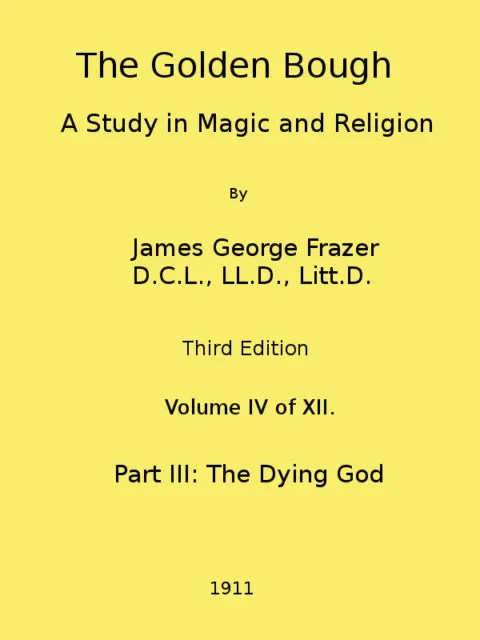
"The Golden Bough: A Study in Magic and Religion (Third Edition, Vol. 04 of 12)" by Sir James George Frazer is a comparative study published between 1906-1915. This monumental work explores mythology and religion across cultures, examining fertility rites, human sacrifice, dying gods, and sacred kings. Frazer argues that humanity progressed from magical thinking through religious belief to scientific thought, tracing these patterns through ancient rituals and seasonal cycles. His controversial thesis compares religious traditions worldwide, including Christianity, sparking debate that continues to influence literature and thought.
Introduction adapted from the source catalogue; source summaries may be automatically generated.
Free to read · English · 133,190 words · No account needed
MAKE TIME FOR A GOOD BOOK
On by default. Untick to stop anonymous reading totals. Each page counts after 10 seconds in view. How this works.
Anonymous counting is on unless you have switched it off.
2 C. Meiners, Geschichte der Religionen (Hannover, 1806-1807), i.
48.
3 R. I. Dodge, Our Wild Indians, p. 112.
4 F. Blumentritt, “Der Ahnencultus und die religiösen Anschauungen der Malaien des Philippinen-Archipels,” Mittheilungen d. Wiener geogr. Gesellschaft, 1882, p. 198.
5 Sir James E. Alexander, Expedition of Discovery into the Interior of Africa, i. 166; H. Lichtenstein, Reisen im Südlichen Africa (Berlin, 1811-1812), i. 349 sq.; W. H. I. Bleek, Reynard the Fox in South Africa (London, 1864), pp. 75 sq.; Theophilus Hahn, Tsuni-Goam, the Supreme Being of the Khoi-Khoi (London, 1881), pp. 56, 69.
6 Callimachus, Hymn to Zeus, 9 sq.; Diodorus Siculus, iii. 61; Lucian, Philopseudes, 3; id., Jupiter Tragoedus, 45; id., Philopatris, 10; Porphyry, Vita Pythagorae, 17; Cicero, De natura deorum, iii. 21. 53; Pomponius Mela, ii. 7. 112; Minucius Felix, Octavius, 21; Lactantius, Divin. instit. i. II.
7 Plutarch, Isis et Osiris, 35; Philochorus, Fragm. 22, in C. Müller’s Fragmenta historicorum Graecorum, i. p. 378; Tatian, Oratio ad Graecos, 8, ed. Otto; J. Tzetzes, Schol. on Lycophron, 208. Compare Ch. Petersen, “Das Grab und die Todtenfeier des Dionysos,” Philologus, xv. (1860) pp. 77-91. The grave of Dionysus is also said to have been at Thebes (Clemens Romanus, Recognitiones, x. 24; Migne’s Patrologia Graeca, i. col. 1434).
8 Porphyry, Vit. Pythag. 16.
9 Philochorus, Fr. 184, in C. Müller’s Fragmenta historicorum Graecorum, ii. p. 414.
10 Ch. Lobeck, Aglaophamus (Königsberg, 1829), pp. 574 sq.
M2 Mortality of Egyptian gods.
11 G. Maspero, Histoire ancienne des peuples de l’Orient classique: les origines, pp. 108-111, 116-118. On the mortality of the Egyptian gods see further A. Moret, Le Rituel du culte divin journalier en Égypte (Paris, 1902), pp. 219 sqq.
12 Plutarch, Isis et Osiris, 21, 22, 38, 61; Diodorus Siculus, i. 27. 4; Dittenberger, Orientis Graeci inscriptiones selectae, i. No. 56, p. 102.
13 A. Wiedemann, Die Religion der alten Aegypter, pp. 59 sq.; G. Maspero, Histoire ancienne des peuples de l’Orient classique: les origines, pp. 104-108, 150. Indeed it was an article of the Egyptian creed that every god must die after he had begotten a son in his own likeness (A. Wiedemann, Herodots zweites Buch, p. 204). Hence the Egyptian deities were commonly arranged in trinities of a simple and natural type, each comprising a father, a mother, and a son. “Speaking generally, two members of such a triad were gods, one old and one young, and the third was a goddess, who was, naturally, the wife, or female counterpart, of the older god. The younger god was the son of the older god and goddess, and he was supposed to possess all the attributes and powers which belonged to his father.... The feminine counterpart or wife of the chief god was usually a local goddess of little or no importance; on the other hand, her son by the chief god was nearly as important as his father, because it was assumed that he would succeed to his rank and throne when the elder god had passed away. The conception of the triad or trinity is, in Egypt, probably as old as the belief in gods, and it seems to be based on the anthropomorphic views which were current in the earliest times about them” (E. A. Wallis Budge, The Gods of the Egyptians, London, 1904, i. 113 sq.). If the Christian doctrine of the Trinity took shape under Egyptian influence, the function originally assigned to the Holy Spirit may have been that of the divine mother. In the apocryphal Gospel to the Hebrews, as Mr. F. C. Conybeare was kind enough to point out to me, Christ spoke of the Holy Ghost as his mother. The passage is quoted by Origen (Comment. in Joan. II. vol. iv. col. 132, ed. Migne), and runs as follows: “My mother the Holy Spirit took me a moment ago by one of my hairs and carried me away to the great Mount Tabor.” Compare Origen, In Jeremiam Hom. XV. 4, vol. iii. col. 433, ed. Migne. In the reign of Trajan a certain Alcibiades, from Apamea in Syria, appeared at Rome with a volume in which the Holy Ghost was described as a stalwart female about ninety-six miles high and broad in proportion. See Hippolytus, Refut. omnium haeresium, ix. 13, p. 462, ed. Duncker and Schneidewin. The Ophites represented the Holy Spirit as “the first woman,” “mother of all living,” who was beloved by “the first man” and likewise by “the second man,” and who conceived by one or both of them “the light, which they call Christ.” See H. Usener, Das Weihnachtsfest, pp. 116 sq., quoting Irenaeus, i. 28. As to a female member of the Trinity, see further id., Dreiheit, ein Versuch mythologischer Zahlenlehre (Bonn, 1903), pp. 41 sqq.; Gibbon, Decline and Fall of the Roman Empire, ch. 1. vol. ix. p. 261, note g (Edinburgh, 1811). Mr. Conybeare tells me that Philo Judaeus, who lived in the first half of the first century of our era, constantly defines God as a Trinity in Unity, or a Unity in Trinity, and that the speculations of this Alexandrian Jew deeply influenced the course of Christian thought on the mystical nature of the deity. Thus it seems not impossible that the ancient Egyptian doctrine of the divine Trinity may have been distilled through Philo into Christianity. On the other hand it has been suggested that the Christian Trinity is of Babylonian origin. See H. Zimmern, in E. Schrader’s Die Keilinschriften und das Alte Testament,3 pp. 418 sq., 440.
Your reading position is saved on this browser. Take it to another device with a library code. Reading pages adapt to text, rather than matching a printed edition.
James George Frazer

James George Frazer
James George Frazer

James George Frazer
BEHIND THE BOOK
This eBook is for the use of anyone anywhere in the United States and most other parts of the world at no cost and with almost no restrictions whatsoever. You may copy it, give it away or re-use it under the terms of the Project Gutenberg License included with this eBook or online at www.gutenberg.org. If you are not located in the United States, you will have to check the laws of the country where you are located before using this eBook. Read the source licence.
The original source file, including credits and licence, is retained by this library. Request an original-format copy at no charge. Please include the book title and Project Gutenberg identifier #41572.
KEEP YOUR CURIOSITY GOING

David Patterson (Spirit) Hatch

David Patterson (Spirit) Hatch

David Patterson (Spirit) Hatch

Maurice Baring
Francis Greenleaf Allinson & Anne C. E. (Anne Crosby Emery) Allinson

Edwin Abbott Abbott