THE CLASSIC COLLECTION✦Psyche’s taskCLASSIC FREE BOOKS
Psyche’s task
James George Frazer
THE CLASSIC COLLECTION · 1890
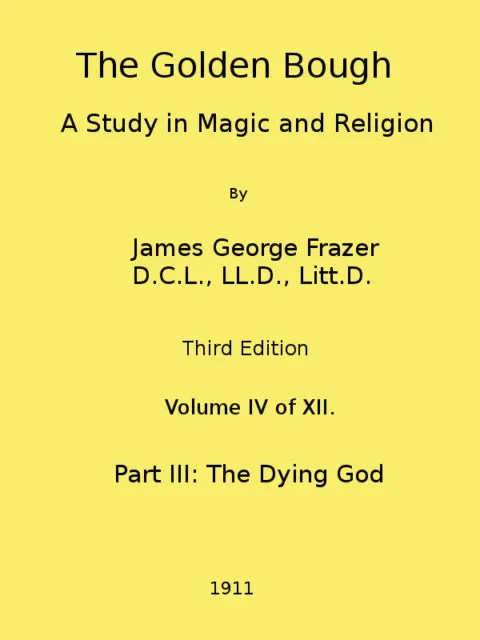
"The Golden Bough: A Study in Magic and Religion (Third Edition, Vol. 04 of 12)" by Sir James George Frazer is a comparative study published between 1906-1915. This monumental work explores mythology and religion across cultures, examining fertility rites, human sacrifice, dying gods, and sacred kings. Frazer argues that humanity progressed from magical thinking through religious belief to scientific thought, tracing these patterns through ancient rituals and seasonal cycles. His controversial thesis compares religious traditions worldwide, including Christianity, sparking debate that continues to influence literature and thought.
Introduction adapted from the source catalogue; source summaries may be automatically generated.
Free to read · English · 133,190 words · No account needed
MAKE TIME FOR A GOOD BOOK
On by default. Untick to stop anonymous reading totals. Each page counts after 10 seconds in view. How this works.
Anonymous counting is on unless you have switched it off.
(M220) Thus we see that people swing in order to procure a plentiful supply of fish and game as well as good crops. In such cases the notion seems to be that the ceremony promotes fertility, whether in the vegetable or the animal kingdom; though why it should be supposed to do so, I confess myself unable to explain. There seem to be some reasons for thinking that the Indian rite of swinging on hooks run through the flesh of the performer is also resorted to, at least in some cases, from a belief in its fertilising virtue. Thus Hamilton tells us that at Karwar, on the west coast of India, a feast is held at the end of May or beginning of June in honour of the infernal gods, “with a divination or conjuration to know the fate of the ensuing crop of corn.” Men were hung from a pole by means of tenter-hooks inserted in the flesh of their backs; and the pole with the men dangling from it was then dragged for more than a mile over ploughed ground from one sacred grove to another, preceded by a young girl who carried a pot of fire on her head. When the second grove was reached, the men were let down and taken off the hooks, and the girl fell into the usual prophetic frenzy, after which she unfolded to the priests the revelation with which she had just been favoured by the terrestrial gods. In each of the groves a shapeless black stone, daubed with red lead to stand for a mouth, eyes, and ears, appears to have represented the indwelling divinity.(735) Sometimes this custom of swinging on hooks, which is known among the Hindoos as Churuk Puja, seems to be intended to propitiate demons. Some Santals asked Mr. V. Ball to be allowed to perform it because their women and children were dying of sickness, and their cattle were being killed by wild beasts; they believed that these misfortunes befell them because the evil spirits had not been appeased.(736) These same Santals celebrate a swinging festival of a less barbarous sort about the month of February. Eight men sit in chairs and rotate round posts in a sort of revolving swing, like the merry-go-rounds which are so dear to children at English fairs.(737) At the Nauroz and Eed festivals in Dardistan the women swing on ropes suspended from trees.(738) During the rainy season in Behar young women swing in their houses, while they sing songs appropriate to the season. The period during which they indulge in this pastime, if a mere pastime it be, is strictly limited; it begins with a festival which usually falls on the twenty-fifth of the month Jeyt and ends with another festival which commonly takes place on the twenty-fifth of the month Asin. No one would think of swinging at any other time of the year.(739) It is possible that this last custom may be nothing more than a pastime meant to while away some of the tedious hours of the inclement season; but its limitation to a certain clearly-defined portion of the year seems rather to point to a religious or magical origin. Possibly the intention may once have been to drive away the rain. We shall see immediately that swinging is sometimes resorted to for the purpose of expelling the powers of evil. About the middle of March the Hindoos observe a swinging festival of a different sort in honour of the god Krishna, whose image is placed in the seat or cradle of a swing and then, just when the dawn is breaking, rocked gently to and fro several times. The same ceremony is repeated at noon and at sunset.(740) In the Rigveda the sun is called, by a natural metaphor, “the golden swing in the sky,” and the expression helps us to understand a ceremony of Vedic India. A priest sat in a swing and touched with the span of his right hand at once the seat of the swing and the ground. In doing so he said, “The great lord has united himself with the great lady, the god has united himself with the goddess.” Perhaps he meant to indicate in a graphic way that the sun had reached that lowest point of its course where it was nearest to the earth.(741) In this connexion it is of interest to note that in the Esthonian celebration of St. John’s Day or the summer solstice swings play, along with bonfires, the most prominent part. Girls sit and swing the whole night through, singing old songs to explain why they do so. For legend tells of an Esthonian prince who wooed and won an Islandic princess. But a wicked enchanter spirited away the lover to a desert island, where he languished in captivity, till his lady-love contrived to break the magic spell that bound him. Together they sailed home to Esthonia, which they reached on St. John’s Day, and burnt their ship, resolved to stray no longer in far foreign lands. The swings in which the Esthonian maidens still rock themselves on St. John’s Day are said to recall the ship in which the lovers tossed upon the stormy sea, and the bonfires commemorate the burning of it. When the fires have died out, the swings are laid aside and never used again either in the village or at the solitary alehouse until spring comes round once more.(742) Here it is natural to connect both swings and bonfires with the apparent course of the sun, who reaches the highest and turning point of his orbit on St. John’s Day. Bonfires and swings perhaps were originally charms intended to kindle and speed afresh on its heavenly road “the golden swing in the sky.” Among the Letts of South Livonia and Curland the summer solstice is the occasion of a great festival of flowers, at which the people sing songs with the constant refrain of lihgo, lihgo. It has been proposed to derive the word lihgo from the Lettish verb ligot, “to swing,” with reference to the sun swinging in the sky at this turning-point of his course.(743)
Your reading position is saved on this browser. Take it to another device with a library code. Reading pages adapt to text, rather than matching a printed edition.
James George Frazer

James George Frazer
James George Frazer

James George Frazer
BEHIND THE BOOK
This eBook is for the use of anyone anywhere in the United States and most other parts of the world at no cost and with almost no restrictions whatsoever. You may copy it, give it away or re-use it under the terms of the Project Gutenberg License included with this eBook or online at www.gutenberg.org. If you are not located in the United States, you will have to check the laws of the country where you are located before using this eBook. Read the source licence.
The original source file, including credits and licence, is retained by this library. Request an original-format copy at no charge. Please include the book title and Project Gutenberg identifier #41572.
KEEP YOUR CURIOSITY GOING

David Patterson (Spirit) Hatch

David Patterson (Spirit) Hatch

David Patterson (Spirit) Hatch

Maurice Baring
Francis Greenleaf Allinson & Anne C. E. (Anne Crosby Emery) Allinson

Edwin Abbott Abbott