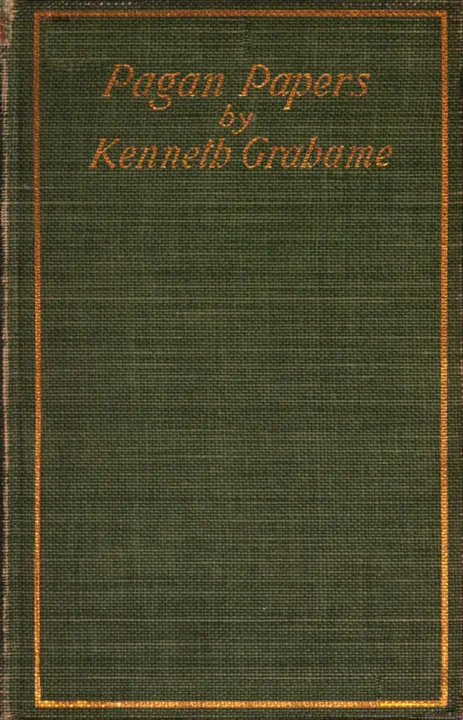
Pagan Papers
Kenneth Grahame
THE CLASSIC COLLECTION · 1895
"The Golden Age" by Kenneth Grahame is a collection of reminiscences first published in 1895. Through a child's eyes, adults become distant "Olympians" who have forgotten what it means to be young. Grahame captures the perpetual warfare between children and the grown-up world, weaving classical mythology into everyday childhood adventures. Widely praised upon release, this pioneering work explores themes of youth and imagination that would influence later authors like J.M. Barrie, establishing itself as a classic of its genre.
Introduction adapted from the source catalogue; source summaries may be automatically generated.
Free to read · English · 35,972 words · No account needed
MAKE TIME FOR A GOOD BOOK
On by default. Untick to stop anonymous reading totals. Each page counts after 10 seconds in view. How this works.
Anonymous counting is on unless you have switched it off.
The artist gazed out over the downs. “'The poet says, dear city of Cecrops;'” he said, softly, to himself, “'and wilt not thou say, dear city of Zeus?' That's from Marcus Aurelius,” he went on, turning again to his work. “You don't know him, I suppose; you will some day.”
“Who's he?” I inquired.
“Oh, just another fellow who lived in Rome,” he replied, dabbing away.
“O dear!” I cried, disconsolately. “What a lot of people seem to live at Rome, and I've never even been there! But I think I'd like MY city best.”
“And so would I,” he replied with unction. “But Marcus Aurelius
wouldn't, you know.”
“Then we won't invite him,” I said, “will we?”
“I won't if you won't,” said he. And that point being settled, we were
silent for a while.
“Do you know,” he said, presently, “I've met one or two fellows from time to time who have been to a city like yours,--perhaps it was the same one. They won't talk much about it--only broken hints, now and then; but they've been there sure enough. They don't seem to care about anything in particular--and every thing's the same to them, rough or smooth; and sooner or later they slip off and disappear; and you never see them again. Gone back, I suppose.”
“Of course,” said I. “Don't see what they ever came away for; I wouldn't,--to be told you've broken things when you haven't, and stopped having tea with the servants in the kitchen, and not allowed to have a dog to sleep with you. But I've known people, too, who've gone there.”
The artist stared, but without incivility.
“Well, there's Lancelot,” I went on. “The book says he died, but it never seemed to read right, somehow. He just went away, like Arthur. And Crusoe, when he got tired of wearing clothes and being respectable. And all the nice men in the stones who don't marry the Princess, 'cos only one man ever gets married in a book, you know. They'll be there!”
“And the men who never come off,” he said, “who try like the rest, but get knocked out, or somehow miss,--or break down or get bowled over in the melee,--and get no Princess, nor even a second-class kingdom,--some of them'll be there, I hope?”
“Yes, if you like,” I replied, not quite understanding him; “if they're friends of yours, we'll ask 'em, of course.”
“What a time we shall have!” said the artist, reflectively; “and how shocked old Marcus Aurelius will be!”
Your reading position is saved on this browser. Take it to another device with a library code. Reading pages adapt to text, rather than matching a printed edition.
Kenneth Grahame
Kenneth Grahame
Kenneth Grahame
BEHIND THE BOOK
This eBook is for the use of anyone anywhere in the United States and most other parts of the world at no cost and with almost no restrictions whatsoever. You may copy it, give it away or re-use it under the terms of the Project Gutenberg License included with this eBook or online at www.gutenberg.org. If you are not located in the United States, you will have to check the laws of the country where you are located before using this eBook. Read the source licence.
The original source file, including credits and licence, is retained by this library. Request an original-format copy at no charge. Please include the book title and Project Gutenberg identifier #291.
KEEP YOUR CURIOSITY GOING
Coulson Kernahan

Maurice Baring
Frances Wright
Cécile Tormay

Frederic Jesup Stimson

W. H. P. (William Henry Pope) Jarvis