The Starling: A Scottish Story
Norman Macleod
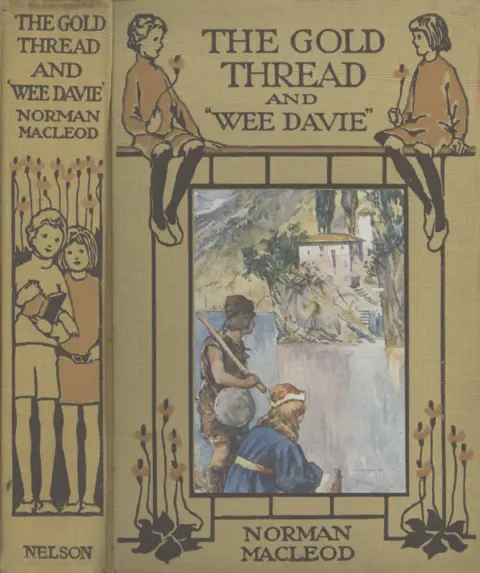
THE CLASSIC COLLECTION · 1878
"The Gold Thread and Wee Davie: Two Stories for the Young" by Norman Macleod is a collection of children's stories written in the mid-19th century. The book features enchanting narratives designed to teach moral lessons, with strong emphasis on themes of duty, bravery, and the importance of parental guidance. The opening story follows Eric, the son of King Magnus, as he navigates a dark and foreboding forest filled with dangers, while characters like Wolf, the swineherd, introduce both friendship and conflict. The beginning of "The Gold Thread" sets up a captivating tale as young Eric finds himself lost in a sprawling forest, struggling with feelings of fear and loss. Described as a lovely boy dressed in royal attire, he encounters various challenges, including a wild confrontation with Wolf, who attempts to rob him. Through a series of harrowing adventures, Eric learns about the consequences of disobedience from his father and discovers the meaning of true loyalty and kindness. The themes of duty and moral growth emerge strongly as he navigates through various trials, leading to critical introspection about his own actions and decisions.
Introduction adapted from the source catalogue; source summaries may be automatically generated.
Free to read · English · 24,622 words · No account needed
MAKE TIME FOR A GOOD BOOK
On by default. Untick to stop anonymous reading totals. Each page counts after 10 seconds in view. How this works.
Anonymous counting is on unless you have switched it off.
His wife had her fears――her horrid anticipations――but did not like to “even” her husband to anything so dreadful as what she in her heart dreaded. She took her own way, however, to win him to the house and to good, and gently insinuated wishes rather than expressed them. The smith, no doubt, was only “merry,” and never was ill-tempered or unkind; “yet at times――” “and then, what if――” Yes, Jeanie, you are right! The demon sneaks into the house by degrees, and at first may be dispelled, and the door shut upon him; but let him only once take possession, then he will keep it, and shut the door against everything pure, and lovely, and of good report, and bar it against thee and “wee Davie,” ay, and against better than thee and than all else, and fill the house with sin and shame, with misery and despair! But “wee Davie,” with his arm of might, drove the demon out.
It happened thus. One evening when the smith returned home so that “you would know it on him,” his child toddled to him, and, lifting him up, he made him stand before him on his knee. The child began to play with the locks of the Samson, and to pat him on the cheek, and to repeat with glee the name of “dad-a.” The smith gazed at him intently, and with a peculiar look of love, mingled with sadness.
“Isn’t he a bonnie bit bairn?” asked Jeanie, as she looked over her husband’s shoulder at the child, nodding and smiling to him.
The smith spoke not a word, but gazed still upon his boy, while some sudden emotion was strongly working in his countenance. “It’s done!” he at last said, as he put his child down.
“What’s wrang? what’s wrang?” exclaimed his wife, as she stood before him, and put her hands round his shoulders, bending down until her face was close to his.
“Everything is wrang, Jeanie!”
“Willie, what is’t? are ye no’ weel?――tell me what’s wrang wi’ you?――oh, tell me!” she exclaimed in evident alarm.
“It’s a’ richt noo!” he said, rising up, and seizing his child, lifted him up to his breast, and kissed him. He then folded him in his arms, clasped him to his heart, and looking up in silence, said, “Davie has done it, along wi’ you, Jeanie. Thank God, I am a free man!”
His wife felt awed, she knew not how.
“Sit doon,” he said, as he took out his handkerchief and wiped away a tear from his eye, “and I’ll tell you a’ aboot it.”
Your reading position is saved on this browser. Take it to another device with a library code. Reading pages adapt to text, rather than matching a printed edition.
BEHIND THE BOOK
This eBook is for the use of anyone anywhere in the United States and most other parts of the world at no cost and with almost no restrictions whatsoever. You may copy it, give it away or re-use it under the terms of the Project Gutenberg License included with this eBook or online at www.gutenberg.org. If you are not located in the United States, you will have to check the laws of the country where you are located before using this eBook. Read the source licence.
The original source file, including credits and licence, is retained by this library. Request an original-format copy at no charge. Please include the book title and Project Gutenberg identifier #63572.
KEEP YOUR CURIOSITY GOING
Cécile Tormay

Moritz Busch
Coulson Kernahan
John L. Ransom

Maurice Baring
Frances Wright