The Starling: A Scottish Story
Norman Macleod
THE CLASSIC COLLECTION · 1878
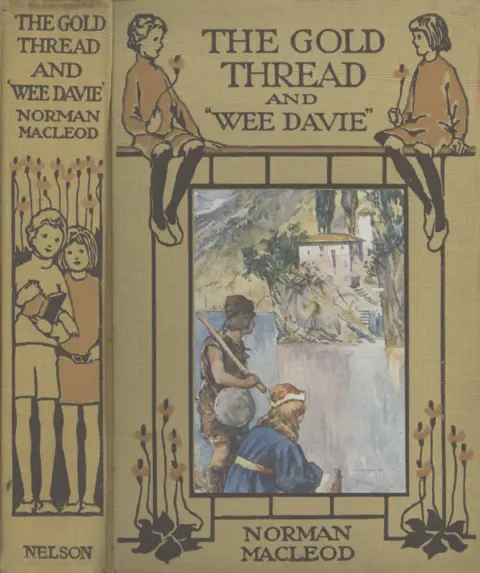
"The Gold Thread and Wee Davie: Two Stories for the Young" by Norman Macleod is a collection of children's stories written in the mid-19th century. The book features enchanting narratives designed to teach moral lessons, with strong emphasis on themes of duty, bravery, and the importance of parental guidance. The opening story follows Eric, the son of King Magnus, as he navigates a dark and foreboding forest filled with dangers, while characters like Wolf, the swineherd, introduce both friendship and conflict. The beginning of "The Gold Thread" sets up a captivating tale as young Eric finds himself lost in a sprawling forest, struggling with feelings of fear and loss. Described as a lovely boy dressed in royal attire, he encounters various challenges, including a wild confrontation with Wolf, who attempts to rob him. Through a series of harrowing adventures, Eric learns about the consequences of disobedience from his father and discovers the meaning of true loyalty and kindness. The themes of duty and moral growth emerge strongly as he navigates through various trials, leading to critical introspection about his own actions and decisions.
Introduction adapted from the source catalogue; source summaries may be automatically generated.
Free to read · English · 24,622 words · No account needed
MAKE TIME FOR A GOOD BOOK
On by default. Untick to stop anonymous reading totals. Each page counts after 10 seconds in view. How this works.
Anonymous counting is on unless you have switched it off.
They both went on at a quick pace, Eric having shown Wolf the thread he had asked him about the day before, and explained to him how he must never part with it, come what might. “Oh, rub-a-dub, dub!” said Wolf, squeezing the water out of his hair, as he trotted along; “I am glad to be away. Ralph would have killed me like a pig. The voice told me to run after you.” So on they went as fast as they could, when suddenly Wolf stopped, and listening with anxious face he said, “Hark! did you hear anything?”
“No,” said Eric; “what was it?”
“Hush!――listen!――there again――I hear it!”
“I think I do hear something far off like a dog’s bark,” replied Eric.
“Hark!”
So they both stopped and listened, and far away they heard a deep “Bow-wow-wow-wow-o-o-o-o-o” echoing through the forest.
“Let us run as fast as we can,” said the boy, in evident fear; “hear
him――hear him!”
“Bow-wow-wow-o-o-o-o,” and the sound came nearer and nearer.
“What is it? why are you so afraid?” anxiously inquired Eric.
“Oh! that is Ralph’s bloodhound, Tuscar,” cried Wolf, “and he is following us. He won’t perhaps touch me, but you he may.” So Eric ran as fast as he could, but never let go the gold thread, which this time led up a steep hill, which they were obliged to scramble up. “Run, Eric!――quick――hide――up a tree――anywhere!”
“I cannot, I dare not,” said Eric; “whatever happens, I must hold fast
my thread.”
But they heard the “Bow-wow-o-o-o” coming nearer and nearer, and as they looked back they saw an immense hound rush out of the wood, and as he came to the water he saw the boys on the opposite hill, and so he leaped into the stream, and in a few minutes would be near them. And now he came bellowing like a fierce bull up the hill, his tongue hanging out, and his nose smelling along the ground, following their footsteps.
“I shall run and meet him,” said Wolf, “and stop him if I can;” and down ran the swineherd, calling “Tuscar! Tuscar! good dog, Tuscar!”
But though Tuscar knew Wolf, he passed him, and ran up to Eric. As he reached Eric, who stood calm and firm, the bloodhound stopped panting, smelling his clothes all round, but, strange to say, wagging his huge tail, and then ran back the way he had come, as if he had made a mistake, and all his race was for nothing! It was the large hound Eric had fed! So his kindness was not lost even on the dog.
Your reading position is saved on this browser. Take it to another device with a library code. Reading pages adapt to text, rather than matching a printed edition.
BEHIND THE BOOK
This eBook is for the use of anyone anywhere in the United States and most other parts of the world at no cost and with almost no restrictions whatsoever. You may copy it, give it away or re-use it under the terms of the Project Gutenberg License included with this eBook or online at www.gutenberg.org. If you are not located in the United States, you will have to check the laws of the country where you are located before using this eBook. Read the source licence.
The original source file, including credits and licence, is retained by this library. Request an original-format copy at no charge. Please include the book title and Project Gutenberg identifier #63572.
KEEP YOUR CURIOSITY GOING
Cécile Tormay

Moritz Busch
Coulson Kernahan
John L. Ransom

Maurice Baring
Frances Wright