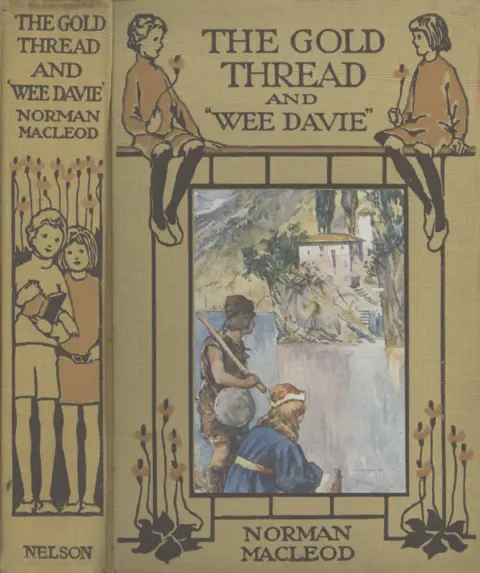
The Gold Thread; and, Wee Davie: Two Stories for the Young
Norman Macleod
THE CLASSIC COLLECTION · 1878
"The Gold Thread: A Story for the Young" by Norman Macleod is a children's story written in the late 19th century. The book follows the adventures of a young prince named Eric, who loses his way in a dark forest and learns important life lessons about trust, obedience, and the pursuit of righteousness through various trials and encounters. The narrative emphasizes the significance of following divine guidance, represented by the gold thread given to Eric by his father, which symbolizes doing what is right despite temptations and dangers. In the story, Eric's adventures begin when he gets lost in a vast forest, leading him to meet various characters, including the wild swineherd Wolf. Together, they face numerous challenges and temptations, such as a cunning robber named Ralph and a fierce lion. Throughout his journey, Eric is reminded of the importance of his gold thread, which represents his duty and moral compass. Ultimately, the story culminates in Eric's realization of the value of love, truth, and the consequences of his choices, leading him back to his father and home, celebrated by his family and friends. The tale serves as a moral guide for young readers, teaching them the virtues of faith, perseverance, and kindness.
Introduction adapted from the source catalogue; source summaries may be automatically generated.
Free to read · English · 12,984 words · No account needed
MAKE TIME FOR A GOOD BOOK
On by default. Untick to stop anonymous reading totals. Each page counts after 10 seconds in view. How this works.
Anonymous counting is on unless you have switched it off.
Wolf was astonished at Eric's escape, until he heard how he and Tuscar had become acquainted; and then Wolf heard the voice in his heart say that there was nothing better than kindness and love shewn to man or beast. They both after this pursued their journey with light and hopeful hearts, for they had got out of what was called the wild robber country, and Eric knew that he was drawing near home. The thread was stronger than ever, and every hour it helped more and more to support him. Wolf trotted along with his short stick, and sometimes snorting and blowing with the fatigue like one of his own pigs. They talked as best they could about all they had seen. "Did you see big Thorold the lion?" asked Wolf. "I did," said Eric; "he is very awful, but he was chained." "Lucky for you!" said Wolf, "for Ralph hunts with him and kills travellers. He will obey none but Ralph. I heard him roaring. He is hungry. He once ate one of my pigs, and would have ate me if he had not first caught the poor black porker. I escaped up a tree." And thus they chatted, as they journeyed on through woods, and across green plains, and over low hills, until Wolf complained of hunger. Eric at once gave him what remained of his large cake; but it did not suffice to appease the hunger of the herd, who was, however, very thankful for what he got. To their delight they now saw a beautiful cottage not far from their path, and, as they approached it, an old woman, with a pretty girl who seemed to be her daughter, came out to meet them. "Good day, young gentlemen!" said the old woman with a kind smile and a courtesy; "you seem to be on your travels, and look wearied? Pray come into my cottage, and I shall refresh you." "What fortunate fellows we are!" said Wolf. "We are much obliged to you for your hospitality," replied Eric. But, alas! the thread drew him in an opposite direction; so turning to Wolf, he said, "I cannot go in." "Come, my handsome young gentleman," said the young woman, "and we shall make you so happy. You shall have such a dinner as will delight you, I am sure; and you may remain as long as you please, and I will dance and sing to you; nor need you pay anything." And she came forward smiling and dancing, offering her arm to Eric. "Surely you won't be so rude as refuse me! you are so beautiful, and have such lovely hair and eyes, and I never saw such a belt as you wear: do come!" "Come, my son," said the old woman to Wolf, as she put her hand round his neck. "With all my heart!" replied Wolf; "for, to tell the truth, I am wearied and hungry; one does not get such offers as yours every day." "I cannot go," again said Eric. They could not see the thread, for to some it was invisible; but he saw it, and felt it like a wire passing away from the cottage. "Who are you, kind friends?" inquired Eric. "Friends of the king and of his family. Honest subjects, good people," said the old woman. "Do you know Prince Eric?" asked Wolf. "Right well!" replied the young woman. "He is a great friend of mine; a fine, tall, comely youth. He calls me his own little sweetheart." "It is false!" said Eric; "you do not know him. You should not lie." But he did not tell her who he was, neither did Wolf, for Eric had made a sign to him to be silent. "I won't enter your dwelling," said Eric, "for my duty calls me away." They both gave a loud laugh, and said, "Hear him! Only hear a fine young fellow talking about duty! Pleasure, ease, and liberty are for the young. We only want to make you happy: come!" "I shall go with you," said Wolf; "do come, Eric." "Wolf, speak to me," whispered Eric to the swineherd. "You know I cannot go, for my duty tells me to follow the thread. But now I see that this is the house of the wicked, for you heard how they lied; they neither know the king nor his children; and they laugh too at duty. Be advised, Wolf, and follow me." Wolf hesitated, and looked displeased. "Only for an hour, Eric!" "Not a minute. Wolf. If you trust them more than me, go; but I am sure you and I shall never meet again." "Then I will trust you, Eric," said Wolf; "the voice in my heart tells me to do so." And so they both passed on. But the old woman and the girl began to abuse them, and call them all manner of evil names, and to laugh at them as silly fellows. The girl threw stones at them, which made Wolf turn round and flourish his stick over his head. At last they entered the cottage, the old woman shaking her fist, and calling out from the door, "I'll soon send my friend Ralph after you!" "Oh, ho! is that the way the wind blows!" exclaimed Wolf, with a whistle; and, grasping Eric's arm, said, "You were right, prince! I never suspected them. I see now they are bad." "I saw that before," replied Eric, "and knew that no good would come to us from making their acquaintance." "Were they not cunning?" "Yes; but, probably, with all their smiles, flattery, and fair promises, they would have proved more cruel in the end than either Ralph or old Thorold." "What would they have done to us? Why did they meet us? Who are they, think you?" "I don't know, Wolf; it was enough for me that they lied, and did not wish us to do what was right. The gold thread given me by my father never could have led me into the society and house of the wicked. I am glad we held it fast."
Your reading position is saved on this browser. Take it to another device with a library code. Reading pages adapt to text, rather than matching a printed edition.
Norman Macleod
Norman Macleod
BEHIND THE BOOK
This eBook is for the use of anyone anywhere in the United States and most other parts of the world at no cost and with almost no restrictions whatsoever. You may copy it, give it away or re-use it under the terms of the Project Gutenberg License included with this eBook or online at www.gutenberg.org. If you are not located in the United States, you will have to check the laws of the country where you are located before using this eBook. Read the source licence.
The original source file, including credits and licence, is retained by this library. Request an original-format copy at no charge. Please include the book title and Project Gutenberg identifier #26039.
KEEP YOUR CURIOSITY GOING
Coulson Kernahan

Maurice Baring
Frances Wright
Cécile Tormay

Frederic Jesup Stimson

W. H. P. (William Henry Pope) Jarvis