THE CLASSIC COLLECTION✦Girls togetherCLASSIC FREE BOOKS
Girls together
Amy Ella Blanchard
THE CLASSIC COLLECTION · 1910
"The glad lady" by Amy Ella Blanchard is a novel written in the early 20th century. Set in northern Spain, it follows spirited American Patience “Patty” Blake, her sister Doña Martina, and their Spanish family and friends as they spend a summer in Asturias. Through fiestas, village customs, seaside rambles, and visits to ancient houses, the tale mixes travel color, gentle romance, and cross‑cultural comedy—especially around Patty’s flirtatious banter with Don Tomás and a homesick American engineer, Robert Lisle. It promises a warm, picturesque story of manners, friendship, and light-hearted intrigue rather than high drama. At the start of the story, a small party gathers in San Sebastián: Dr. Juan Estradas and his American wife Martina, his brother Tomás, and Martina’s sister Patty with her schoolmate Paulette. Patty’s teasing charm and halting Spanish lead Tomás to dub her “the glad lady,” and the group moves on to a mountain town, where a clean but primitive inn, the lively plaza, and village routines set the scene. They visit a peasant weaver and a venerable old house, stroll to a cave-fringed beach, and lunch in style at Don Felipe’s antiquity-filled palacio, leaving with souvenir cups and later bouquets. A reserved traveler reappears as Robert Lisle, an American with Kentucky roots, who bonds with Patty over homesickness. The party then settles into the Estrada family home, and St. John’s Eve and Day bring local traditions: decking streams and the fountain with flowers, villagers bringing gifts—including a lamb from Perdita—and preparations for music and dancing as the community arrives singing a song in honor of Don Juan.
Introduction adapted from the source catalogue; source summaries may be automatically generated.
Free to read · English · 66,681 words · No account needed
MAKE TIME FOR A GOOD BOOK
On by default. Untick to stop anonymous reading totals. Each page counts after 10 seconds in view. How this works.
Anonymous counting is on unless you have switched it off.
“You’re not a Spaniard,” returned her sister.
“Let us ask them the subject of their discourse and settle it at once,” proposed Patty; “it would be interesting to know.”
They advanced toward the two men, who now hurried forward with apologies for not having seen them sooner.
“And what were you talking about that you couldn’t see us?” Patty asked
Don Juan.
“What? Let me see, what. Simple matters enough; of what we may be having for luncheon, of the report that we shall have rain to-night.”
Doña Martina brought her hands softly together. “What did I tell you?” she exclaimed with a nod toward her sister. “I said it might be the weather.”
“Yes, but the other subject: luncheon, warranted any amount of excitement,” returned Patty as they all turned toward the dining-room.
An hour later the party was included in the throng which promenaded the Esplanade. To Patty’s share fell Don Tomás as escort. “It is very beautiful,” said the girl with a wave of the hand toward the rock-encircled harbor.
“Shocking,” replied Don Tomás with a desire to say something his companion could understand.
“Oh, no, not at all.” Patty turned to speak to her sister. “Come here, Tina, and walk with us; we need a translator.”
Doña Martina joined the two.
“Tell him,” said Patty, “that I will teach him English if he will teach
me Spanish.”
Her sister bent a searching look upon the girl’s innocently grave face. “Very well,” she said. “He agrees,” she went on after a few words in Spanish to her brother-in-law.
“Is he delighted at my gracious suggestion? He ought to be.”
“Why, any more than you?”
“Because he is a man.”
“That is no reason.”
“It is to me. All right, Tina, you may go back to your husband. We shall get along now, no doubt, since he knows what is expected of him.”
“I shall walk with you two,” said Doña Martina firmly. “You are not to
be trusted.”
“Oh nonsense! You can keep your stern eye upon us all you like, but I shall be embarrassed if you are listening to my faltering tongue lisping in Castilian. Go back or Juan will be jealous.”
“What a silly speech. However, I will go because I want to, and because it is reasonable to believe you will get on better if I am not listening.”
In a few minutes there was low laughter heard from the two, who plunged into a halting conversation, and it was evident that the progress was pleasant if not rapid.
Your reading position is saved on this browser. Take it to another device with a library code. Reading pages adapt to text, rather than matching a printed edition.
Amy Ella Blanchard
Amy Ella Blanchard
Amy Ella Blanchard
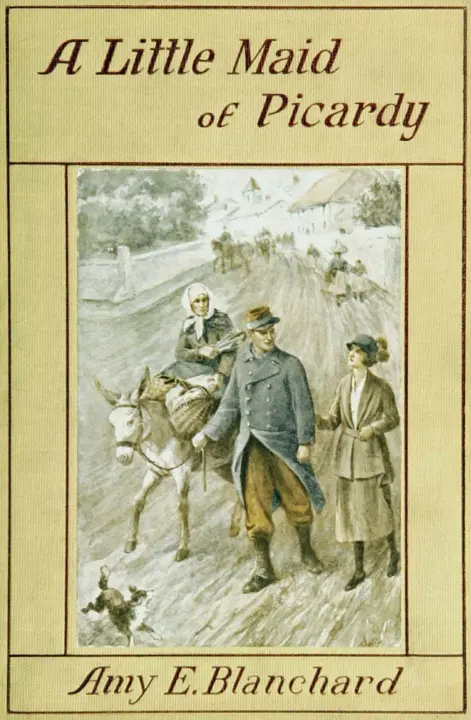
Amy Ella Blanchard
BEHIND THE BOOK
This eBook is for the use of anyone anywhere in the United States and most other parts of the world at no cost and with almost no restrictions whatsoever. You may copy it, give it away or re-use it under the terms of the Project Gutenberg License included with this eBook or online at www.gutenberg.org. If you are not located in the United States, you will have to check the laws of the country where you are located before using this eBook. Read the source licence.
The original source file, including credits and licence, is retained by this library. Request an original-format copy at no charge. Please include the book title and Project Gutenberg identifier #76495.
KEEP YOUR CURIOSITY GOING
Coulson Kernahan

Maurice Baring
Frances Wright
Cécile Tormay

Frederic Jesup Stimson

W. H. P. (William Henry Pope) Jarvis