Rockhaven
Charles Clark Munn
THE CLASSIC COLLECTION · 1906
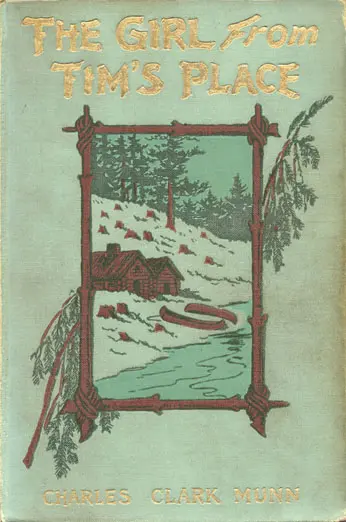
"The Girl From Tim's Place" by Charles Clark Munn is a novel written in the early 20th century. The story centers around a young girl named Chip McGuire, who struggles to escape a life of servitude and brutality in a remote wilderness community run by harsh individuals, including her outlaw father. Her flight from Tim's Place leads her through the challenges of nature and her own harrowing fears, setting the stage for themes of survival, resilience, and the search for a better life. At the start of the narrative, we are introduced to Chip, a sixteen-year-old girl who is subjected to a miserable existence at Tim's Place, where she is treated as a menial servant. The opening illustrates her weariness and sense of despair as she overhears a discussion that reveals her father has sold her to a half-breed trapper named Pete Bolduc. Terrified of her impending fate, Chip decides to flee, embarking on a treacherous journey through the wilderness filled with supernatural fears inspired by the stories of an old Indian named Tomah. The opening of the book paints a vivid picture of her desperation and determination as she navigates both physical and emotional challenges, ultimately leading to a chance encounter with a more compassionate group of strangers who may help her rewrite her fate.
Introduction adapted from the source catalogue; source summaries may be automatically generated.
Free to read · English · 89,481 words · No account needed
MAKE TIME FOR A GOOD BOOK
On by default. Untick to stop anonymous reading totals. Each page counts after 10 seconds in view. How this works.
Anonymous counting is on unless you have switched it off.
"He didn't kill mother," Chip returned promptly; "he used to lick her, though, but she got killed in a mill, 'n' I wisht it 'ud bin him. I wouldn't 'a' bin an orfin then. Say," she added, as they entered a woods-bordered stretch of road, "did ye ever see spites here?"
"Spites," he responded, now more than ever in doubt as to her sanity,
"what's them?"
"Why, they's just spites--things ye can't see much of 'ceptin' it's dark. Then they come crawlin' round. They's souls o' animals mostly, Old Tomah says. I've seen thousands on 'em."
Uncle Joe shifted his quid, turned and eyed the girl once more. First, a wild and wofully mixed tale of murder, and then spookish things! Beyond question she had wheels, and he resolved to humor her.
"Oh, yes, we see them things here now 'n' then," he said, "but it takes considerable licker to do it. We hain't had a murder, though, for quite a spell. This is a sorter peaceful neck o' woods ye're comin' to."
But Chip failed to grasp his quiet humor, and all through that twenty-mile autumn day stage ride she chattered on like a magpie.
He soon concluded she was sane enough, however, but the most voluble talker who ever shared his seat.
"I never seen the beat o' her," he said that night at Phinney's store,--the village news agency,--"she clacked every minit from the time we started till we fetched in, an' I never callated sich goin's on ez she told about cud ever happen. Thar was murder 'n' runnin' away, 'n' she got ketched 'n' carried off 'n' fetched back, 'n' a whole lot o' resky business. She believes in ghosts, too, sorter Injun sperits, 'n' she kin swear jist ez easy ez I kin. It seems the Frisbies hev kinder 'dopted her, 'n' I guess they'll hev their hands full. She's a bright 'un, though, but sich a talker!"
At Aunt Comfort's spacious, old-fashioned home, where Chip was now installed, she soon began to create the same impression. This had been Angie's former home, and her Aunt Comfort Day had been her foster-mother.
This family, in addition to the new arrival, consisted of Aunt Comfort, rotund and warm-hearted; Hannah Pettibone, a well-along spinster of angular form and temper, thin to an almost painful degree, with a well-defined mustache; and a general helper on the farm, and a chore boy about Chip's age named Nezer, completed the list.
Once included in this somewhat diverse group, Chip became an immediate
bone of contention.
Your reading position is saved on this browser. Take it to another device with a library code. Reading pages adapt to text, rather than matching a printed edition.
BEHIND THE BOOK
This eBook is for the use of anyone anywhere in the United States and most other parts of the world at no cost and with almost no restrictions whatsoever. You may copy it, give it away or re-use it under the terms of the Project Gutenberg License included with this eBook or online at www.gutenberg.org. If you are not located in the United States, you will have to check the laws of the country where you are located before using this eBook. Read the source licence.
The original source file, including credits and licence, is retained by this library. Request an original-format copy at no charge. Please include the book title and Project Gutenberg identifier #34202.
KEEP YOUR CURIOSITY GOING
Coulson Kernahan

Maurice Baring
Frances Wright
Cécile Tormay

Frederic Jesup Stimson

W. H. P. (William Henry Pope) Jarvis