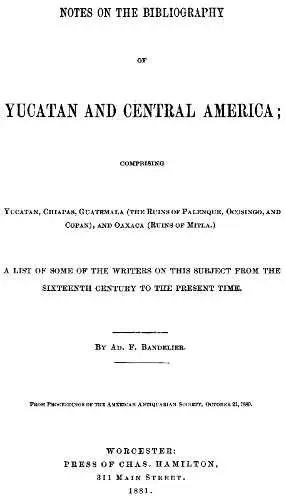
Notes on the Bibliography of Yucatan and Central America Comprising Yucatan, Chiapas, Guatemala (the Ruins of Palenque, Ocosingo, and Copan), and Oaxaca (Ruins of Mitla)
Adolph Francis Alphonse Bandelier
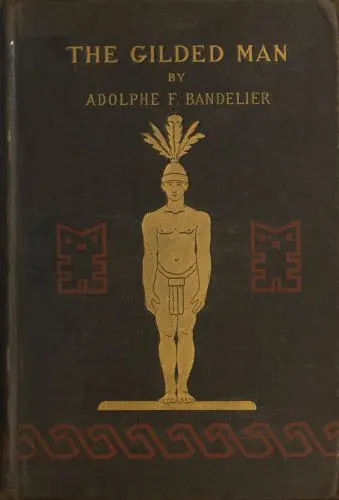
THE CLASSIC COLLECTION · 1893
"The Gilded Man (El Dorado) and Other Pictures of the Spanish Occupancy of America" by A. F. Bandelier is a historical account written in the late 19th century. This work explores the Spanish exploration and colonization of the Americas, particularly focusing on the mythical El Dorado legend and the quest for wealth that characterized these expeditions. The narrative delves into the richly detailed and often harrowing history of the encounters between Spanish adventurers and Indigenous tribes, highlighting the consequences of the greed that drove these early conquests." "The opening of this work introduces the context of Spanish exploration in the Americas, emphasizing the historical neglect of the Spanish presence in the Southwest compared to the Atlantic seaboard. It discusses how the pursuit of gold led Spaniards into both remarkable adventures and devastating consequences for Indigenous populations. The text sets the stage with references to the tales of El Dorado, manly exploits, and the darker moral implications of these conquests, establishing a foundation for the detailed exploration of significant expeditions and encounters that follow."
Introduction adapted from the source catalogue; source summaries may be automatically generated.
Free to read · English · 86,614 words · No account needed
MAKE TIME FOR A GOOD BOOK
On by default. Untick to stop anonymous reading totals. Each page counts after 10 seconds in view. How this works.
Anonymous counting is on unless you have switched it off.
[33] They are: Ananas; Cobéus (man-eater); Piraiurus (fish-snout); Pisas (net); Tapurus (tapir); Uaracus (fish); Tucunderas (ant); Jacamis (trumpet-bird); Mucuras (opossum); Taiassus (hog); Tijucos (mud); Arapassos (woodpecker); Tucanas (pepper-eater); Uacarras (crane); Ipecas (duck); Gis (axe); Coua (wasp); Corocoro (green ibis); Armadillos (armadillo); Tatus; Penimbucas (ashes). These names are somewhat similar to the designations which the Iroquois chose for their gentes, and prove, by the use of the names of peculiar animals, that the tribe of the Uaupés was certainly formed or divided up within tropical America.
[34] This story related to the unfortunate expedition of Herrera.
[35] The former sings in “Araucana” of Chili; the latter of La Plata in
“Argentina.”
[36] Dec. v. lib. viii. cap. xiv.
[37] Father Gumilla says likewise in “El Orinoco ilustrado,” etc.: “Reports concerning the gilded king were current from the earliest times of the conquest at Santa Marta, as well as on the coast of Venezuela.”
[38] As Fray Pedro Simon records in the fragment of his “Noticias historiales” printed by Lord Kingsborough.
[39] In this act he abused his powers, which only permitted him to concede the whole government of Peru at pleasure, while single districts were put under the direction of commanders who could not be changed by him. See Herrera, dec. vi. lib. iii. cap. xi., and lib. viii. cap. vi.
[40] Herrera, dec. vi. lib. viii. cap. vi.
[41] It was probably the black cinnamon which Balmont de Bomaré” in his “Dictionnaire d’Histoire Naturelle” of 1765 calls “Canelle geroflée, Capelet ou Bois de Crabe.”
[42] Oviedo says 230; Zarate, 200, and 4000 Indians.
[43] “Historia del Descubrimiento y de la Conquista del Peru.”
[44] “Une Barca llena de Bastimento.”
[45] Fray Gaspar de Carvajal, a Dominican, who went in Orellana’s voyage, says that the current was so strong that they travelled twenty-five leagues a day.
[46] On which a contemporary, Gómara, in his “Historia General de las Indias,” division, “Rio de Orellana,” lays special emphasis.
[47] The later Peruvian fable of the Paytiti is connected, as Von Humboldt has justly remarked, with the last concerted efforts of the Inca tribe to hold its position on the upper tributaries of the Amazon, and has therefore no connection the real dorado legend.
[48] Herrera, dec. vii. lib. iv. cap. xii.
[49] Oviedo, lib. xxvi. cap. xxx.
[50] According to Oviedo (lib. xxv. cap. xvi.), 1262 pesos for the men and 1700 pesos for Von Speyer.
[51] Oviedo quotes from a report of Von Speyer’s dated Coro, October 9, 1538, which has not since received any attention. Possibly it no longer exists.
Your reading position is saved on this browser. Take it to another device with a library code. Reading pages adapt to text, rather than matching a printed edition.
Adolph Francis Alphonse Bandelier
Adolph Francis Alphonse Bandelier
Adolph Francis Alphonse Bandelier
Adolph Francis Alphonse Bandelier
BEHIND THE BOOK
This eBook is for the use of anyone anywhere in the United States and most other parts of the world at no cost and with almost no restrictions whatsoever. You may copy it, give it away or re-use it under the terms of the Project Gutenberg License included with this eBook or online at www.gutenberg.org. If you are not located in the United States, you will have to check the laws of the country where you are located before using this eBook. Read the source licence.
The original source file, including credits and licence, is retained by this library. Request an original-format copy at no charge. Please include the book title and Project Gutenberg identifier #56596.
KEEP YOUR CURIOSITY GOING
Wilfrid Scawen Blunt
Wilfrid Scawen Blunt

E. W. (Edgar Watson) Howe
Cécile Tormay

Moritz Busch
John L. Ransom