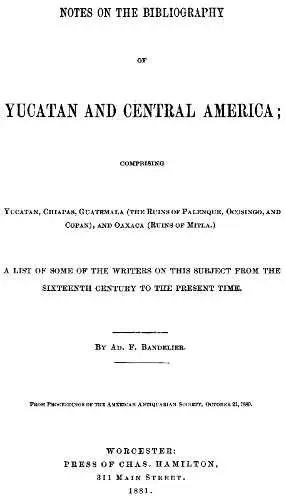
Notes on the Bibliography of Yucatan and Central America Comprising Yucatan, Chiapas, Guatemala (the Ruins of Palenque, Ocosingo, and Copan), and Oaxaca (Ruins of Mitla)
Adolph Francis Alphonse Bandelier
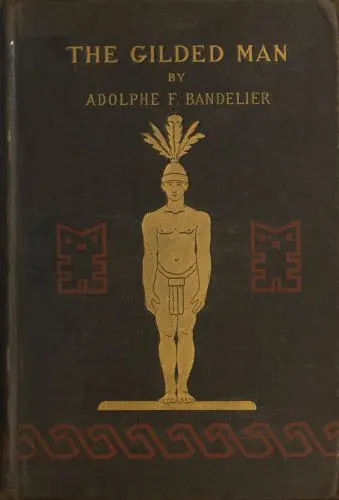
THE CLASSIC COLLECTION · 1893
"The Gilded Man (El Dorado) and Other Pictures of the Spanish Occupancy of America" by A. F. Bandelier is a historical account written in the late 19th century. This work explores the Spanish exploration and colonization of the Americas, particularly focusing on the mythical El Dorado legend and the quest for wealth that characterized these expeditions. The narrative delves into the richly detailed and often harrowing history of the encounters between Spanish adventurers and Indigenous tribes, highlighting the consequences of the greed that drove these early conquests." "The opening of this work introduces the context of Spanish exploration in the Americas, emphasizing the historical neglect of the Spanish presence in the Southwest compared to the Atlantic seaboard. It discusses how the pursuit of gold led Spaniards into both remarkable adventures and devastating consequences for Indigenous populations. The text sets the stage with references to the tales of El Dorado, manly exploits, and the darker moral implications of these conquests, establishing a foundation for the detailed exploration of significant expeditions and encounters that follow."
Introduction adapted from the source catalogue; source summaries may be automatically generated.
Free to read · English · 86,614 words · No account needed
MAKE TIME FOR A GOOD BOOK
On by default. Untick to stop anonymous reading totals. Each page counts after 10 seconds in view. How this works.
Anonymous counting is on unless you have switched it off.
Alvarado was received by the Pecos with drums and flutes. The native flute might rather be called a clarinet, for it has a mouth of painted gourd-shell, and is blown from the end and not from the side. Many cotton cloths and turquoises were presented to him. Such a reception indicated that the Pecos Indians were somewhat doubtful concerning the human origin of their guest. He also met here a strange Indian who lived with the Pecos,[84] and whom the Spaniards called a “Turk” on account of his appearance. He was a native of the Mississippi Valley, and belonged to one of the tribes of that region. He informed the Spaniards that gold-bearing and thickly populated districts lay toward the east. Such information was extremely welcome; he was taken as a guide for the visit to the buffalo herds of the plains that was to be made in pursuance of Coronado’s directions; but this was not continued long, for Alvarado hastened back, in order to communicate to his commander what he regarded as important news. He returned speedily to Tiguex or Bernalillo, where Garcia Lopez de Cárdenas had in the meantime arrived, Coronado having despatched him to prepare quarters for the whole army, which was to spend the rest of the winter there.
“The Turk” (el Turco) was to play so important a part henceforth in the fortunes of Coronado’s expedition, that I think it right to give the charge of deliberate deception which the Spaniards have made against him a closer examination. The charge has perhaps some foundation. The Indian was unquestionably a native of the plains, and had been carried to Pecos by war or the incidents of hunting expeditions. It was a custom among the Pueblo Indians (and it ceased only a few years ago) to make at least one expedition a year to these plains for the purpose of providing themselves with buffalo meat, and more particularly with buffalo skins, which they used in armor, for shoes, and for many other of their needs. The plains were not constantly inhabited; even the Apaches, who regularly roamed through a part of them, did not live there, for they are without water, and are a long distance from it, and the buffaloes resort to them only at certain seasons. As the tribes of the southwest made their regular hunts on the plains, those of the east likewise resorted to them, from Kansas, Arkansas, and the present Indian Territory, in similar expeditions, and they met. Trade or war was the result; often both; and thus these deserts were the market in which the novelties of either half of the North American continent were exchanged. “The Turk” there fell into the hands of the Pecos Indians, and they did not kill him. He tried now to make the Spaniards understand whence he had come, and what was the character of the country there, and as his language was not sufficient for the purpose, he was obliged to employ gestures. Conversation in this way was very inconvenient, and mistakes were inevitable. He is said to have told the Spaniards of houses like those of the pueblos, but larger. If he did this, he intentionally falsified, as the result showed. But while the Spaniards were thinking of houses, he may have had something quite different in his mind, and may have mentioned the pueblos only for comparison. He spoke, they said, of gold. Did he know what gold was? I am satisfied that he did not know the difference between gold, yellow mica, bright pyrites, and copper pyrites, of which there is much in the Mississippi Valley. That he should prefer his native land, where vegetation was apparently more luxuriant than in New Mexico, and where animal life was consequently more abundant, to the more barren southwest was natural, and so it was, too, that he should extol it to the Spaniards, for he had reason to suppose that he might possibly, with the aid of these strangers, be restored to his people. It is also probable that “the Turk” eventually ally led the Spaniards wofully astray, but this, too, was possibly as much the result of mistakes as of wilful deception on his part; for it was not possible to reach an adequate mutual understanding under the circumstances.
Your reading position is saved on this browser. Take it to another device with a library code. Reading pages adapt to text, rather than matching a printed edition.
Adolph Francis Alphonse Bandelier
Adolph Francis Alphonse Bandelier
Adolph Francis Alphonse Bandelier
Adolph Francis Alphonse Bandelier
BEHIND THE BOOK
This eBook is for the use of anyone anywhere in the United States and most other parts of the world at no cost and with almost no restrictions whatsoever. You may copy it, give it away or re-use it under the terms of the Project Gutenberg License included with this eBook or online at www.gutenberg.org. If you are not located in the United States, you will have to check the laws of the country where you are located before using this eBook. Read the source licence.
The original source file, including credits and licence, is retained by this library. Request an original-format copy at no charge. Please include the book title and Project Gutenberg identifier #56596.
KEEP YOUR CURIOSITY GOING
Wilfrid Scawen Blunt
Wilfrid Scawen Blunt

E. W. (Edgar Watson) Howe
Cécile Tormay

Moritz Busch
John L. Ransom