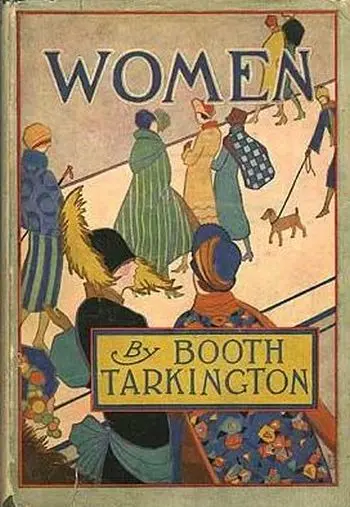
Women
Booth Tarkington
THE CLASSIC COLLECTION · 1919
"The Gibson Upright" by Booth Tarkington and Harry Leon Wilson is a play written in the early 20th century that delves into the dynamics between labor and management within a piano factory. The narrative follows Andrew Gibson, the owner of the factory, and Nora Gorodna, a labor organizer and piano tester, as they navigate the complexities of class struggle, workers' rights, and capitalist ideals amid impending labor unrest. Through a series of confrontations and discussions among the characters, the play explores themes of ownership, responsibility, and the moral implications of capitalism. The opening of the play introduces us to Andrew Gibson’s factory office, where we find Gibson preoccupied with the day-to-day operations and tensions arising among his workers. Nora Gorodna is introduced as a key character, engaging in work on a Gibson piano as she prepares for an interview with Mr. Mifflin, a journalist and socialist. As labor disputes escalate, various workers confront Gibson with their grievances, revealing their dissatisfaction with wages and working conditions. With the factory facing potential strikes, the tensions unfold chaotically among the workers, imploring discussions about ownership and the rationale behind their strikes. The characters exemplify different viewpoints regarding capitalism and labor rights, setting the stage for conflict and resolution as the narrative progresses.
Introduction adapted from the source catalogue; source summaries may be automatically generated.
Free to read · English · 19,744 words · No account needed
MAKE TIME FOR A GOOD BOOK
On by default. Untick to stop anonymous reading totals. Each page counts after 10 seconds in view. How this works.
Anonymous counting is on unless you have switched it off.
[He goes out jauntily. GIBSON has never moved from his chair; he turns his head, still not rising, and looks fixedly at NORA. She slowly lifts her head, meets his eye; her head sinks again. He rises and slowly walks over to her, looking down at her. Then, bending still lower, she begins to cry.]
GIBSON: Well, Nora, what was the matter with it?
NORA [not looking up]: I don't know. What was?
GIBSON: You needed a manager to do what I had been doing.
NORA: Couldn't we have learned? Couldn't one of us?
GIBSON: One of you did--Hill.
NORA: But he left!
GIBSON: Why did Hill leave?
NORA: Other people offered him more money.
GIBSON: Yes; he was the one man that all the rest of you depended on. He
was worth more.
NORA: But were you worth all that you took? You took all that the
business made.
GIBSON: Yes; and last year it was fifty thousand.
NORA: Were you actually worth that much to it?
GIBSON: Other men in the business think so. [Shows her a letter.] Here's an offer from the Coles-Hibbard people, out in Cleveland, of that much salary to do for them what I did here.
NORA: It isn't right; you pay labour only what you have to pay.
GIBSON: The Coles-Hibbard people offer to pay me what they'd have to, and they're pretty hard-headed men. The whole world pays only what it has to.
NORA: It isn't right! It isn't right!
GIBSON: Last winter I saw you in a three-dollar seat listening to Caruso. Have you ever given that much to the organ grinder who comes under these windows?
NORA: Will it always be so?
GIBSON: I don't know. But it's so now.
NORA: But will the plan always fail?
GIBSON: I think it will until human beings are as near alike as the ants and bees are. Your system is in full effect with them, but we--we strive; even in this fellowship here of yours the striving began to show.
NORA [looking up at him appealingly]: But are these inequalities
right?
GIBSON [gently, rather sadly]: I don't know. I only know what is.
NORA: Well--I'm whipped.
[Smiles ruefully, away from him; then she turns again to
him.]
Are you going to accept that offer?
GIBSON: What do you say?
[Her head droops again. Angry voices are heard, growing louder as they approach. The door is thrown open, and the members of the committee, noisily talking, appear in the doorway.]
FRANKEL: It was a bum deal all through!
SHOMBERG: Shovin' his run-down factory off onto us!
RILEY [fiercely]: You never give us no deed to this plant, Mr. Gibson!
Your reading position is saved on this browser. Take it to another device with a library code. Reading pages adapt to text, rather than matching a printed edition.
Booth Tarkington
Booth Tarkington
Booth Tarkington
Booth Tarkington
BEHIND THE BOOK
This eBook is for the use of anyone anywhere in the United States and most other parts of the world at no cost and with almost no restrictions whatsoever. You may copy it, give it away or re-use it under the terms of the Project Gutenberg License included with this eBook or online at www.gutenberg.org. If you are not located in the United States, you will have to check the laws of the country where you are located before using this eBook. Read the source licence.
The original source file, including credits and licence, is retained by this library. Request an original-format copy at no charge. Please include the book title and Project Gutenberg identifier #13275.
KEEP YOUR CURIOSITY GOING
Maurice Baring
W. B. (William Butler) Yeats
Edward Martyn

John Brougham & Charlotte Brontë
Marguerite Merington
Leonid Andreyev