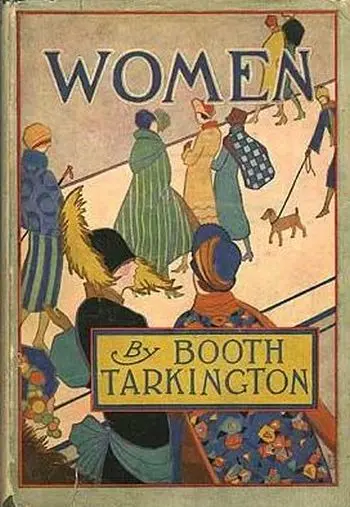
Women
Booth Tarkington
THE CLASSIC COLLECTION · 1919
"The Gibson Upright" by Booth Tarkington and Harry Leon Wilson is a play written in the early 20th century that delves into the dynamics between labor and management within a piano factory. The narrative follows Andrew Gibson, the owner of the factory, and Nora Gorodna, a labor organizer and piano tester, as they navigate the complexities of class struggle, workers' rights, and capitalist ideals amid impending labor unrest. Through a series of confrontations and discussions among the characters, the play explores themes of ownership, responsibility, and the moral implications of capitalism. The opening of the play introduces us to Andrew Gibson’s factory office, where we find Gibson preoccupied with the day-to-day operations and tensions arising among his workers. Nora Gorodna is introduced as a key character, engaging in work on a Gibson piano as she prepares for an interview with Mr. Mifflin, a journalist and socialist. As labor disputes escalate, various workers confront Gibson with their grievances, revealing their dissatisfaction with wages and working conditions. With the factory facing potential strikes, the tensions unfold chaotically among the workers, imploring discussions about ownership and the rationale behind their strikes. The characters exemplify different viewpoints regarding capitalism and labor rights, setting the stage for conflict and resolution as the narrative progresses.
Introduction adapted from the source catalogue; source summaries may be automatically generated.
Free to read · English · 19,744 words · No account needed
MAKE TIME FOR A GOOD BOOK
On by default. Untick to stop anonymous reading totals. Each page counts after 10 seconds in view. How this works.
Anonymous counting is on unless you have switched it off.
CARTER: Well, I did want to a long while ago, when we first set down and begun the meeting. I says then, I report on my committee and--
VARIOUS MEMBERS: Oh, for heaven's sake! Go ahead! Cut it out!
CARTER [picking up the sheets]: On the first page is says Soomary.
RILEY: What's that mean?
MRS. SIMPSON: Oh, my goodness!
FRANKEL: Git to the figures!
CARTER: Well, here, on one side it says gross receipts--
SHOMBERG [rubbing his hands]: Ah!
CARTER: What?
SIMPSON [shouting]: Read it!
CARTER: Gross receipts $2,162.43. On the other side it says: "Cash paid
out $19,461.53."
[All are puzzled.]
It didn't sound right to me, even the first time I read it. Looks like he's got the wrong words, crossed over.
FRANKEL: Why, gross receipts last month was over twenty-four thousand
dollars!
SHOMBERG: Yes, and that was a fall off from the month before.
CARTER [rubbing his head]: Well, I don't pretend to understand it, but he told me all them was mostly payments on old sales anyhow.
RILEY: Read it again, read it again!
SIMPSON: Yes, let's see if we can't get what the sense of it is.
CARTER: It says "Gross receipts, $2,162.43"--that's over here. "Cash
paid out, $19,461.53."
[All seem dazed.]
RILEY: What else you got there?
CARTER: As near as it seems to me, just a lot of items.
SALVATORE: Well, we must have a lot of money in the bank; what's the matter we draw that out and divide it?
RILEY: Wait a minute! What's there besides them items?
CARTER: He's got a note. "Note," he says; here it is: He says: "Bank notified us this morning we're overdrawn $59.01."
RILEY: Overdrawn?
SHOMBERG: Then we got to deposit some to our account. Who's got charge of the checks that comes in?
NORA: The bookkeeper has charge, but there aren't any checks.
CARTER: No, they ain't been any checks comin' in for some days; a week or so, or two weeks, you might say. We've looked everywhere for 'em--
FRANKEL [aghast]: You looked all through them letters?
CARTER: They ain't none left in 'em that wasn't took out a good while
ago.
SALVATORE: You ain't looked through the safe, have you?
CARTER: They ain't a one in it; it's got me all puzzled up, I tell you. I was jest waitin' for the meeting to settle it.
FRANKEL: But heaven's sakes! There must be checks comin' in from new
sales!
CARTER: It says here sales has fallen off. So fur this month they was only three instruments sold.
SIMPSON: But, my gosh, this is the end of the month!
CARTER: They was two sold in Council Bluffs and one in Detroit.
[General agitation and excitement.]
Your reading position is saved on this browser. Take it to another device with a library code. Reading pages adapt to text, rather than matching a printed edition.
Booth Tarkington
Booth Tarkington
Booth Tarkington
Booth Tarkington
BEHIND THE BOOK
This eBook is for the use of anyone anywhere in the United States and most other parts of the world at no cost and with almost no restrictions whatsoever. You may copy it, give it away or re-use it under the terms of the Project Gutenberg License included with this eBook or online at www.gutenberg.org. If you are not located in the United States, you will have to check the laws of the country where you are located before using this eBook. Read the source licence.
The original source file, including credits and licence, is retained by this library. Request an original-format copy at no charge. Please include the book title and Project Gutenberg identifier #13275.
KEEP YOUR CURIOSITY GOING
Maurice Baring
W. B. (William Butler) Yeats
Edward Martyn

John Brougham & Charlotte Brontë
Marguerite Merington
Leonid Andreyev