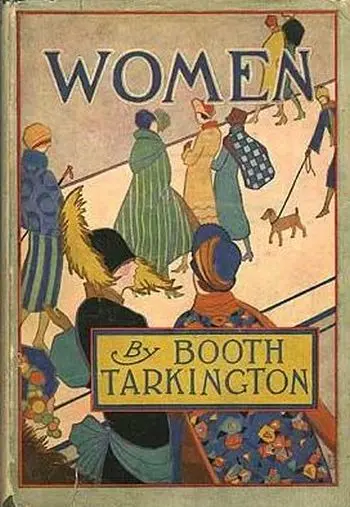
Women
Booth Tarkington
THE CLASSIC COLLECTION · 1919
"The Gibson Upright" by Booth Tarkington and Harry Leon Wilson is a play written in the early 20th century that delves into the dynamics between labor and management within a piano factory. The narrative follows Andrew Gibson, the owner of the factory, and Nora Gorodna, a labor organizer and piano tester, as they navigate the complexities of class struggle, workers' rights, and capitalist ideals amid impending labor unrest. Through a series of confrontations and discussions among the characters, the play explores themes of ownership, responsibility, and the moral implications of capitalism. The opening of the play introduces us to Andrew Gibson’s factory office, where we find Gibson preoccupied with the day-to-day operations and tensions arising among his workers. Nora Gorodna is introduced as a key character, engaging in work on a Gibson piano as she prepares for an interview with Mr. Mifflin, a journalist and socialist. As labor disputes escalate, various workers confront Gibson with their grievances, revealing their dissatisfaction with wages and working conditions. With the factory facing potential strikes, the tensions unfold chaotically among the workers, imploring discussions about ownership and the rationale behind their strikes. The characters exemplify different viewpoints regarding capitalism and labor rights, setting the stage for conflict and resolution as the narrative progresses.
Introduction adapted from the source catalogue; source summaries may be automatically generated.
Free to read · English · 19,744 words · No account needed
MAKE TIME FOR A GOOD BOOK
On by default. Untick to stop anonymous reading totals. Each page counts after 10 seconds in view. How this works.
Anonymous counting is on unless you have switched it off.
CARTER [doggedly]: Well, it's got to vote on it.
NORA: We did vote on Mrs. Simpson last meeting.
CARTER: Well, we got to vote on her and all the rest of 'em this time.
NORA: It didn't seem to settle Mrs. Simpson, did it?
CARTER: Well, it hadn't got so bad then. Now it's got to be settled! We got to git everything fixed up now.
[A frightful dispute is heard in numerous male voices; some speaking Italian, some Yiddish, and some broken English. This grows louder as FRANKEL rushes in, throwing the door shut behind him and leaning against it, wiping his forehead.]
FRANKEL: Life ain't worth livin'! Life ain't worth livin'!
CARTER: Serves you right, Frankel!
[At the filter FRANKEL pours water from the glass upon a
dirty handkerchief and passes the handkerchief over his
forehead.]
FRANKEL: I got to git some peace! I got to collect myself.
CARTER: That shows you ain't got no rights like you claimed. You can't control your labour element.
FRANKEL [bitterly]: I'll control 'em all right! I'll show 'em who's
their master!
[A man's head with shaggy hair and ragged whiskers is thrust in at the factory door. This is POLENSKI.]
POLENSKI [ferociously]: Are you goin' to come out here like a man?
FRANKEL: You bet I'm comin' out there, Polenski! I'll show you who's the man here! You Hunnyacks try to browbeat me!
[As he goes out, babbling fiercely, the howls of a Roman mob
are heard greeting him.]
CARTER: I don't feel no sympathy with him.
NORA: No; I should think not!
[A more distant outbreak of the mob is heard, brief but fierce, and just a moment before it ceases MIFFLIN enters, beaming. He is dressed as usual, with his umbrella and the same old magazines and newspapers under his arm.]
MIFFLIN: Everything is lovely! How do you do, Miss Gorodna! Carter, old fellow! It's a great morning, a great morning! Mr. Gibson drove me down in his car. It's wonderful to feel the inspiration it's going to be for an ex-capitalist to see this place and its harmony. My phrase for it is "harmonized industry." It will mark an epoch for him.
[GIBSON comes in. MIFFLIN greets him.]
MIFFLIN: Ah, Mr. Gibson! You'll see a difference! You'll see a
difference!
GIBSON: Yes, I do. Good morning, Miss Gorodna!
NORA [just barely looking round]: Good morning, Mr. Gibson.
Your reading position is saved on this browser. Take it to another device with a library code. Reading pages adapt to text, rather than matching a printed edition.
Booth Tarkington
Booth Tarkington
Booth Tarkington
Booth Tarkington
BEHIND THE BOOK
This eBook is for the use of anyone anywhere in the United States and most other parts of the world at no cost and with almost no restrictions whatsoever. You may copy it, give it away or re-use it under the terms of the Project Gutenberg License included with this eBook or online at www.gutenberg.org. If you are not located in the United States, you will have to check the laws of the country where you are located before using this eBook. Read the source licence.
The original source file, including credits and licence, is retained by this library. Request an original-format copy at no charge. Please include the book title and Project Gutenberg identifier #13275.
KEEP YOUR CURIOSITY GOING
Maurice Baring
W. B. (William Butler) Yeats
Edward Martyn

John Brougham & Charlotte Brontë
Marguerite Merington
Leonid Andreyev