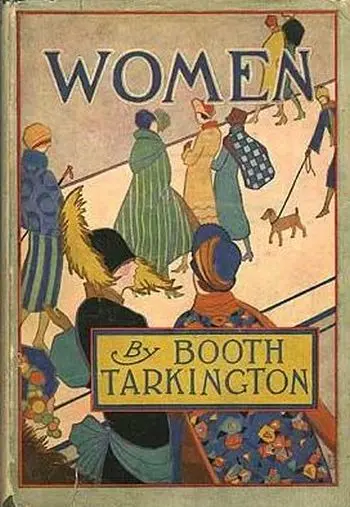
Women
Booth Tarkington
THE CLASSIC COLLECTION · 1919
"The Gibson Upright" by Booth Tarkington and Harry Leon Wilson is a play written in the early 20th century that delves into the dynamics between labor and management within a piano factory. The narrative follows Andrew Gibson, the owner of the factory, and Nora Gorodna, a labor organizer and piano tester, as they navigate the complexities of class struggle, workers' rights, and capitalist ideals amid impending labor unrest. Through a series of confrontations and discussions among the characters, the play explores themes of ownership, responsibility, and the moral implications of capitalism. The opening of the play introduces us to Andrew Gibson’s factory office, where we find Gibson preoccupied with the day-to-day operations and tensions arising among his workers. Nora Gorodna is introduced as a key character, engaging in work on a Gibson piano as she prepares for an interview with Mr. Mifflin, a journalist and socialist. As labor disputes escalate, various workers confront Gibson with their grievances, revealing their dissatisfaction with wages and working conditions. With the factory facing potential strikes, the tensions unfold chaotically among the workers, imploring discussions about ownership and the rationale behind their strikes. The characters exemplify different viewpoints regarding capitalism and labor rights, setting the stage for conflict and resolution as the narrative progresses.
Introduction adapted from the source catalogue; source summaries may be automatically generated.
Free to read · English · 19,744 words · No account needed
MAKE TIME FOR A GOOD BOOK
On by default. Untick to stop anonymous reading totals. Each page counts after 10 seconds in view. How this works.
Anonymous counting is on unless you have switched it off.
GIBSON: Would you mind staying, Miss Gorodna? Miss Gorodna knows more about one side of this factory than I do, I'm afraid, Mr. Mifflin. We may need her for reference, especially as she seems to be the ringleader of the insurgents.
MIFFLIN [with jovial reproach]: Now, now! Before we come to that, Mr. Gibson, suppose we get at the origin of this interesting product. [He waves to the sample piano.] Let's see! I understand it was never your own creation, Mr. Gibson; that you inherited this factory from your father.
GIBSON: Oh, no, I didn't.
NORA [challenging]: What! [She checks herself.] I beg your pardon!
GIBSON: The piano factory I inherited from my father was about one third
this size.
MIFFLIN [genially; always genial]: Nevertheless, you inherited it. We know that everything grows with the times, naturally. Let us simply state that it was a capitalistic family inheritance.
NORA [under her breath but emphatically]: Yes!
MIFFLIN: Up to the time of your inheriting it, you, I suppose, had led the usual life of pleasure of the wealthy young man?
GIBSON: I'd been through school and college and through every department of the factory. That wasn't hard; it was a pretty run-down factory, Mr. Mifflin.
MIFFLIN: And then at your father's death the lives and fortunes, souls and bodies of all these workmen passed into your hands?
GIBSON: Not quite that; there were only forty-one workmen, and nineteen of them didn't stay when father died. They got other jobs before I could stop them.
MIFFLIN: And how many men have you now?
GIBSON: I believe there are one hundred and seventy-five on the pay roll
now.
MIFFLIN: One hundred and seventy-five [with gusto] labourers!
GIBSON: Some of them are; some of them are orators.
MIFFLIN [jovially]: Ah, I'm afraid that's hard on Miss Gorodna.
GIBSON [quietly]: She's both.
MIFFLIN: I understand you are not fighting the labour unions?
GIBSON: No. The workmen themselves declined to unionize the factory.
MIFFLIN: Mr. Gibson, when your father began manufacturing "The Gibson
Upright"--
GIBSON: He didn't. He made a very fine piano--and only a few of them. It was "The Gibson Upright" that saved the factory. You see, with this model we began to get on a quantity-production basis. That's why the business has grown and is growing.
MIFFLIN: You mean that "The Gibson Upright" is the reason for the present great prosperity of this plant?
GIBSON: Yes.
MIFFLIN: Now be careful, Mr. Gibson; I'm going to ask a trap question. [Wagging his pencil at him.] What is the reason for "The Gibson Upright?"
GIBSON: Do you mean who designed it?
Your reading position is saved on this browser. Take it to another device with a library code. Reading pages adapt to text, rather than matching a printed edition.
Booth Tarkington
Booth Tarkington
Booth Tarkington
Booth Tarkington
BEHIND THE BOOK
This eBook is for the use of anyone anywhere in the United States and most other parts of the world at no cost and with almost no restrictions whatsoever. You may copy it, give it away or re-use it under the terms of the Project Gutenberg License included with this eBook or online at www.gutenberg.org. If you are not located in the United States, you will have to check the laws of the country where you are located before using this eBook. Read the source licence.
The original source file, including credits and licence, is retained by this library. Request an original-format copy at no charge. Please include the book title and Project Gutenberg identifier #13275.
KEEP YOUR CURIOSITY GOING
Maurice Baring
W. B. (William Butler) Yeats
Edward Martyn

John Brougham & Charlotte Brontë
Marguerite Merington
Leonid Andreyev