
Last letters from the living dead man
David Patterson (Spirit) Hatch
THE CLASSIC COLLECTION · 1915
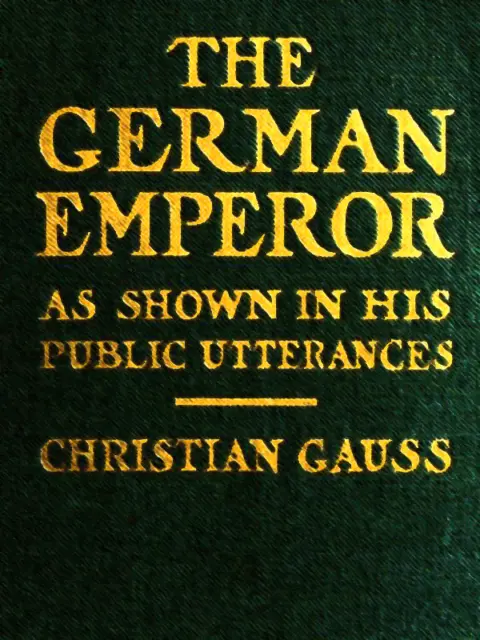
"The German Emperor as Shown in His Public Utterances" by Christian Gauss is a historical account written in the early 20th century. The book captures the many speeches made by German Emperor William II, revealing his perspectives on various national and international issues during his reign, particularly around the turn of the 20th century and the lead-up to World War I. The opening of the work introduces the context of the Emperor's public statements and sets the stage for a deeper examination of his views on governance, the military, and social issues. It provides a preface that emphasizes the Emperor's direct involvement in political discourse, contrasting him with his predecessors who relied on their chancellors. Gauss notes the vast number of speeches given by William II and maintains that his aim is to present a faithful representation of the Emperor's rhetoric. The author hints at the fluctuating relations and ideas exchanged with other nations, the Emperor's handling of internal politics regarding the Social Democratic movement, and his attempts to shape the identity of Germany through a powerful military presence and imperialist rhetoric.
Introduction adapted from the source catalogue; source summaries may be automatically generated.
Free to read · English · 74,625 words · No account needed
MAKE TIME FOR A GOOD BOOK
On by default. Untick to stop anonymous reading totals. Each page counts after 10 seconds in view. How this works.
Anonymous counting is on unless you have switched it off.
As a testimony to the industry of the Fatherland, after the diligent labors of the imperial dockyards, this vessel now stands before us ready to be given over to its element. Thou shalt now be enrolled in the German navy. Thou shalt serve in the protection of the Fatherland to bring defiance and annihilation to the enemy. The names of the ships which belong to the same class are taken from the old Germanic sagas. Therefore thou also shalt hark back to the ancient time of our ancestors, to the powerful divinity who was worshipped and feared by all our German seafaring forefathers and whose mighty realm stretched from the north even unto the south pole, in whose province the northern battles were fought, and whence death and destruction were brought into the land of the enemy. Thou shalt bear the name of this great and mighty god. Mayst thou prove thyself worthy of it! So do I christen thee with the name of Ægir.
Historians of modern Germany have discussed and explained in various ways the causes of the retirement of Bismarck, the "Iron Chancellor." From the moment he became "Minister President and Minister of Foreign Affairs," in 1862, his hand was the hand that guided German policy, and his was the genius that presided over and shaped the unification of Germany and the building of the empire. It has been truly said that the biography of Bismarck is the history of German union. He had been born in Brandenburg and spent his life in the service of the Prussian Kings. It was he who in the dark days preceding the victories of the sixties had given William I heart and had prevented him from giving up his task. It was, therefore, a great shock to the German world to learn that, two years after the accession of William II, the great founder of German unity had been forced into retirement. There had been rumors of previous disagreements. The German Chancellor is responsible not to the Reichstag but solely to the Emperor; he takes the responsibility of shaping the imperial policy. It was said that Bismarck resented certain interference with his authority in his own cabinet. It is certain that he looked with disfavor on the Emperor's policy with regard to labor legislation. With regard to the attitude toward Russia there was likewise disagreement, and Bismarck opposed the Emperor's visit to Constantinople. But aside from these questions of policy, there were deep psychological incompatibilities. Crabbed age and romantic youth could not live together. Furthermore, the Emperor wished to take the credit for initiating and carrying through his own policies. He was not content to be a shadow king. Bismarck, after nearly forty years of service, was not willing to be a puppet chancellor. He insisted on the form of cabinet government decreed in 1852. The Emperor's disposition of mind may be gathered from the following extracts from a speech delivered shortly before Bismarck's retirement, and it should be remembered that at this time Bismarck was far from being an enthusiastic supporter of certain measures then taking shape in the mind of William II. On the 5th of March, 1890, the Emperor announced to the Brandenburgers: "All those who wish to help me in this work I bid heartily welcome, whoever they may be; but all those (whoever they may be) who oppose me in this work I shall smash to pieces" (zerschmettern). Bismarck was forced to offer his resignation two weeks later. Besides his ducal title, he was given the honorary title of general of cavalry, with the rank of field-marshal. Because of his opposition, he was treated in the following years with extreme coolness and occasionally as an enemy. The German ambassador at Vienna was instructed from Berlin, on the occasion of the marriage of Bismarck's son, not to accept an invitation to the wedding. Foreign ambassadors were informed that for the Emperor there were two Bismarcks: the former responsible servant and the present irresponsible subject. The honors given him were not generally honors due a great ex-chancellor, but honors due a military officer. "Living," said Bismarck, "they give me the honors of the dead." On this, his eightieth birthday, the Reichstag voted down the proposal that they send him their congratulations. The Emperor, with an exclusively military suite, however, paid him this visit and presented him with a sword engraved with his arms and with the arms of the conquered provinces, Alsace-Lorraine. In all probability, Bismarck felt the lack of mention of his services as Chancellor; his entirely diplomatic reply printed below would seem to indicate this.
Your reading position is saved on this browser. Take it to another device with a library code. Reading pages adapt to text, rather than matching a printed edition.
BEHIND THE BOOK
This eBook is for the use of anyone anywhere in the United States and most other parts of the world at no cost and with almost no restrictions whatsoever. You may copy it, give it away or re-use it under the terms of the Project Gutenberg License included with this eBook or online at www.gutenberg.org. If you are not located in the United States, you will have to check the laws of the country where you are located before using this eBook. Read the source licence.
The original source file, including credits and licence, is retained by this library. Request an original-format copy at no charge. Please include the book title and Project Gutenberg identifier #43666.
KEEP YOUR CURIOSITY GOING
David Patterson (Spirit) Hatch

David Patterson (Spirit) Hatch

David Patterson (Spirit) Hatch
Cécile Tormay

Moritz Busch
John L. Ransom