
Last letters from the living dead man
David Patterson (Spirit) Hatch
THE CLASSIC COLLECTION · 1915
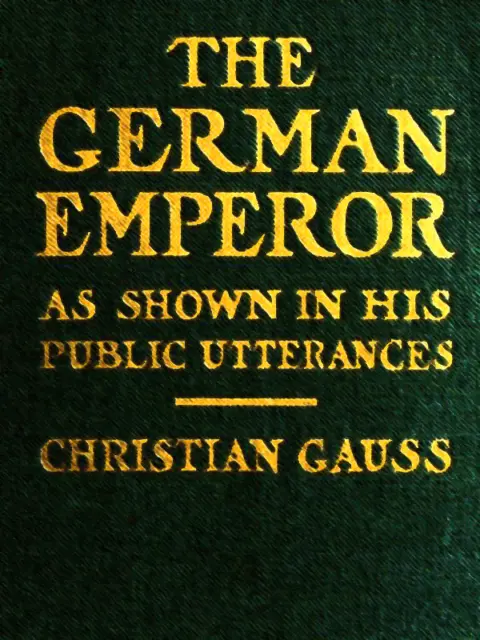
"The German Emperor as Shown in His Public Utterances" by Christian Gauss is a historical account written in the early 20th century. The book captures the many speeches made by German Emperor William II, revealing his perspectives on various national and international issues during his reign, particularly around the turn of the 20th century and the lead-up to World War I. The opening of the work introduces the context of the Emperor's public statements and sets the stage for a deeper examination of his views on governance, the military, and social issues. It provides a preface that emphasizes the Emperor's direct involvement in political discourse, contrasting him with his predecessors who relied on their chancellors. Gauss notes the vast number of speeches given by William II and maintains that his aim is to present a faithful representation of the Emperor's rhetoric. The author hints at the fluctuating relations and ideas exchanged with other nations, the Emperor's handling of internal politics regarding the Social Democratic movement, and his attempts to shape the identity of Germany through a powerful military presence and imperialist rhetoric.
Introduction adapted from the source catalogue; source summaries may be automatically generated.
Free to read · English · 74,625 words · No account needed
MAKE TIME FOR A GOOD BOOK
On by default. Untick to stop anonymous reading totals. Each page counts after 10 seconds in view. How this works.
Anonymous counting is on unless you have switched it off.
My heart bids me express to the men of this province the pleasure which her Majesty and I feel on finding ourselves again within the borders of this beautiful country and on having been received with such enthusiasm by the citizens of our loyal city and of the province. The sentiment that finds expression now in Königsberg proves that it is an entirely unique bond which joins the city and the province to our house. And, in fact, if one looks back upon the history of the country and of the house it becomes evident that great and important portions are common to both. Here it was that the Great Elector, by his own right, created himself the sovereign Duke in Prussia; here his son set the King's crown upon his head; and the sovereign house of Brandenburg thus became one of the European powers. Frederick William I established here his authority as "rocher de bronze"; under Frederick the Great, the province shared in the joys and sorrows of his reign. Then came the difficult time of trial. The great soldier Emperor of the French resided here, and after the power of Prussia had been shattered he let both the city and the country feel his merciless hand. Here, however, the thoughts of raising up and freeing the Fatherland were first put into action. After Tauroggen,[44] when the old, unyielding York stirred up the people with his flaming speeches, came the courageous decision of the Prussian Diet to begin the work of liberation. And here my grandfather, again, by his own right, set the Prussian crown upon his head, once more distinctly emphasizing the fact that it was accorded him by the will of God alone and not by parliament or by any assemblage of the people or by popular vote, and that he thus looked upon himself as the chosen instrument of Heaven and as such performed his duties as regent and sovereign. And adorned with this crown, forty years ago, he rode forth to battle to win the Emperor's crown also. Truly it was a long way to the time of the famous telegram of the Emperor to my late grandmother: "What a change through the providence of God!" This picture would, however, be incomplete if I did not mention one figure which especially in that year had occupied and gripped anew the Prussians and, I may truly say, the whole German people. It is not possible to think of the time of our collapse and our revival, without remembering the figure of Queen Louise. The people of the city of Königsberg and the province of East Prussia likewise saw this angel in human form wandering among them and they were influenced by her and helped her to bear her grievous ills. The noble Queen has been described by many as going about among her subjects, and our people hold her in grateful remembrance. But I think that one thing cannot be sufficiently emphasized, and that is that in the general shattering of our Fatherland, when even the statesmen and leaders of the army gave up everything as lost, the Queen was the only one who never for one moment doubted for the future of the Fatherland. Through her example, through her letters, through her conversation, and through the bringing up of her children she showed the people the way in which to find themselves again. She showed them the way back to religion and with it to a recognition of and a confidence in themselves. She encouraged our people in the thought of rallying about the King again and of winning back our freedom. And after she--a noble martyr--had faded away and enthusiasm flamed forth in the land again and old and young seized their weapons to drive the intruder from the country, then, in spirit, she marched before the colors and inspired the warriors with courage that the great work could be accomplished. What does the noble figure of Queen Louise teach us? It teaches us that, as she once imbued her sons with the one thought of restoring the country's honor and of defending the Fatherland, so we men should cultivate all warlike virtues. As in the time of the liberation young and old rallied to the standard and gave everything they had--when even women and girls did not spare their hair--so we must ever be prepared and keep our equipment intact, in view of the fact that the neighboring powers have made such astounding progress. For only upon our preparedness does our peace rest. And what shall our wives learn from the Queen? They will learn that the chief duty of German women lies not in the province of meetings and club life, not in reaching out after imaginary rights so that they may do as men do, but in the quiet work in the house and in the family. They are to educate the younger generation, especially in obedience and in respect toward their elders. They are to make clear to their children and to their children's children that it is not a question to-day of living their own life at the expense of others or of achieving their own aims at the expense of the Fatherland, but that they must singly and solely keep the Fatherland before their eyes and singly and solely devote all their powers and their thoughts to the good of the Fatherland. That is the lesson which has been bequeathed to us by this noble figure whom the Fatherland and the citizens of this city have so beautifully described on her simple monument as "the good genius of the Prussian people." I cherish the hope that all of the people of East Prussia who have gathered here will understand me and that, as they return again to their work and their occupation, they will think of these things. We must co-operate for the good of the Fatherland, no matter who and where we are. And for me, too, the conduct of this vanished Queen will be an example, as it was for my grandfather. Looking upon myself as the instrument of the Lord, without regard for daily opinions and intentions, I go my way, which is devoted solely and alone to the welfare and peaceful development of the Fatherland. But in this work I need the co-operation of every one in the country and to this co-operation I would like to invite you also. I empty my glass in the hope that this attitude may ever prevail in the province of East Prussia and that it may lend me its assistance in my labors. Long live the province of East Prussia!--Long may she prosper!
Your reading position is saved on this browser. Take it to another device with a library code. Reading pages adapt to text, rather than matching a printed edition.
BEHIND THE BOOK
This eBook is for the use of anyone anywhere in the United States and most other parts of the world at no cost and with almost no restrictions whatsoever. You may copy it, give it away or re-use it under the terms of the Project Gutenberg License included with this eBook or online at www.gutenberg.org. If you are not located in the United States, you will have to check the laws of the country where you are located before using this eBook. Read the source licence.
The original source file, including credits and licence, is retained by this library. Request an original-format copy at no charge. Please include the book title and Project Gutenberg identifier #43666.
KEEP YOUR CURIOSITY GOING
David Patterson (Spirit) Hatch

David Patterson (Spirit) Hatch

David Patterson (Spirit) Hatch
Cécile Tormay

Moritz Busch
John L. Ransom