
Last letters from the living dead man
David Patterson (Spirit) Hatch
THE CLASSIC COLLECTION · 1915
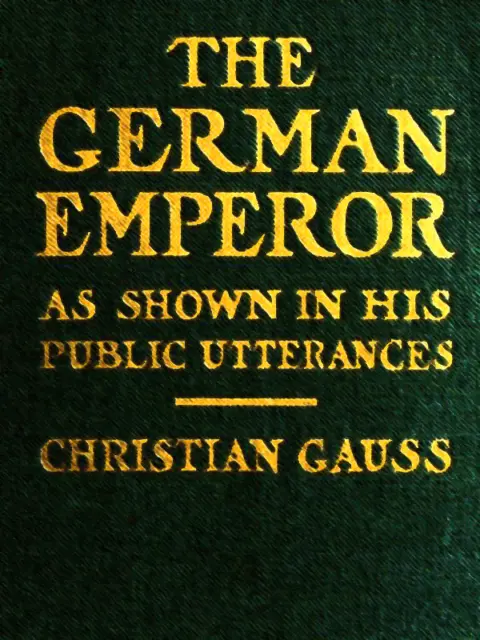
"The German Emperor as Shown in His Public Utterances" by Christian Gauss is a historical account written in the early 20th century. The book captures the many speeches made by German Emperor William II, revealing his perspectives on various national and international issues during his reign, particularly around the turn of the 20th century and the lead-up to World War I. The opening of the work introduces the context of the Emperor's public statements and sets the stage for a deeper examination of his views on governance, the military, and social issues. It provides a preface that emphasizes the Emperor's direct involvement in political discourse, contrasting him with his predecessors who relied on their chancellors. Gauss notes the vast number of speeches given by William II and maintains that his aim is to present a faithful representation of the Emperor's rhetoric. The author hints at the fluctuating relations and ideas exchanged with other nations, the Emperor's handling of internal politics regarding the Social Democratic movement, and his attempts to shape the identity of Germany through a powerful military presence and imperialist rhetoric.
Introduction adapted from the source catalogue; source summaries may be automatically generated.
Free to read · English · 74,625 words · No account needed
MAKE TIME FOR A GOOD BOOK
On by default. Untick to stop anonymous reading totals. Each page counts after 10 seconds in view. How this works.
Anonymous counting is on unless you have switched it off.
During an evening meeting among ourselves Professor Delitzsch had the opportunity, with her Majesty, the Empress, and General Superintendent Dryander, to confer and discuss thoroughly for several hours, during which I remained a passive listener. He, unfortunately, departed from the standpoint of the thoroughgoing historian and Assyriologist and penetrated into the region of theological and religious conclusions and hypotheses, which were hazy and bold. When, however, he came to the New Testament it soon became evident that I could not agree with him in the ideas which he developed concerning the person of the Redeemer, and I was compelled to state my own standpoint, which was diametrically opposed to his. He does not recognize the divinity of Christ and therefore concludes in regard to the Old Testament that it does not refer to Him as the Messiah. Here the Assyriologist and investigating historian ceases and the theologian with all his lights and shades steps in. In this province I can only advise him to go very carefully, step by step, and in any case to ventilate his theories only in theological publications and in the circles of his colleagues and to spare us laymen and especially the Oriental Society, before whose forum all this is out of place. We excavate and read whatever we find and publish it for the advancement of knowledge and history, but not in order to help justify or combat the religious hypotheses of any one of many learned men.
In Delitzsch's case the theologian has run away with the historian, and the latter serves merely as a point of departure for the former. I think it unfortunate that Delitzsch should not have stuck to his original programme, which he developed in former years, namely, on the basis of the discoveries of our society, to ascertain through scientifically approved translations of the Scriptures how far these offer an illustration of the chronicle of the people of Israel; that is, enlightenment as to historical events, customs, and uses, traditions, politics, legislation, etc.; in other words, how far the undeniably highly developed Babylonian culture came into contact with the Israelites, could work upon them, yes, even impress its stamp upon them, and thereby accomplish, from a purely human point of view, a sort of rehabilitation for the Babylonians, who were, according to the Old Testament at least, a very crude, shameful, and one-sided people. That was his original intention, at least as I understood it, and a province very fruitful and interesting to us all, the investigation, explanation, and exposition of which must have interested us laymen to the highest degree and would have demanded our deepest gratitude. But he should have stuck to this. Unfortunately, however, in his zeal he has overshot the mark. As was to be expected, the excavations brought to light communications which bear in a religious way upon the Old Testament. He should have collated this material and pointed out and explained coincidences, when such occurred, but he should have left it to the listener to draw for himself all purely religious conclusions. In this way his discourse would have commanded the interest and good-will of the lay public. That, unfortunately, he has not done. Pretending that he could explain it all on historical and purely human grounds, he has attacked the question of revelation in a very polemical manner and more or less denied it. That was a serious mistake, because he touched many of his hearers in what was deepest and most sacred to them. And whether he was right or wrong--that for the moment is all one, since we are concerned not with a purely scientific gathering of theologians but with laymen of all kinds and conditions--he has overturned and rudely shaken many favorite conceptions and images with which these people connect sacred and cherished ideas and has ruthlessly shaken the foundation of their belief, if he has not swept it away altogether, a thing which only a mighty genius dare be bold enough to undertake and which the study of Assyriology alone does not justify. Goethe also once treated this subject and pointed out especially that one must be careful before a great, general public to break down only "Terminologiepagoden" [the pagodas of terminology]. The excellent professor, in his zeal, has overlooked the principle that it is very necessary to distinguish between what is and what is not fitting to the place, the public, etc. As a theological specialist he can, through the avenue of special publications, express for his circle of colleagues his theses, hypotheses, and theories as well as his convictions, which it would not do to express in a popular lecture or book.
Your reading position is saved on this browser. Take it to another device with a library code. Reading pages adapt to text, rather than matching a printed edition.
BEHIND THE BOOK
This eBook is for the use of anyone anywhere in the United States and most other parts of the world at no cost and with almost no restrictions whatsoever. You may copy it, give it away or re-use it under the terms of the Project Gutenberg License included with this eBook or online at www.gutenberg.org. If you are not located in the United States, you will have to check the laws of the country where you are located before using this eBook. Read the source licence.
The original source file, including credits and licence, is retained by this library. Request an original-format copy at no charge. Please include the book title and Project Gutenberg identifier #43666.
KEEP YOUR CURIOSITY GOING
David Patterson (Spirit) Hatch

David Patterson (Spirit) Hatch

David Patterson (Spirit) Hatch
Cécile Tormay

Moritz Busch
John L. Ransom