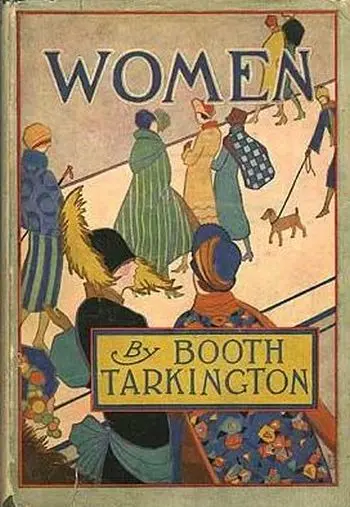
Women
Booth Tarkington
THE CLASSIC COLLECTION · 1899
"The Gentleman from Indiana" by Booth Tarkington is a novel written during the late 19th century. Set in the fictional town of Plattville, Indiana, the story introduces readers to a range of local characters while exploring themes of ambition, politics, and small-town life. At its center is John Harkless, a young man from the East who arrives in Plattville with dreams of revitalizing the struggling "Carlow County Herald" newspaper. At the start of the novel, Harkless's arrival creates a stir among the townspeople, who are intrigued by this outsider. As he settles in, he encounters the challenges of small-town politics, particularly the influence of the "White Caps," a local group that represents lawlessness and intimidation. Tarkington paints a vivid picture of Plattville's flat landscape and the eccentricities of its residents, all while establishing Harkless's internal conflict as he tries to forge his path in a community that is steeped in tradition. The opening chapters set the stage for Harkless's struggles, not just in the realm of journalism, but also in navigating the complexities of his new environment and the relationships he will form within it.
Introduction adapted from the source catalogue; source summaries may be automatically generated.
Free to read · English · 101,757 words · No account needed
MAKE TIME FOR A GOOD BOOK
On by default. Untick to stop anonymous reading totals. Each page counts after 10 seconds in view. How this works.
Anonymous counting is on unless you have switched it off.
“Doesn't that thrill you, boy?” said Meredith, joining the group about Harkless's chair. “Those fellows are Sophomores, class of heaven knows what. Aren't you feeling a fossil. Father Abraham?”
A banjo chattered on the lawn to the north, and soon a mixed chorus of girls and boys sang from there:
“O, 'Arriet, I'm waiting, waiting alone out 'ere.”
Then a piano across the street sounded the dearthful harmonies of
Chopin's Funeral March.
“You may take your choice,” remarked Meredith, flicking a spark over the rail in the ash of his cigar, “Chopping or Chevalier.”
“Chopin, my friend,” said the lady who had attached herself to Harkless. She tapped Tom's shoulder with her fan and smiled, graciously corrective.
“Thank you, Miss Hinsdale,” he answered, gratefully. “And as I, perhaps, had better say, since otherwise there might be a pause and I am the host, we have a wide selection. In addition to what is provided at present, I predict that within the next ten minutes a talented girl who lives two doors south will favor us with the Pilgrims' Chorus, piano arrangement, break down in the middle, and drift, into 'Rastus on Parade,' while a double quartette of middle-aged colored gentlemen under our Jim will make choral offering in our own back yard.”
“My dear Tom,” exclaimed Miss Hinsdale, “you forget Wetherford Swift!”
“I could stand it all,” put forth the widower, “if it were not for
Wetherford Swift.”
“When is Miss Sherwood coming home?” asked one of the ladies. “Why does she stay away and leave him to his sufferings?”
“Us to his sufferings,” substituted a bachelor. “He is just beginning;
listen.”
Through all the other sounds of music, there penetrated from an unseen source, a sawish, scraped, vibration of catgut, pathetic, insistent, painstaking, and painful beyond belief.
“He is in a terrible way to-night,” said the widower.
Miss Hinsdale laughed. “Worse every night. The violinist is young Wetherford Swift,” she explained to Harkless. “He is very much in love, and it doesn't agree with him. He used to be such a pleasant boy, but last winter he went quite mad over Helen Sherwood, Mr. Meredith's cousin, our beauty, you know--I am so sorry she isn't here; you'd be interested in meeting her, I'm sure--and he took up the violin.”
“It is said that his family took up chloroform at the same time,” said
the widower.
“His music is a barometer,” continued the lady, “and by it the neighborhood nightly observes whether Miss Sherwood has been nice to him or not.”
“It is always exceedingly plaintive,” explained another.
“Except once,” rejoined Miss Hinsdale. “He played jigs when she came home from somewhere or other, in June.”
Your reading position is saved on this browser. Take it to another device with a library code. Reading pages adapt to text, rather than matching a printed edition.
Booth Tarkington
Booth Tarkington
Booth Tarkington
Booth Tarkington
BEHIND THE BOOK
This eBook is for the use of anyone anywhere in the United States and most other parts of the world at no cost and with almost no restrictions whatsoever. You may copy it, give it away or re-use it under the terms of the Project Gutenberg License included with this eBook or online at www.gutenberg.org. If you are not located in the United States, you will have to check the laws of the country where you are located before using this eBook. Read the source licence.
The original source file, including credits and licence, is retained by this library. Request an original-format copy at no charge. Please include the book title and Project Gutenberg identifier #9659.
KEEP YOUR CURIOSITY GOING
Coulson Kernahan

Maurice Baring
Frances Wright
Cécile Tormay

Frederic Jesup Stimson

W. H. P. (William Henry Pope) Jarvis