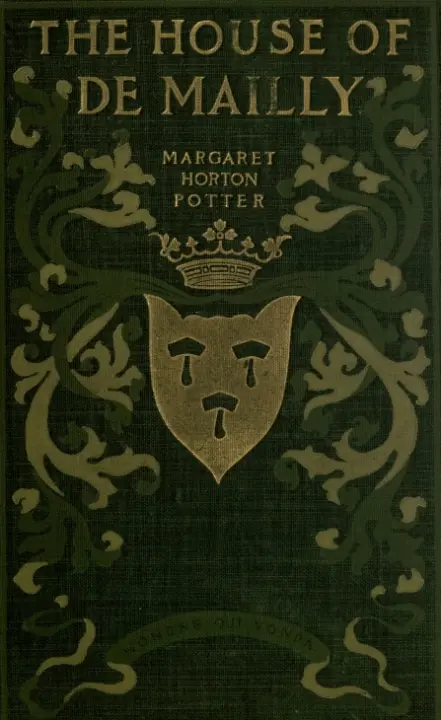
The House of de Mailly
Margaret Horton Potter
THE CLASSIC COLLECTION · 1906
"The Genius" by Margaret Horton Potter is a historical novel written in the early 20th century. Set in 19th century Russia during the reign of Czar Nicholas I, the story revolves around Princess Sophia Ivanovna Gregoriev and her struggles within a loveless marriage to Michael Gregoriev, a powerful and feared official. The narrative explores themes of solitude, desire for companionship, and the societal pressures in a world rife with cruelty and ambition. The beginning of the novel introduces Princess Sophia on New Year's night in 1840, where she finds herself at a low point, expressing her deep longing for a child to a distant figure of Mary, the Virgin. This poignant prologue sets the tone for Sophia's life, marked by isolation and anguish in her tumultuous marriage. As the opening chapters unfold, the narrative shifts to the preparations for a grand ball hosted by her husband, a desperate attempt for social recognition amidst their disgraced lineage. The budding relationship with their son, Ivan, is highlighted, suggesting new hopes as he grows. However, it foreshadows the conflicts that will arise from her husband's ruthless ambition and the unnatural dynamics of their family life.
Introduction adapted from the source catalogue; source summaries may be automatically generated.
Free to read · English · 137,801 words · No account needed
MAKE TIME FOR A GOOD BOOK
On by default. Untick to stop anonymous reading totals. Each page counts after 10 seconds in view. How this works.
Anonymous counting is on unless you have switched it off.
At the entrance of the two young men, de Windt grasping Ivan by the arm, the Grand-Duchess turned, in time to hear their names announced. And after a moment, she summoned them to her, with a slight gesture. Then, breaking off her argument with Ivan's future biographer, she held out a hand for de Windt to salute.
"Vladimir Vassilyitch, I expected you.--Have you enrolled yourself under Zaremba yet, for proper instruction?"
De Windt laughed. "Your Highness should get his Majesty and my Colonel to claim less time of me!"
"Bah, Monsieur Impertinence! The yacht club's green tables see more of you than your Colonel, as we all know.--Whom have you brought me?"
"My brother officer and good friend, Lieutenant Ivan Mikhailovitch
Gregoriev, lately of Moscow."
Her Highness started and straightened. "Gregoriev!--The son of Gregoriev of Moscow, here!--Are you aware, sir--" Suddenly she stopped, her gaze meeting that of Ivan, and noting the deathly pallor of his face, the sudden fire in his eyes. With an effort, she restrained herself, and presently observed, in a different tone:
"I have heard of your father, Lieutenant.--Are you a musician?"
A shred of color crept back into Ivan's lips; but his voice was unsteady as he said, in a low, rather rough voice: "I ask the pardon of your Royal Highness, and beg leave to go.--The fault and the mistake of my presence are entirely mine!"
At these words, de Windt turned towards him, sharply; but their hostess interrupted his first syllable:
"You have made no mistake, sir. Vladimir Vassilyitch is responsible for all that he does. You are, I presume, a lover of music?"
"Indeed yes, your Highness!"
"You play?"
Ivan, glancing towards the piano, encountered the keen look of the world's master-pianist. "I have played at home, as a boy, for--my mother," he answered, the last word uttered very low.
A brief silence followed his speech. The little scene was unusual, and had by this time caught the attention of the room. Ivan felt the hostile fire of many eyes fixed on him, and perceived dimly what they had resolved:--that he was to be tried, here, as others had been before him--rather cruelly.
Finally the Duchess herself glanced towards the piano. "Anton, have you
marked your expression?"
"That is finished.--But I have not as yet suggested a fingering for the
cadenza."
"No matter.--Ivan Gregoriev, Monsieur Rubinstein has brought us a new manuscript--a barcarolle, you said, Anton?--finished to-day, and brought here to be played to me. He writes a clear hand. Sit down, then, and let us hear you interpret it."
"I, madame!"
"I said so."
Your reading position is saved on this browser. Take it to another device with a library code. Reading pages adapt to text, rather than matching a printed edition.
Margaret Horton Potter
Margaret Horton Potter
Margaret Horton Potter
BEHIND THE BOOK
This eBook is for the use of anyone anywhere in the United States and most other parts of the world at no cost and with almost no restrictions whatsoever. You may copy it, give it away or re-use it under the terms of the Project Gutenberg License included with this eBook or online at www.gutenberg.org. If you are not located in the United States, you will have to check the laws of the country where you are located before using this eBook. Read the source licence.
The original source file, including credits and licence, is retained by this library. Request an original-format copy at no charge. Please include the book title and Project Gutenberg identifier #22004.
KEEP YOUR CURIOSITY GOING
Cécile Tormay

Moritz Busch
Coulson Kernahan
John L. Ransom

Maurice Baring
Frances Wright