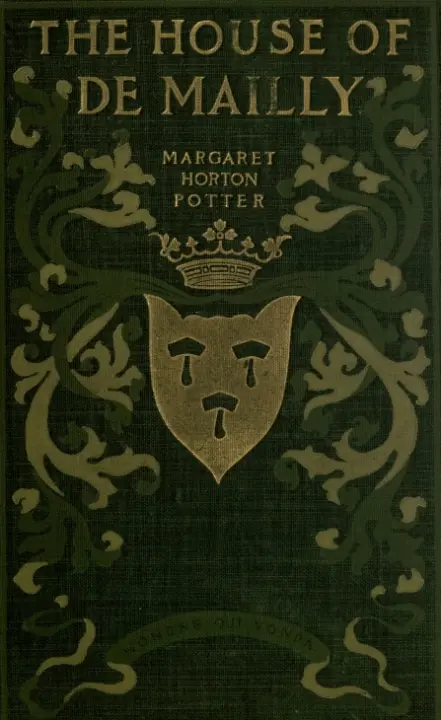
The House of de Mailly
Margaret Horton Potter
THE CLASSIC COLLECTION · 1906
"The Genius" by Margaret Horton Potter is a historical novel written in the early 20th century. Set in 19th century Russia during the reign of Czar Nicholas I, the story revolves around Princess Sophia Ivanovna Gregoriev and her struggles within a loveless marriage to Michael Gregoriev, a powerful and feared official. The narrative explores themes of solitude, desire for companionship, and the societal pressures in a world rife with cruelty and ambition. The beginning of the novel introduces Princess Sophia on New Year's night in 1840, where she finds herself at a low point, expressing her deep longing for a child to a distant figure of Mary, the Virgin. This poignant prologue sets the tone for Sophia's life, marked by isolation and anguish in her tumultuous marriage. As the opening chapters unfold, the narrative shifts to the preparations for a grand ball hosted by her husband, a desperate attempt for social recognition amidst their disgraced lineage. The budding relationship with their son, Ivan, is highlighted, suggesting new hopes as he grows. However, it foreshadows the conflicts that will arise from her husband's ruthless ambition and the unnatural dynamics of their family life.
Introduction adapted from the source catalogue; source summaries may be automatically generated.
Free to read · English · 137,801 words · No account needed
MAKE TIME FOR A GOOD BOOK
On by default. Untick to stop anonymous reading totals. Each page counts after 10 seconds in view. How this works.
Anonymous counting is on unless you have switched it off.
In one way, indeed, the young man had hardly needed this active proof of his ability; for, for some time now, there had been growing in him a quality much needed by his kind: a stern, dogged, ineradicable belief in himself and his eventual recognition. Rooted, as, to the shame of mankind, has been the lot of so many of the world's true great, in the deep bitterness of non-recognition; growing, sturdily, in the midst of beating storms and freezing snows of jealousy, malice, criticism incredibly stupid, misfortunes persistent and discouraging; such natures as these are bound at last to blossom, gloriously, in the sunlight of success; and live, nourished by the quiet dews of appreciation; unless, indeed, as in certain cases, the growth has been too delicate, too exquisite, too sensitive to outlive the probation years, and fades before it has come into maturity, while the bloom of full achievement is yet in the bud. But Ivan was not of these last. His stubbornness was great; and he labored on, doggedly, sore as was his heart, till June brought release from his labors at the Conservatoire. Then he betook himself and his few belongings joyously back to Vevey, where surroundings of natural beauty, rest, isolation, the absence of unwelcome tasks, gave him back his strength, and restored both his hope and his ambition.
During this period his great task was always "The Boyar." But, in the intervals between his stretches of regular work, he undertook certain lighter things, based on themes jotted down in his note-book at odd moments. It was, indeed, during this summer,--though Kashkine has erroneously attributed them to a later year, that he produced the celebrated "Songs of the Steppes," those "Chansons sans Paroles," which the world hums still, even after a vogue which would, in six months, have killed anything less original, less intangibly charming and uncommon. These finished--and the sheets of manuscript were printed, eighteen months later, almost without change--he caught a sudden fever of entomology: hunted daily for specimens, but preserved, eventually, only six of his captures: a moth, silver and green; a butterfly of steely, iridescent blue; a solemn, black-coated cricket; a bee bound round with the five golden rings of Italy; a tiny, rainbow-hued humming-bird, found dead in a fast-shut moon-flower; and, finally, a slender, bright-winged dragon-fly. These, humanely chloroformed and pasted upon cards, Ivan studied, wondering at his own interest; nor understood its reason till, by the dark and tortuous ways of unconscious cerebration, there sprang from his brain, Minerva-like, the six dances which are incorporated in the most charming ballet of his time the famous "Reve d'Ete." When, a year later, immediately before its first production, Monsieur Venara, maitre de ballet of the Royal Opera, asked the composer for a special pas for his favorite premiere danseuse, Ivan meditated, and returned in spirit to the fields of Vevey, hunting for one more sprite of field or wood. In vain. He could think of nothing but an old familiar hedge of eglantine. And to that, finally, was written the "Rose Waltz" to which Mademoiselle Pakrovsky, Venara's "discovery," later danced her way through La Scala to Paris, that end and aim of the dancer's dreams.
Your reading position is saved on this browser. Take it to another device with a library code. Reading pages adapt to text, rather than matching a printed edition.
Margaret Horton Potter
Margaret Horton Potter
Margaret Horton Potter
BEHIND THE BOOK
This eBook is for the use of anyone anywhere in the United States and most other parts of the world at no cost and with almost no restrictions whatsoever. You may copy it, give it away or re-use it under the terms of the Project Gutenberg License included with this eBook or online at www.gutenberg.org. If you are not located in the United States, you will have to check the laws of the country where you are located before using this eBook. Read the source licence.
The original source file, including credits and licence, is retained by this library. Request an original-format copy at no charge. Please include the book title and Project Gutenberg identifier #22004.
KEEP YOUR CURIOSITY GOING
Cécile Tormay

Moritz Busch
Coulson Kernahan
John L. Ransom

Maurice Baring
Frances Wright