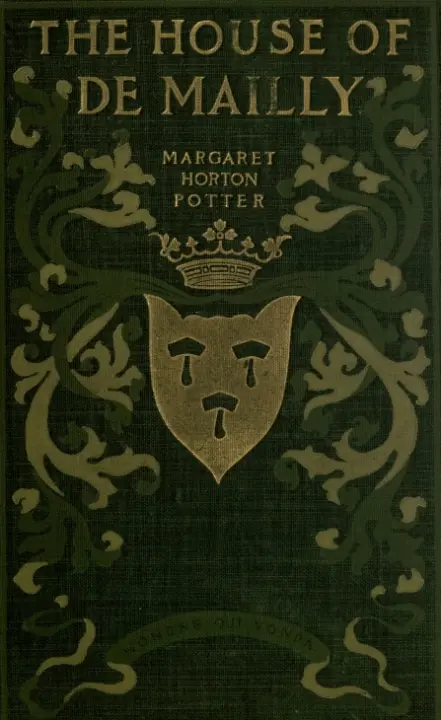
The House of de Mailly
Margaret Horton Potter
THE CLASSIC COLLECTION · 1906
"The Genius" by Margaret Horton Potter is a historical novel written in the early 20th century. Set in 19th century Russia during the reign of Czar Nicholas I, the story revolves around Princess Sophia Ivanovna Gregoriev and her struggles within a loveless marriage to Michael Gregoriev, a powerful and feared official. The narrative explores themes of solitude, desire for companionship, and the societal pressures in a world rife with cruelty and ambition. The beginning of the novel introduces Princess Sophia on New Year's night in 1840, where she finds herself at a low point, expressing her deep longing for a child to a distant figure of Mary, the Virgin. This poignant prologue sets the tone for Sophia's life, marked by isolation and anguish in her tumultuous marriage. As the opening chapters unfold, the narrative shifts to the preparations for a grand ball hosted by her husband, a desperate attempt for social recognition amidst their disgraced lineage. The budding relationship with their son, Ivan, is highlighted, suggesting new hopes as he grows. However, it foreshadows the conflicts that will arise from her husband's ruthless ambition and the unnatural dynamics of their family life.
Introduction adapted from the source catalogue; source summaries may be automatically generated.
Free to read · English · 137,801 words · No account needed
MAKE TIME FOR A GOOD BOOK
On by default. Untick to stop anonymous reading totals. Each page counts after 10 seconds in view. How this works.
Anonymous counting is on unless you have switched it off.
"Irresponsible; and--too much money."
"Um--a--oh--this new man we hear of--Monsieur Kashkine, of Moscow."
"He's literary, rather than musical. No real time for classes."
"Wieniawski, then?"
"By nature a virtuoso. It would be rather a pity to waste his technique and pin him down to a teacher's life. With a composer, the thing's different. One can always find time for composition, even while teaching. But practice knocks any possibility of other work on the head at once."
There was a pause. Ivan, at the end of his suggestions, began to feel puzzled at Rubinstein's coming to him with such questions at all. Presently, however, he decided that this was not the real object of the visit; and asked, with a change of tone: "Well, have you some new work for me?--Some copying?"
"I've got some new work for you, certainly. But not copying."
"What then?"
"Well--this. I want you to leave here for Moscow, with me, in five days; and prepare to take Serov's place in the new Conservatoire."
"What!" The exclamation was low, and absolutely incredulous.
"You heard me. Aren't you perfectly well fitted to teach theory and harmony laws, and the principles of composition, to a lot of ignoramuses, at one hundred roubles a month?"
Before Nicholas had finished, Ivan jumped to his feet and began to pace up and down the attic-room. In his cheeks there appeared two vivid spots of red; and his eyes shone, peculiarly. Rubinstein sat puffing at the pipe for which he had just exchanged his cigar; while he stared about the bare room, and waited, patiently, for his sudden proposition to sink home. He was unprepared, however, for what came. Ivan presently stopped in front of him, saying, hurriedly:
"You know I was born in Moscow?"
"I have heard it."
"My father lives there."
"That will be fortunate for you."
"Oh! but--he--I'm disinherited, you know! And--where should I live, there, on my hundred roubles a month?"
"Well, it is not a large sum; but it can be done. Besides, as soon as we prove the thing a success, we'll increase the salaries. Also, you shall have time to work on your own little ideas.--Ah! I have it!--I've an apartment, close to the Conservatoire. It's furnished, and Shradik--violin, you know--is living there already. He has one room, I another. Will you take the third? We'll share the parlor."
"Oh--oh Nicholas Ivanovitch, stop! You misunderstand!--The pay is double what I live on now.--I mean, only, that--for me--there are memories in Moscow: bitter ones.--I'm used to ostracism here; but in Moscow--where my mother's family has always been--Oh! I don't see my way to it!"
Your reading position is saved on this browser. Take it to another device with a library code. Reading pages adapt to text, rather than matching a printed edition.
Margaret Horton Potter
Margaret Horton Potter
Margaret Horton Potter
BEHIND THE BOOK
This eBook is for the use of anyone anywhere in the United States and most other parts of the world at no cost and with almost no restrictions whatsoever. You may copy it, give it away or re-use it under the terms of the Project Gutenberg License included with this eBook or online at www.gutenberg.org. If you are not located in the United States, you will have to check the laws of the country where you are located before using this eBook. Read the source licence.
The original source file, including credits and licence, is retained by this library. Request an original-format copy at no charge. Please include the book title and Project Gutenberg identifier #22004.
KEEP YOUR CURIOSITY GOING
Cécile Tormay

Moritz Busch
Coulson Kernahan
John L. Ransom

Maurice Baring
Frances Wright