THE CLASSIC COLLECTION✦An American tragedy, v. 2CLASSIC FREE BOOKS
An American tragedy, v. 2
Theodore Dreiser
THE CLASSIC COLLECTION · 1915
"The 'Genius'" by Theodore Dreiser is a semi-autobiographical novel first published in 1915. It follows Eugene Witla, a talented painter who struggles between his artistic ambitions and overwhelming sexual desires. Unable to remain faithful to his wife Angela, Eugene pursues affairs that devastate his marriage and derail his career. The novel traces his journey from small-town Illinois to the art world of New York, culminating in scandal and tragedy as his uncontrolled passions destroy everything around him.
Introduction adapted from the source catalogue; source summaries may be automatically generated.
Free to read · English · 304,353 words · No account needed
MAKE TIME FOR A GOOD BOOK
On by default. Untick to stop anonymous reading totals. Each page counts after 10 seconds in view. How this works.
Anonymous counting is on unless you have switched it off.
She caressed his hand. "Don't cry," she said, "I'll be all right. I'm going to get well. We'll both do better. It's as much my fault as yours. I've been too hard." She worked at his fingers, but he only choked. His vocal cords hurt him.
"I'm so sorry. I'm so sorry," he finally managed to say.
The child was taken away after a little while and Angela was feverish again. She grew very weak, so weak that although she was conscious later, she could not speak. She tried to make some signs. Eugene, the nurse, Myrtle, understood. The baby. It was brought and held up before her. She smiled a weak, yearning smile and looked at Eugene. "I'll take care of her," he said, bending over her. He swore a great oath to himself. He would be decent--he would be clean henceforth and for ever. The child was put beside her for a little while, but she could not move. She sank steadily and died.
Eugene sat by the bed holding his head in his hands. So, he had his wish. She was really dead. Now he had been taught what it was to fly in the face of conscience, instinct, immutable law. He sat there an hour while Myrtle begged him to come away.
"Please, Eugene!" she said. "Please!"
"No, no," he replied. "Where shall I go? I am well enough here."
After a time he did go, however, wondering how he would adjust his life from now on. Who would take care of of----
"Angela" came the name to his mind. Yes, he would call her "Angela." He had heard someone say she was going to have pale yellow hair.
The rest of this story is a record of philosophic doubt and speculation and a gradual return to normality, his kind of normality--the artistic normality of which he was capable. He would--he thought--never again be the maundering sentimentalist and enthusiast, imagining perfection in every beautiful woman that he saw. Yet there was a period when, had Suzanne returned suddenly, all would have been as before between them, and even more so, despite his tremulousness of spirit, his speculative interest in Christian Science as a way out possibly, his sense of brutality, almost murder, in the case of Angela--for, the old attraction still gnawed at his vitals. Although he had Angela, junior, now to look after, and in a way to divert him,--a child whom he came speedily to delight in--his fortune to restore, and a sense of responsibility to that abstract thing, society or public opinion as represented by those he knew or who knew him, still there was this ache and this non-controllable sense of adventure which freedom to contract a new matrimonial alliance or build his life on the plan he schemed with Suzanne gave him. Suzanne! Suzanne!--how her face, her gestures, her voice, haunted him. Not Angela, for all the pathos of her tragic ending, but Suzanne. He thought of Angela often--those last hours in the hospital, her last commanding look which meant "please look after our child," and whenever he did so his vocal cords tightened as under the grip of a hand and his eyes threatened to overflow, but even so, and even then, that undertow, that mystic cord that seemed to pull from his solar plexus outward, was to Suzanne and to her only. Suzanne! Suzanne! Around her hair, the thought of her smile, her indescribable presence, was built all that substance of romance which he had hoped to enjoy and which now, in absence and probably final separation, glowed with a radiance which no doubt the reality could never have had.
Your reading position is saved on this browser. Take it to another device with a library code. Reading pages adapt to text, rather than matching a printed edition.
Theodore Dreiser
Theodore Dreiser
Theodore Dreiser
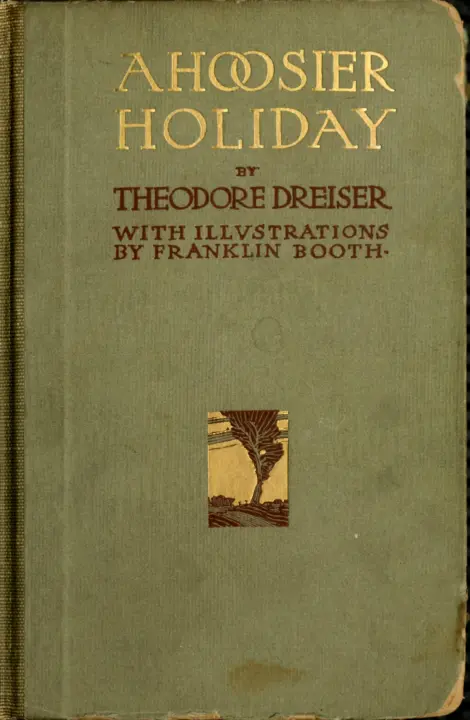
Theodore Dreiser
BEHIND THE BOOK
This eBook is for the use of anyone anywhere in the United States and most other parts of the world at no cost and with almost no restrictions whatsoever. You may copy it, give it away or re-use it under the terms of the Project Gutenberg License included with this eBook or online at www.gutenberg.org. If you are not located in the United States, you will have to check the laws of the country where you are located before using this eBook. Read the source licence.
The original source file, including credits and licence, is retained by this library. Request an original-format copy at no charge. Please include the book title and Project Gutenberg identifier #31824.
KEEP YOUR CURIOSITY GOING
Coulson Kernahan

Maurice Baring
Frances Wright
Cécile Tormay

Frederic Jesup Stimson

W. H. P. (William Henry Pope) Jarvis