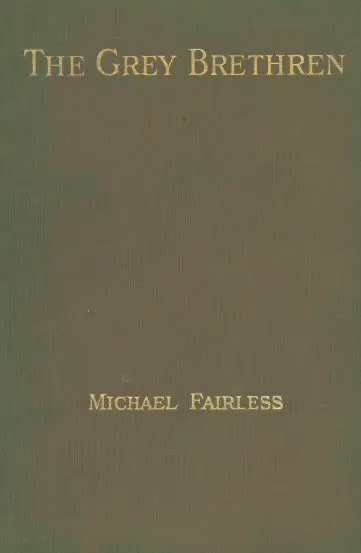
The Grey Brethren, and Other Fragments in Prose and Verse
Michael Fairless
THE CLASSIC COLLECTION · 1901
"The Gathering of Brother Hilarius" by Michael Fairless is a romance novel likely written in the early 20th century. The story explores the inner struggles of a young novice named Hilarius, who grapples with the tensions between his monastic duties and the enchantments of the worldly life he has long been sheltered from. Set against the backdrop of the Black Death, it delves into themes of love, longing, and the quest for spiritual truth. At the start of the novel, we are introduced to Hilarius standing at the gates of his monastery, where he is overtaken by a sense of yearning for the outside world. As he gazes down the road, he is torn between his commitment to the cloistered life and the allure of the forest that beckons him. His encounter with a spirited young dancer reveals the complexities of love and desire, complicating his innocent understanding of the world. As Hilarius contemplates the meaning of love, guided by the inspired words of the people he meets, he begins a journey that promises to oscillate between divine calling and human affections, setting the stage for a profound exploration of faith and love in a tumultuous time.
Introduction adapted from the source catalogue; source summaries may be automatically generated.
Free to read · English · 27,828 words · No account needed
MAKE TIME FOR A GOOD BOOK
On by default. Untick to stop anonymous reading totals. Each page counts after 10 seconds in view. How this works.
Anonymous counting is on unless you have switched it off.
A hawk swooped, struck near him, and rose again with its prey. Hilarius shuddered; but perhaps the hawk had nestlings waiting open-mouthed for food? His little maid! His eyes filled with tears as he thought of those who awaited him. He picked up a stone, and watched if perchance a coney might show itself. He had never killed, but were not his nestlings agape?
Nothing stirred, but along the road came a waggon of strange shape and
gaily painted.
He rose to his feet, praying the great Mother to send him help in his
awful need.
The waggon drew near; the driver sat asleep upon the shaft, the horse took his own pace. It passed him before he could pluck up heart to ask an alms, and from the back dangled a small sack and a hen. If he begged and was refused his little maid must die. A minute later the sack and the hen had changed owners—but not unobserved; a clear voice called a halt; the waggon stood fast; two figures sprang out, a girl and a boy: and Hilarius stood before them on the white highway—a thief.
“Seize the knave!” cried the girl sharply.
Hilarius stared at her and she at him. It was his dancer, and she knew him, ay, despite the change of dress and scene, she knew him.
“What! The worthy novice turned worldling and thief! Nay, ’tis a rare jest. What of thy fine sermons now, good preacher?”
But Hilarius answered never a word; overcome by shame, grief, and hunger, sudden darkness fell upon him.
When he came to himself he was sitting propped against the hedge; the waggon was drawn up by the roadside, and the dancer and her brother stood watching him.
“Fetch bread and wine,” said the girl, and to Hilarius who tried to speak, “Peace, ’til thou hast eaten.”
Hilarius ate eagerly, and when he had made an end the dancer said:—
“Now tell thy tale. Prithee, since when didst thou leave thy Saints and thy nursery for such an ill trade as this?”
Hilarius told her all, and when he had finished he wept because of his little maid, and his were not the only tears.
The dancer went to the waggon and came back with much food taken from her store, to which she added the hen; the sack held but fodder.
“But, Gia,” grumbled her brother, “there will be naught for us to-night.”
“Thou canst eat bread, or else go hungry,” she retorted, and filled a small sack with the victuals.
Hilarius watched her, hardly daring to hope. She held it out to him: “Now up and off to thy little maid.”
Your reading position is saved on this browser. Take it to another device with a library code. Reading pages adapt to text, rather than matching a printed edition.
BEHIND THE BOOK
This eBook is for the use of anyone anywhere in the United States and most other parts of the world at no cost and with almost no restrictions whatsoever. You may copy it, give it away or re-use it under the terms of the Project Gutenberg License included with this eBook or online at www.gutenberg.org. If you are not located in the United States, you will have to check the laws of the country where you are located before using this eBook. Read the source licence.
The original source file, including credits and licence, is retained by this library. Request an original-format copy at no charge. Please include the book title and Project Gutenberg identifier #789.
KEEP YOUR CURIOSITY GOING
Cécile Tormay

Moritz Busch
Coulson Kernahan
John L. Ransom

Maurice Baring
Frances Wright