A vision of life
Darrell Figgis
THE CLASSIC COLLECTION · 1917
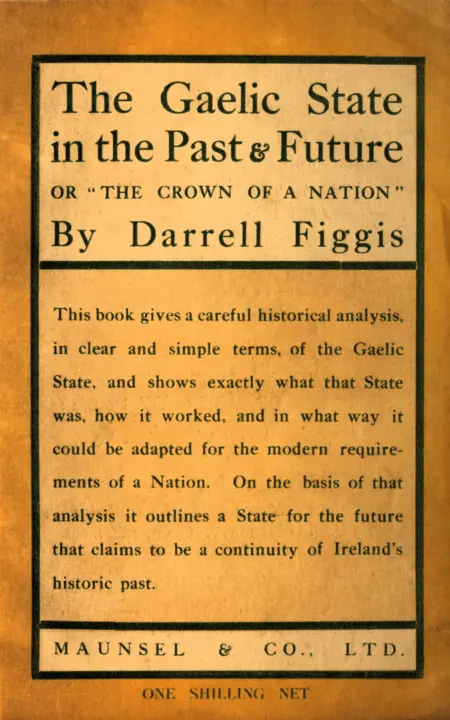
"The Gaelic State in the Past & Future; or, ''The Crown of a Nation''" by Darrell Figgis is a historical-political treatise written in the early 20th century. It argues that Ireland’s statehood should be rebuilt from its own historic polity—rooted in Brehon law, landholding tuatha, and functional assemblies—rather than borrowed from imperial or colonial models. Blending analysis and prescription, it reconstructs the workings of the old Gaelic State and outlines how its principles could be modernized into a sovereign, democratic framework. The opening of the work defines a “crowned” nation as one that expresses its spirit through its own State, then contends that Ireland once possessed such sovereignty and must rediscover it by studying its own history. Figgis traces the emergence of a centralized Gaelic polity from Tuathal and Cormac through Tara’s assemblies, the codification of law, and the layered organization of tuatha, brehons, elected kings, and public hospitallers, with land held corporately by the people. He explains how this system functioned, its social equity (including women’s legal standing), and its weaknesses—dynastic succession, disruptive provincial power, and the absence of a national army—which the Norman conquest froze before they could be resolved. He then surveys the broken state: invasion, partial Gaelicization of Norman lords, the Statutes of Kilkenny, Tudor reconquest, Hugh O’Neill’s bid to preserve the tuatha, Cromwellian dispossession, and the people’s quiet return to their lands beneath a landlord layer. The nineteenth-century “resurrection” follows: Emancipation, the Land War’s reassertion of the freeman’s right (including boycotting as a revival of communal sanction), cultural revival via the Gaelic League, and co‑operative societies as modern echoes of stateships. Finally, he turns to the future: discard English administrative molds, complete land purchase, and build a modern Irish State with a representative assembly anchored by specialized national councils (for farming, labour, law, education, defence) and a balancing senate—thus translating the old Gaelic polity into contemporary form.
Introduction adapted from the source catalogue; source summaries may be automatically generated.
Free to read · English · 22,973 words · No account needed
MAKE TIME FOR A GOOD BOOK
On by default. Untick to stop anonymous reading totals. Each page counts after 10 seconds in view. How this works.
Anonymous counting is on unless you have switched it off.
Certain parts of government belong so essentially to the business of the whole that they would not come under the review of any special council. The Minister, or Ministers, in charge of these would be responsible to none but the Nation, for they would directly concern the Nation as a whole and not in any one of its parts. The chief of these of course is finance. The only council which the Minister of Finance could consult or advise would be the Assembly of Representatives, as drawn directly, well or ill, from the people’s choice. All direct money arrangements, such as taxes, the creation of debt or credit, the purchase of properties or monopolies, and so forth, would lie in his care, would arise at his initiative and would be solved by the Assembly. The Senate could claim the right to debate any such measure, and to suggest alterations, but whether the Assembly accepted or rejected these alterations would lie at its own discretion.
There would be other matters of the same nature. The creation of new forms or units of government, for example, or changes in the constitution, where rendered necessary by changing conditions, or any matter outside the range of the councils, or transcending their capacity, or any new legislation at the initiative of one council that would demand some independent measure to bring it into co-ordination with the working of some other council, would all be of this kind, and would lie at the initiative of the Chief Minister of State, who would be responsible for the State to its elected President and would be chosen by him to create the Ministry.
Such business would naturally be more frequent at the beginning of the working of the State than when it was in complete movement. For example, the first work of the State would inevitably be the re-creation of its local government in order to bring it into conformity with practical necessities on the lines of the stateships of the old State. Nothing more unwieldy and uneconomical than the present system, or lack of system, could very well have been devised. It is a patchwork quilt of foreign ideas, that express no realities in Ireland, that are alternately the theme of the mirth and the tears, but always the derision, of Irishmen, and that even in the country of their invention have not proved to be a conspicuous success. Urban Councils, District Councils, Poor Law Guardians, Town Commissioners and County Councils all have their independent lives without being fitted in as parts of a co-related whole. Seen in contrast with the compactness and completeness of the old stateships nothing could seem more haphazard and accidental. So long as they exist, as they now do, it will be impossible to speak of an Irish State, for a State does not exist only by reason of the larger, more central forms of government, but in the degree in which those larger forms are drawn into relation with smaller and local units of government. They neither correspond to any efficiency in the State nor to any efficiency in relation to their own needs. They divide up a given area into a number of separate and even opposed units, whereas the life of that area is generally itself a unit, however variously its activities may be expressed. A small township and the country lying about it, for example, can only artificially be broken up into two units, one the town and the other the country, for their life is woven of one piece. Even the industries of the towns depend on the country lying round about. Any weakening of the whole weakens each one of its parts, and the whole is weakened by being broken into irresponsible parts. For the life of the whole exists as a community not as a patchwork.
Your reading position is saved on this browser. Take it to another device with a library code. Reading pages adapt to text, rather than matching a printed edition.
BEHIND THE BOOK
This eBook is for the use of anyone anywhere in the United States and most other parts of the world at no cost and with almost no restrictions whatsoever. You may copy it, give it away or re-use it under the terms of the Project Gutenberg License included with this eBook or online at www.gutenberg.org. If you are not located in the United States, you will have to check the laws of the country where you are located before using this eBook. Read the source licence.
The original source file, including credits and licence, is retained by this library. Request an original-format copy at no charge. Please include the book title and Project Gutenberg identifier #77101.
KEEP YOUR CURIOSITY GOING
Cécile Tormay

Moritz Busch
John L. Ransom
Frances Wright
Cécile Tormay

Mabel Potter Daggett