A vision of life
Darrell Figgis
THE CLASSIC COLLECTION · 1917
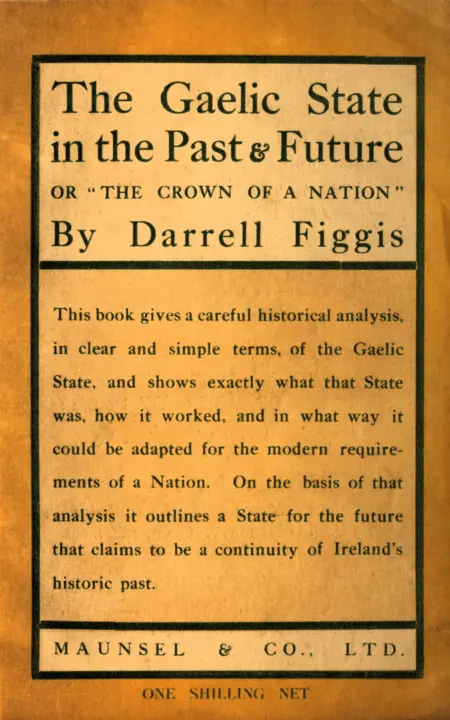
"The Gaelic State in the Past & Future; or, ''The Crown of a Nation''" by Darrell Figgis is a historical-political treatise written in the early 20th century. It argues that Ireland’s statehood should be rebuilt from its own historic polity—rooted in Brehon law, landholding tuatha, and functional assemblies—rather than borrowed from imperial or colonial models. Blending analysis and prescription, it reconstructs the workings of the old Gaelic State and outlines how its principles could be modernized into a sovereign, democratic framework. The opening of the work defines a “crowned” nation as one that expresses its spirit through its own State, then contends that Ireland once possessed such sovereignty and must rediscover it by studying its own history. Figgis traces the emergence of a centralized Gaelic polity from Tuathal and Cormac through Tara’s assemblies, the codification of law, and the layered organization of tuatha, brehons, elected kings, and public hospitallers, with land held corporately by the people. He explains how this system functioned, its social equity (including women’s legal standing), and its weaknesses—dynastic succession, disruptive provincial power, and the absence of a national army—which the Norman conquest froze before they could be resolved. He then surveys the broken state: invasion, partial Gaelicization of Norman lords, the Statutes of Kilkenny, Tudor reconquest, Hugh O’Neill’s bid to preserve the tuatha, Cromwellian dispossession, and the people’s quiet return to their lands beneath a landlord layer. The nineteenth-century “resurrection” follows: Emancipation, the Land War’s reassertion of the freeman’s right (including boycotting as a revival of communal sanction), cultural revival via the Gaelic League, and co‑operative societies as modern echoes of stateships. Finally, he turns to the future: discard English administrative molds, complete land purchase, and build a modern Irish State with a representative assembly anchored by specialized national councils (for farming, labour, law, education, defence) and a balancing senate—thus translating the old Gaelic polity into contemporary form.
Introduction adapted from the source catalogue; source summaries may be automatically generated.
Free to read · English · 22,973 words · No account needed
MAKE TIME FOR A GOOD BOOK
On by default. Untick to stop anonymous reading totals. Each page counts after 10 seconds in view. How this works.
Anonymous counting is on unless you have switched it off.
Everything that has been introduced by England into Ireland is destined to rejection, and not as a matter of prejudice, but as an inevitable fact in statesmanship. Suits cut for other people, or demanded by other people’s necessities, are the proper wear for clowns. At best these things were wrung as concessions given with poor grace after long and bitter war; at worst they were anticipations of further war and the spontaneous creation of an alien thought. The first was better than the second because it did spring from the initiative of the people, and partially and ineffectually answered that demand, while the second sprang from the same alien intention that has created three centuries of almost unremitting warfare. And whether that intention stalk as an undisguised foe, or prank about with the antics of a philanthropist, the result in statesmanship is the same. Instead of effecting an organisation it creates a configuration; instead of producing human contentment, comfort and ease it produces irritation, exasperation and enmity; instead of being as flexible as the life it contains it is as rigid as the thought that made it; instead of being capable of development it is only capable of being broken or abused; instead of being a National State it is a national despair and futility. Therefore statesmanship must neglect its achievements (though continuity of government may compel their continuance for awhile) and must make a direct approach to the national life, and its needs and necessities, human and economic, in order to build again, however slowly to build, from the foundations the structure that those foundations decree and suggest.
It is in the discovery of those foundations that history becomes a matter of first importance. Not a portion of that history; not the history of the eighteenth century, which did not express the life of the people but the life of a small colony the proportion of which to the whole is even smaller now than it was then, besides being under the influence of the awakening of the nineteenth century; but the whole of that history, from the beginnings to the present, for in Irish history probably more than in any other the end is in the beginning and the beginning in the end. That we have already seen. We have seen, first, the National State as it existed, and we saw that it was indeed a National State although it was not finally centralised before it was assaulted. We have seen the assault that suspended its completion, and we saw that that assault meant for some centuries the war of a State against a State, a Polity against a Polity, a foreign and alien polity seeking to break and displace the polity of the Nation. We have seen that polity broken and displaced, and we saw the ideas that went to the building of that polity lying resident in the people and creating a continual warfare with the alien polity that had been imposed upon the country from without. We have seen that those ideas maintained the warfare unceasingly, it being the first principle of life to find an outlet for the ideas of the mind and the impulses of the blood, and to war for them when they are thwarted; and we saw that warfare successful in winning back much of what had been lost, and especially winning back the land on which the old polity had been based. We have seen those ideas breaking out in some remarkable acts reminiscent of the old process of law; and we saw that when some scheme was advocated to the people that could be worked independently of the alien polity it was taken and bent into the form of the stateships in which the old polity had been expressed. In a word, we have seen the end in the beginning, and the beginning in the end, with a persistent continuity throughout. The question is, how may that continuity be carried forward, and some State be devised that shall express the National intuition and desire, and be the old State re-born into modern conditions while perfectly fitting and conveying the requirements of a new and intricate life?
Your reading position is saved on this browser. Take it to another device with a library code. Reading pages adapt to text, rather than matching a printed edition.
BEHIND THE BOOK
This eBook is for the use of anyone anywhere in the United States and most other parts of the world at no cost and with almost no restrictions whatsoever. You may copy it, give it away or re-use it under the terms of the Project Gutenberg License included with this eBook or online at www.gutenberg.org. If you are not located in the United States, you will have to check the laws of the country where you are located before using this eBook. Read the source licence.
The original source file, including credits and licence, is retained by this library. Request an original-format copy at no charge. Please include the book title and Project Gutenberg identifier #77101.
KEEP YOUR CURIOSITY GOING
Cécile Tormay

Moritz Busch
John L. Ransom
Frances Wright
Cécile Tormay

Mabel Potter Daggett