THE CLASSIC COLLECTION✦A day in old RomeCLASSIC FREE BOOKS
A day in old Rome
William Stearns Davis
THE CLASSIC COLLECTION · 1912
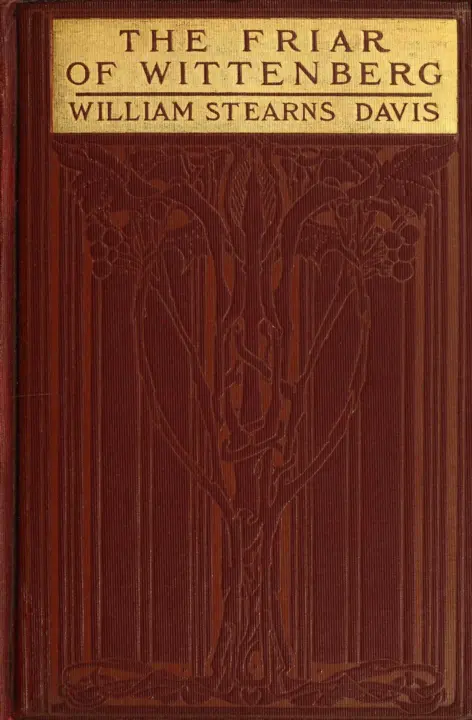
The friar of Wittenberg by William Stearns Davis is a historical novel written in the early 20th century. Set amid the splendor and corruption of Renaissance Rome on the eve of the Reformation, it follows Gualtiero, Conte di Palaestro (Graf von Regenstein), an Italian-bred German noble entangled with cardinals, artists, and courtiers whose path bends north toward Martin Luther and a crisis of conscience. Expect intrigue, romance, and grand pageantry turning into moral reckoning as Italian humanism collides with German reforming fervor.
The opening of The friar of Wittenberg plunges into Vatican intrigue: Cardinals Forli and Rocca plot to unseat—and, by hired dagger, remove—the favored Archbishop of Bari, dangling church advancement before Gualtiero, who refuses to join a murder. Between a glimpse of Raphael’s new painting and a glittering Chigi banquet, Gualtiero woos Forli’s brilliant daughter Marianna, defends Germans against Bembo’s jibes, then is abruptly arrested when the bravo Ettore Orosi blames him for a failed attack on Bari. Before Pope Leo X, Gualtiero will not betray Forli or Rocca; Leo soothes Bari with a prebend, stays the bravo’s fate, and banishes Gualtiero from Italy. The section closes with his journey north and stark arrival at his ancestral fortress of Regenstein, signaling a turn from Roman luxury to a harsher, awakening world.
Introduction adapted from the source catalogue; source summaries may be automatically generated.
Free to read · English · 135,604 words · No account needed
MAKE TIME FOR A GOOD BOOK
On by default. Untick to stop anonymous reading totals. Each page counts after 10 seconds in view. How this works.
Anonymous counting is on unless you have switched it off.
I forget all that we talked about during the innumerable courses, but I recall that when some luscious pheasants were served, the Contessa shrugged her shoulders.
“After all,” smiled she, “it is not yet midnight and to-day was
Friday.”
“All things are permitted in Rome,” I replied lightly. “How is that,
my wise Priario?”
“Excellently said,” returned the censor, lifting a choice morsel. “Says not Scripture, ‘The Kings of the Earth take tribute of strangers, but the Children (ourselves, of course), are free.’”
“Full pardon, then!” cried the Contessa, who had taken enough wine to be a little gay. She helped herself, and I was complimenting her upon some fine corals, when Cardinale di Porto, near by, asked if I had read Pomponazzi of Mantua’s new essay upon “The Immortality of the Soul.”
“Yes, I have read it,” I assented; “but I cannot claim to judge it as an expert churchman.”
“Yet you have an opinion?”
“If I were a theologian, I should say the learned author has the incredulity of Lucretius and the infidelity of a Moslem.”
“Too harsh, my dear Conte. It is a most excellent book. The author declares clearly he submits to the Church in all its teachings, even if the immortality of the soul is disproved by all human reasoning.”
“Nevertheless,” I contended, “for much lesser heresies better men have walked to the stake.”
“The stake! Don’t mention the horrid word, Eccellenza,” begged the
lady nervously.
“Nevertheless,” I rejoined, “the book is so dangerous and heretical that its sale is forbidden in Venice.”
“Of course,” retorted Porto, “your Venetian is ultra-orthodox; praised be the immortals, His Holiness is more liberal!”
“I fear he would not prove so liberal,” I ventured, “if instead of writing for a few philosophers, Pomponazzi had declared to the multitude that ‘since it is doubtful whether we have immortal souls, it is also doubtful whether we ought to pay tithes to Rome.’”
“There is no parallel!” cried the lady.
“The Contessa is right,” chimed Porto. “It is quite a different matter to advance a cautious theory for the learned few, than to cast pearls before swine,--I mean to cast sage conclusions before the ignorant.”
“We will deal with your second case when it arises,” thrust in Priario grimly, but at this moment the discussion was widened by a question I heard the learned Messere Bembo putting, a little way down the table.
“And tell me, my dear Chigi, how the last indulgence in Germany sells? Will it not relieve His Holiness’s financial troubles?”
Your reading position is saved on this browser. Take it to another device with a library code. Reading pages adapt to text, rather than matching a printed edition.
William Stearns Davis

William Stearns Davis

William Stearns Davis
William Stearns Davis
BEHIND THE BOOK
This eBook is for the use of anyone anywhere in the United States and most other parts of the world at no cost and with almost no restrictions whatsoever. You may copy it, give it away or re-use it under the terms of the Project Gutenberg License included with this eBook or online at www.gutenberg.org. If you are not located in the United States, you will have to check the laws of the country where you are located before using this eBook. Read the source licence.
The original source file, including credits and licence, is retained by this library. Request an original-format copy at no charge. Please include the book title and Project Gutenberg identifier #77944.
KEEP YOUR CURIOSITY GOING
Cécile Tormay

Moritz Busch
Coulson Kernahan
John L. Ransom

Maurice Baring
Frances Wright