THE CLASSIC COLLECTION✦A day in old RomeCLASSIC FREE BOOKS
A day in old Rome
William Stearns Davis
THE CLASSIC COLLECTION · 1912
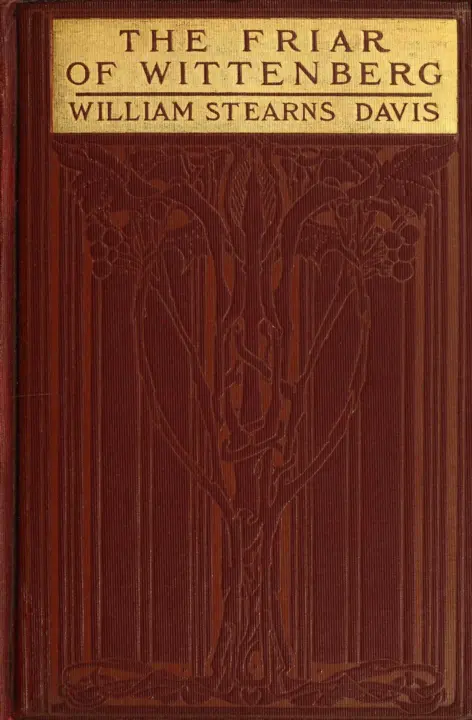
The friar of Wittenberg by William Stearns Davis is a historical novel written in the early 20th century. Set amid the splendor and corruption of Renaissance Rome on the eve of the Reformation, it follows Gualtiero, Conte di Palaestro (Graf von Regenstein), an Italian-bred German noble entangled with cardinals, artists, and courtiers whose path bends north toward Martin Luther and a crisis of conscience. Expect intrigue, romance, and grand pageantry turning into moral reckoning as Italian humanism collides with German reforming fervor.
The opening of The friar of Wittenberg plunges into Vatican intrigue: Cardinals Forli and Rocca plot to unseat—and, by hired dagger, remove—the favored Archbishop of Bari, dangling church advancement before Gualtiero, who refuses to join a murder. Between a glimpse of Raphael’s new painting and a glittering Chigi banquet, Gualtiero woos Forli’s brilliant daughter Marianna, defends Germans against Bembo’s jibes, then is abruptly arrested when the bravo Ettore Orosi blames him for a failed attack on Bari. Before Pope Leo X, Gualtiero will not betray Forli or Rocca; Leo soothes Bari with a prebend, stays the bravo’s fate, and banishes Gualtiero from Italy. The section closes with his journey north and stark arrival at his ancestral fortress of Regenstein, signaling a turn from Roman luxury to a harsher, awakening world.
Introduction adapted from the source catalogue; source summaries may be automatically generated.
Free to read · English · 135,604 words · No account needed
MAKE TIME FOR A GOOD BOOK
On by default. Untick to stop anonymous reading totals. Each page counts after 10 seconds in view. How this works.
Anonymous counting is on unless you have switched it off.
“Walter! Ach! Liebe Gott!”
He ran up to me, and almost crushed me with his powerful embrace. Then he led me to the window-seat, and sat for some moments holding both my hands, and pelting me with questions, so rapidly that I could hardly answer one, ere he had discharged another.
“Oh! dear Lord Jesus Christ!” he cried at length, “what have I, poor Brother Martin, done, that the noble Graf von Regenstein should run this peril for my sake?”
“The peril was nothing, but I am come back a beaten soldier. I have
failed.”
“Yes, the Bull is issued. Good! Asses must bray, wolves howl, and cardinals clamor for a poor German’s blood. Heaven has made it so. We cannot complain.”
“Yet consider, dear Dr. Martin, who and what will save us now?”
“Us? ‘Me’ you intended to say.”
“Us, for am I not one with you for life and for death?”
He was silent for an instant, then the grip on my hand was renewed. “I have not deserved this. I cannot involve noble friends. The cause will triumph, but very likely over my bones. It must not march over yours also.”
“Dear Doctor,” said I, “it is you who have taught me to seek God and to play the man and not the accursed fool. It is ‘us’ from this time forth, though the Pope and every king rise up against us.”
“I have not deserved this. I thank you.” Then he reached to the table and took up a Psalter. “Let me say the forty-sixth psalm.”
And in the gray twilight, with the book unopened before him, I heard his deep voice roll out the majestic Latin of the Vulgate.
“God is our refuge and strength, a very present help in trouble.
Therefore will we not fear, though the earth be removed, and though the mountains be carried into the midst of the sea.
Though the waters therefore roar and be troubled: though the mountains shake with the swelling thereof.
The heathen raged, the kingdoms were moved: He uttered His
voice, the earth melted.
Be still and know that I am God; I will be exalted among the heathen, I will be exalted in the earth.
The Lord of hosts is with us. The God of Jacob is our refuge.”
We sat silent again for a long time when he ceased. The daylight faded. I shall no more forget that hour than I shall forget the scene in the hunting lodge with Leo de’ Medici. A few years afterward Luther was to cast this psalm into a hymn which Germany, and many Christians afar, will verily sing forever, ‘Ein feste Burg ist unser Gott.’...
Your reading position is saved on this browser. Take it to another device with a library code. Reading pages adapt to text, rather than matching a printed edition.
William Stearns Davis

William Stearns Davis
William Stearns Davis
William Stearns Davis
BEHIND THE BOOK
This eBook is for the use of anyone anywhere in the United States and most other parts of the world at no cost and with almost no restrictions whatsoever. You may copy it, give it away or re-use it under the terms of the Project Gutenberg License included with this eBook or online at www.gutenberg.org. If you are not located in the United States, you will have to check the laws of the country where you are located before using this eBook. Read the source licence.
The original source file, including credits and licence, is retained by this library. Request an original-format copy at no charge. Please include the book title and Project Gutenberg identifier #77944.
KEEP YOUR CURIOSITY GOING
Cécile Tormay

Moritz Busch
Coulson Kernahan
John L. Ransom

Maurice Baring
Frances Wright