
German Society at the Close of the Middle Ages
Ernest Belfort Bax
THE CLASSIC COLLECTION · 1913
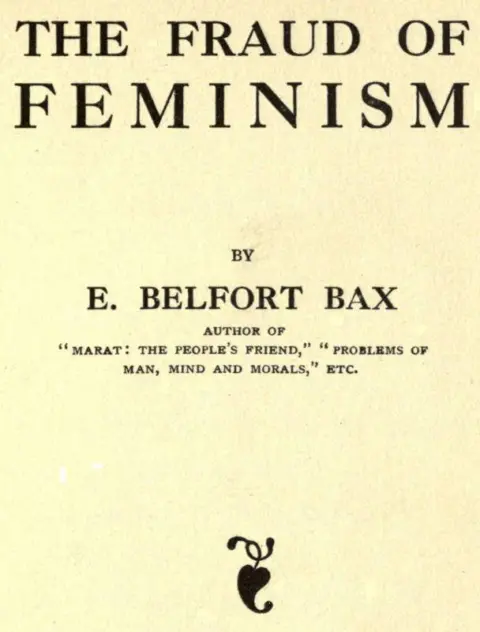
"The Fraud of Feminism" by E. Belfort Bax is a critical exploration of the feminist movement, written in the early 20th century. This work aims to analyze and refute what the author perceives as the misleading claims and privileges that contemporary feminism advocates. Bax's focus is on discrediting the notion that women are oppressed and argues that they actually enjoy various legal and societal privileges that favor them over men. At the start of the book, the author establishes the premise that modern feminism consists of contradictory demands, including equality in rights and a desire for special protections for women. He outlines the historical context of women's social status and suggests that many assertions made by feminists are merely unchallenged legends or distortions of reality. Bax introduces the two sides of modern feminism—political and sentimental—and posits that the latter's influence has resulted in a gender bias within the legal system that favors women. Through this opening, he sets the stage for a broader critique of arguments supporting feminist ideologies.
Introduction adapted from the source catalogue; source summaries may be automatically generated.
Free to read · English · 39,802 words · No account needed
MAKE TIME FOR A GOOD BOOK
On by default. Untick to stop anonymous reading totals. Each page counts after 10 seconds in view. How this works.
Anonymous counting is on unless you have switched it off.
Another fallacy analogous to the preceding, inasmuch as it seeks to counterbalance female defects and weaknesses by the false allegation of corresponding deficiencies in men, is the Feminist retort sometimes heard when the question of hysteria in women is raised: “Oh! men can also suffer from hysteria!” This has been already dealt with in an earlier chapter, but for the sake of completing the list of prominent Feminist fallacies I restate it concisely here. Now as we have seen it is exceedingly doubtful whether this statement is true in any sense whatever. There are eminent authorities who would deny that men ever have true hysteria. There are others, of course, again, who would extend the term hysteria so as to include every form of neurasthenic disturbance. The question is largely, with many persons who discuss the subject, one of terminology. It suffices here to cut short quibbling on this score. For the nonce, let us drop the word hysteria and formulate the matter as follows:—Women are frequently subject to a pathological mental condition, differing in different cases but offering certain well-marked features in common, a condition which seldom, if ever, occurs in men. This I take to be an incontrovertible proposition based upon experience which will be admitted by every impartial person.
Now the existence of the so-called hysterical man I have hitherto found to be attested on personal experience solely by certain Feminist medical practitioners who allege that they have met with him in their consulting-rooms. His existence is thus vouchsafed for just as the reality of the sea-serpent is vouchsafed for by certain sea captains or other ancient mariners. Far be it from me to impugn the ability, still less the integrity, of these worthy persons. But in either case I may have my doubts as to the accuracy of their observation or of their diagnosis. It may be that the sea-serpent exists and it may be that hysteria is at times discoverable in male persons. But while a conclusive proof of the discovery of a single sea-serpent of the orthodox pattern would go far to justify the yarn of the ancient mariner, the proof of the occurrence, in an occasional case, of hysteria in men, would not by far justify the implied contention that hysteria is not essentially a female malady. If hysterical men are as common a phenomenon as certain hard-pressed Feminists would make out, what I want to know is: Where are they? While we come upon symptoms which would be commonly attributed to hysteria in well-nigh every second or third woman of whose life we have any intimate knowledge, how often do we find in men symptoms in any way resembling these? In my own experience I have come across but two cases of men giving indications of a temperament in any way analogous to that of the “hysterical woman.” After all, the experience of the average layman, and in this I contend my own is more or less typical, is more important in the case of a malady manifesting itself in symptoms obvious to common observation, such as the one we are considering, than that of the medical practitioner, who by reason of his profession would be especially likely to see cases, if there were any at all, however few they might be. The possibility, moreover, at least suggests itself, that the latter may often mistake for hysteria (using the word in the sense commonly applied to the symptoms presented by women) symptoms resulting from general neurasthenia or even from purely extraneous causes, such as alcohol, drugs, etc. That this is sometimes the case is hardly open to question. That the pathological mental symptoms referred to as prevalent in the female, whether we attribute them to hysteria or not, are rarely if ever found in the male sex is an undoubted fact. The rose, it is said, is as sweet by any other name, and whether we term these affections symptoms of hysteria, or describe them as hysteria itself, or deny that they have anything to go with “true hysteria,” their existence and frequency in the female sex remains nevertheless a fact. No! whether some of the symptoms of hysteria, “true” or “so-called,” are occasionally to be found in men or not, every impartial person must admit that they are extremely rare, whereas as regards certain pathological mental symptoms, common in women and popularly identified (rightly or wrongly) with hysteria, there is, I contend, little evidence of their occurring in men at all. Wriggle and prevaricate as they may, it is impossible for Suffragists and Feminists to successfully evade the undoubted truth that the mentality of women is characterised constitutionally by a general instability, manifesting itself in pathological symptoms radically differing in nature and in frequency from any that obtain in men.
Your reading position is saved on this browser. Take it to another device with a library code. Reading pages adapt to text, rather than matching a printed edition.
BEHIND THE BOOK
This eBook is for the use of anyone anywhere in the United States and most other parts of the world at no cost and with almost no restrictions whatsoever. You may copy it, give it away or re-use it under the terms of the Project Gutenberg License included with this eBook or online at www.gutenberg.org. If you are not located in the United States, you will have to check the laws of the country where you are located before using this eBook. Read the source licence.
The original source file, including credits and licence, is retained by this library. Request an original-format copy at no charge. Please include the book title and Project Gutenberg identifier #51877.
KEEP YOUR CURIOSITY GOING

Charles G. (Charles Griffith) Ross
Hannah Webster Foster

Emily Lawless
Edwin Hamlin Carr

Charles De Lano Hine
Andrew Ure