
German Society at the Close of the Middle Ages
Ernest Belfort Bax
THE CLASSIC COLLECTION · 1913
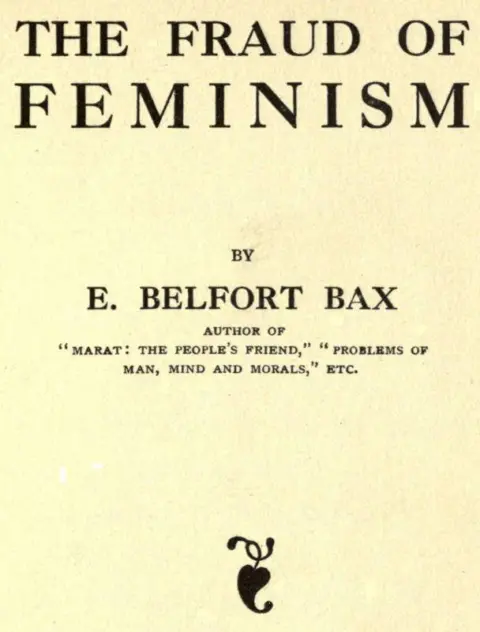
"The Fraud of Feminism" by E. Belfort Bax is a critical exploration of the feminist movement, written in the early 20th century. This work aims to analyze and refute what the author perceives as the misleading claims and privileges that contemporary feminism advocates. Bax's focus is on discrediting the notion that women are oppressed and argues that they actually enjoy various legal and societal privileges that favor them over men. At the start of the book, the author establishes the premise that modern feminism consists of contradictory demands, including equality in rights and a desire for special protections for women. He outlines the historical context of women's social status and suggests that many assertions made by feminists are merely unchallenged legends or distortions of reality. Bax introduces the two sides of modern feminism—political and sentimental—and posits that the latter's influence has resulted in a gender bias within the legal system that favors women. Through this opening, he sets the stage for a broader critique of arguments supporting feminist ideologies.
Introduction adapted from the source catalogue; source summaries may be automatically generated.
Free to read · English · 39,802 words · No account needed
MAKE TIME FOR A GOOD BOOK
On by default. Untick to stop anonymous reading totals. Each page counts after 10 seconds in view. How this works.
Anonymous counting is on unless you have switched it off.
The “injured innocent” theory usually comes into play with magistrates when a woman is charged with aggravated annoyance and harassing of men in their business or profession, when, as already stated, the administrator of the law will usually tell the prosecutor that he cannot interfere. In the opposite case of a man annoying a woman under like circumstances he invariably has to find substantial sureties for his good behaviour or go to gaol. No injured innocence for him!
There is another case in which it seems probable that, animated by the same fixed idea, those responsible for the framing of laws have flagrantly neglected an obvious measure for public safety. We refer to the unrestricted sale of sulphuric acid (vitriol) which is permitted. Now here we have a substance subserving only very special purposes in industry, none in household economy, or in other departments, save for criminal ends, which is nevertheless procurable without let or hindrance. Is it possible to believe that this would be the case if men were in the habit of using this substance in settling their differences with each other, even still more if they employed it by way of emphasising their disapproval of the jilting of sweethearts? That it should be employed by women in wreaking their vengeance on recalcitrant lovers seems a natural if not precisely a commendable action, in the eyes of a Sentimental Feminist public opinion, and one which, on the mildest hypothesis, “doesn’t matter.” Hence a deadly substance may be freely bought and sold as though it were cod-liver oil. A very nice thing for dastardly viragoes for whom public opinion has only the mildest of censures! In any reasonable society the indiscriminate sale of corrosive substances would in itself be a crime punishable with a heavy term of imprisonment.
It is not only by men, and by a morbid public opinion inflamed by Feminist sentiment in general, that female criminals are surrounded by a halo of injured innocence. The reader can hardly fail to notice that such women have the effrontery to pretend to regard themselves in this light. This is often so in cases of assault, murder or attempted murder of lovers by their sweethearts. Such is, of course, particularly noticeable in the senselessly wicked outrages, of which more anon. The late Otto Weininger, in his book before quoted, “Geschlecht und Charakter” (Sex and Character), has some noteworthy remarks on this, remarks which, whether we accept his suggested theory or not, might well have been written as a comment on recent cases of suffragette crimes and criminals. “The male criminal,” says Weininger, “has from his birth the same relation to the idea of value [moral value] as any other man in whom the criminal tendencies governing himself may be wholly absent. The female on the other hand often claims to be fully justified when she has committed the greatest conceivable infamy. While the genuine criminal is obtusely silent against all reproaches, a woman will express her astonishment and indignation that anyone can doubt her perfect right to act as she has done. Women are convinced of their being in the right without ever having sat in judgment on themselves. The male criminal, it may be true, does not do so either, but then he never maintains that he is in the right. He rather goes hastily out of the way of discussing right and wrong, because it reminds him of his guilt. In this fact we have a proof that he has a relationship to the [moral] idea, and that it is unfaithfulness to his better self of which he is unwilling to be reminded. No male criminal has ever really believed that injustice has been done him by punishment. The female criminal on the other hand is convinced of the maliciousness of her accusers, and if she is unwilling no man can persuade her that she has done wrong. Should someone admonish her, it is true that she often bursts into tears, begs for forgiveness and admits her fault; she may even believe indeed that she really feels this fault. Such is only the case, however, when she has felt inclined to do so, for this very dissolving in tears affects her always with a certain voluptuous pleasure. The male criminal is obstinate, he does not allow himself to be turned round in a moment as the apparent defiance of a woman may be converted into an apparent sense of guilt, where, that is, the accuser understands how to handle her” (“Geschlecht und Charakter,” pp. 253-254). Weininger’s conclusion is: “Not that woman is naturally evil or anti-moral, but rather that she is merely a-moral, in other words that she is destitute of what is commonly called ‘moral sense.’” The cases of female penitents and others which seem to contradict this announcement Weininger explains by the hypothesis that “it is only in company and under external influence that woman can feel remorse.”
Your reading position is saved on this browser. Take it to another device with a library code. Reading pages adapt to text, rather than matching a printed edition.
BEHIND THE BOOK
This eBook is for the use of anyone anywhere in the United States and most other parts of the world at no cost and with almost no restrictions whatsoever. You may copy it, give it away or re-use it under the terms of the Project Gutenberg License included with this eBook or online at www.gutenberg.org. If you are not located in the United States, you will have to check the laws of the country where you are located before using this eBook. Read the source licence.
The original source file, including credits and licence, is retained by this library. Request an original-format copy at no charge. Please include the book title and Project Gutenberg identifier #51877.
KEEP YOUR CURIOSITY GOING

Charles G. (Charles Griffith) Ross
Hannah Webster Foster

Emily Lawless
Edwin Hamlin Carr

Charles De Lano Hine
Andrew Ure