
German Society at the Close of the Middle Ages
Ernest Belfort Bax
THE CLASSIC COLLECTION · 1913
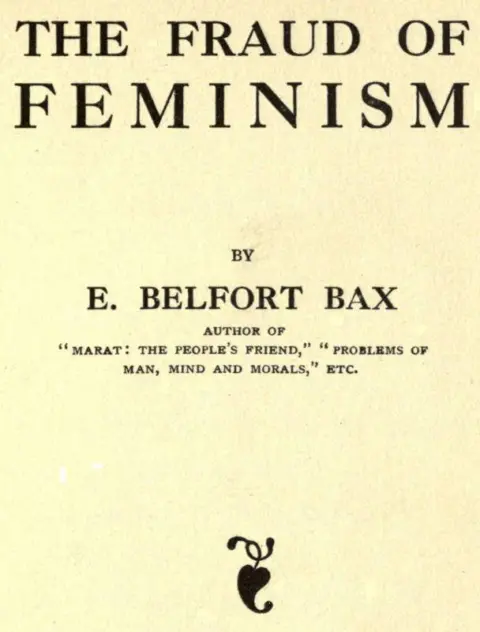
"The Fraud of Feminism" by E. Belfort Bax is a critical exploration of the feminist movement, written in the early 20th century. This work aims to analyze and refute what the author perceives as the misleading claims and privileges that contemporary feminism advocates. Bax's focus is on discrediting the notion that women are oppressed and argues that they actually enjoy various legal and societal privileges that favor them over men. At the start of the book, the author establishes the premise that modern feminism consists of contradictory demands, including equality in rights and a desire for special protections for women. He outlines the historical context of women's social status and suggests that many assertions made by feminists are merely unchallenged legends or distortions of reality. Bax introduces the two sides of modern feminism—political and sentimental—and posits that the latter's influence has resulted in a gender bias within the legal system that favors women. Through this opening, he sets the stage for a broader critique of arguments supporting feminist ideologies.
Introduction adapted from the source catalogue; source summaries may be automatically generated.
Free to read · English · 39,802 words · No account needed
MAKE TIME FOR A GOOD BOOK
On by default. Untick to stop anonymous reading totals. Each page counts after 10 seconds in view. How this works.
Anonymous counting is on unless you have switched it off.
It is the fashion of Feminists, ignoring these fundamental physiological sex differences, to affirm that the actual inferiority of women, where they have the honesty to admit such an obvious fact, is accountable by the centuries of oppression in which Woman has been held by wicked and evil-minded Man. The absurdity of this contention has been more than once pointed out. Assuming its foundation in fact, what does it imply? Clearly that the girls inherit only through their mothers and boys only through their fathers, an hypothesis plainly at variance with the known facts of heredity. Yet those who maintain that distinction of intelligence, etc., between the sexes are traceable to external conditions affecting one sex only and inherited through that sex alone, cannot evade the above assumption. Those, therefore, who regard it as an article of their faith that Woman would show herself not inferior in mental power to man, if only she had the chance of exercising that power, must find a surer foundation for their opinion than this theory of the centuries of oppression, under which, as they allege, the female sex has laboured.
We now come to the important question of morbid and pathological mental conditions to which the female sex is liable and which are usually connected with those constitutional disturbances of the nervous system which pass under the name of hysteria. The word is, as everyone knows, derived from hystera—the womb, and was uniformly regarded by the ancients as directly due to disease of the uterus, this view maintaining itself in modern medicine up till well-nigh the middle of the nineteenth century. Thus Dr J. Mason Good (in his “Study of Medicine,” 1822, vol. iii., p. 528, an important medical text-book during the earlier half of the nineteenth century) says: “With a morbid condition of this organ, hysteria is in many instances very closely connected, though it is going too far to say that it is always dependent upon such condition, for we meet with instances, occasionally, in which no possible connexion can be traced between the disease and the organ,” etc. This is perhaps the first appearance, certainly in English medicine, of doubts being thrown on the uterine origin of the various symptoms grouped under the general term, hysteria. Towards the latter part of the nineteenth century the prevalent view tended more and more to dissociate hysteria from uterine trouble. Lately, however, some eminent pathologists have shown a tendency to qualify the terms of the latter view. Thus Dr Thomas Stevenson in 1902 admits that “it [hysteria] frequently accompanies a morbid state of the uterus,” especially where inflammation and congestion are present, and it is not an uncommon thing for surgeons at the present time to remove the ovaries in obstinate cases of hysteria. On the other hand Dr Thomas Buzzard, in an article on the subject in Quain’s Dictionary of Medicine, 1902, states that hysteria is only exceptionally found in women suffering from diseases of the genital organs, and its relation to uterine and ovarian disturbances is probably neither more nor less than that which pertains to the other affections of the nervous system which may occur without any obvious material cause. Dr Thomas Luff (“Text-Book on Forensic Medicine,” 1895) shows that the derangements of the reproductive functions are undoubtedly the cause of various attacks of insanity in the female. Dr Savage, in his book “On Neuroses,” says that acute mania in women occurs most frequently at the period of adult and mature life, and may occasionally take place at either extreme age. Acute mania sometimes occurs at the suppression of the menses. The same is true of melancholia and other pathological mental symptoms. Dr Luff states that acute mania may replace hysteria; that this happens at periods such as puberty, change of life and menstruation. These patients in the intervals of their attacks are often morbidly irritable or excitable, but as time goes on their energies become diminished and their emotions blunted (“Forensic Medicine,” ii. 307). Such patients are often seized with a desire to commit violence; they are often very mischievous, tearing up clothes, breaking windows, etc. In this mental disorder the patient is driven by a morbid and uncontrollable impulse to such acts. It is not accompanied by delusions, and frequently no change will have been noticed in the individual prior to the commission of the act, and consequently, says Dr Luff, “there is much difference of opinion as to the responsibility of the individual” (ii. 297). Among the acts spoken of Dr Luff mentions a propensity to set fire to furniture, houses, etc. All this, though written in 1895, might serve as a commentary on the Suffragette agitation of recent years. The renowned French professor, Dr Paul Janet (“Les Hysteriques,” 1894) thus defined hysteria: “Hysteria is a mental affection belonging to the large group of diseases due to cerebral weakness and debility. Its physical symptoms are somewhat indefinite, consisting chiefly in a general diminution of nutrition. It is largely characterised by moral symptoms, chief of which is an impairment of the faculty of psychological synthesis, an abolition and a contraction of the field of consciousness. This manifests itself in a peculiar manner and by a certain number of elementary phenomena. Thus sensations and images are no longer perceived, and appear to be blotted out from the individual perception, a tendency which results in their persistent and complete separation from the personality in some cases and in the formation of many independent groups. This series of psychological facts alternate the one with the other or co-exist. Finally this synthetic defect favours the formation of certain independent ideas, which develop complete in themselves, and unattached from the control of the consciousness of the personality. These ideas show themselves in affections possessing very various and unique characteristics.” According to Mr A. S. Millar, F.R.C.S.E. (Encyclopædia Medica, vol. v.), “Hysteria is that . . . condition in which there is imagination, imitation, or exaggeration. . . . It occurs mostly in females and persons of nervous temperament, and is due to some nervous derangement, which may or may not be pathological.” Sir James Paget (“Clinical Lectures on Mimicry”) says also that hysterical patients are mostly females of nervous temperament. “They think of themselves constantly, are fond of telling everyone of their troubles and thus court sympathy, for which they have a morbid craving. Will power is deficient in one direction, though some have it very strongly where their interests are concerned.” He thinks the term “hysteria” in the sense now employed incorrect, and would substitute “mimicry.” “The will should be controlled by the intellect,” observes Dr G. F. Still of King’s College Hospital, “rather than by the emotions and the lack of this control appears to be at the root of some, at least, of the manifestations of hysteria.”
Your reading position is saved on this browser. Take it to another device with a library code. Reading pages adapt to text, rather than matching a printed edition.
BEHIND THE BOOK
This eBook is for the use of anyone anywhere in the United States and most other parts of the world at no cost and with almost no restrictions whatsoever. You may copy it, give it away or re-use it under the terms of the Project Gutenberg License included with this eBook or online at www.gutenberg.org. If you are not located in the United States, you will have to check the laws of the country where you are located before using this eBook. Read the source licence.
The original source file, including credits and licence, is retained by this library. Request an original-format copy at no charge. Please include the book title and Project Gutenberg identifier #51877.
KEEP YOUR CURIOSITY GOING

Charles G. (Charles Griffith) Ross
Hannah Webster Foster

Emily Lawless
Edwin Hamlin Carr

Charles De Lano Hine
Andrew Ure