THE CLASSIC COLLECTION✦The art of fictionCLASSIC FREE BOOKS
The art of fiction
Walter Besant
THE CLASSIC COLLECTION · 1899
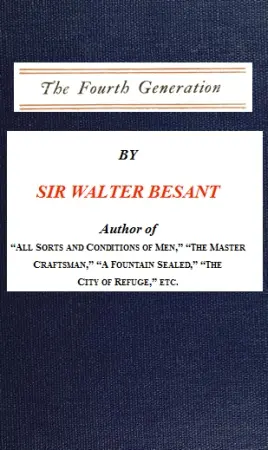
"The Fourth Generation" by Sir Walter Besant is a novel written in the late 19th century. The story explores themes of family legacy, ancestral burdens, and the consequences of one’s heritage. At its center is the character of Leonard Campaigne, who is confronted with the eccentricity of his great-grandfather, a recluse, and begins to uncover the hidden misfortunes that have befallen his family over generations. The opening of the novel introduces a stark and desolate March morning, where the protagonist’s great-grandfather walks the terrace of his grand but decaying estate in solitude. As Leonard reflects on his ancestor's peculiar and isolated existence, he is simultaneously engrossed in his own ambitions and doubts about family legacy. The narrative reveals that the old man has lived a life devoid of outside interaction for nearly seventy years, suggesting a deeper story of loss tied to past events. The chapter culminates with Leonard's visit, eliciting a complex mix of emotions, as he comes to terms with the weight of his family's history—a tapestry woven with tragedy, unspoken words, and the shadow of misfortune.
Introduction adapted from the source catalogue; source summaries may be automatically generated.
Free to read · English · 86,003 words · No account needed
MAKE TIME FOR A GOOD BOOK
On by default. Untick to stop anonymous reading totals. Each page counts after 10 seconds in view. How this works.
Anonymous counting is on unless you have switched it off.
“This would happen--as you see. I believe no one has so much as walked in the garden except ourselves for seventy years. In the eyes of the village, I know, the whole place is supposed to be haunted day and night. Even the chance of apples would not tempt the village children into the garden. Come, Constance, let us go into the village and see the church.”
It was a pretty village, consisting of one long street, with an inn, a small shop, and post-office, a blacksmith’s, and one or two other trades. In the middle of the street a narrow lane led to the churchyard and the church. The latter, much too big for the village, was an early English cruciform structure, with later additions and improvements.
The church was open, for it was Saturday afternoon. The chancel was full of monuments of dead and gone Campaignes. Among them was a tablet, “To the Memory of Langley Holme, born at Great Missenden, June, 1798, found murdered in a wood in this parish, May 18, 1826. Married February 1, 1824, to Eleanor, daughter of the late Marmaduke Flight, of Little Beauchamp, in this county; left one child, Constance, born January 1, 1825.”
“Yes,” said Constance, “one can realise it: the death of wife and friend at once, and in this dreadful manner.”
In the churchyard an old man was occupied with some work among the graves. He looked up and straightened himself slowly, as one with stiffened joints.
“Mornin’, sir,” he said. “Mornin’, miss. I hope I see you well. Beg your pardon, sir, but you be a Campaigne for sure. All the Campaignes are alike--tall men they are, and good to look upon. But you’re not so tall, nor yet so strong built, as the Squire. Been to see the old gentleman, sir? Ay, he do last on, he do. It’s wonderful. Close on ninety-five he is. Everybody in the village knows his birthday. Why, he’s a show. On Sundays, in summer, after church, they go to the garden wall and look over it, to see him marching up and down the terrace. He never sees them, nor wouldn’t if they were to walk beside him.”
“You all know him, then?”
“I mind him seventy years ago. I was a little chap then. You wouldn’t think I was ever a little chap, would you? Seventy years ago I was eight--I’m seventy-eight now. You wouldn’t think I was seventy-eight, would you?” A very garrulous old man, this.
“I gave evidence, I did, at the inquest after the murder. They couldn’t do nohow without me, though I was but eight years old.”
Your reading position is saved on this browser. Take it to another device with a library code. Reading pages adapt to text, rather than matching a printed edition.
Walter Besant
Walter Besant
Walter Besant
Walter Besant
BEHIND THE BOOK
This eBook is for the use of anyone anywhere in the United States and most other parts of the world at no cost and with almost no restrictions whatsoever. You may copy it, give it away or re-use it under the terms of the Project Gutenberg License included with this eBook or online at www.gutenberg.org. If you are not located in the United States, you will have to check the laws of the country where you are located before using this eBook. Read the source licence.
The original source file, including credits and licence, is retained by this library. Request an original-format copy at no charge. Please include the book title and Project Gutenberg identifier #50177.
KEEP YOUR CURIOSITY GOING
Coulson Kernahan

Maurice Baring
Frances Wright
Cécile Tormay

Frederic Jesup Stimson

W. H. P. (William Henry Pope) Jarvis