
Last letters from the living dead man
David Patterson (Spirit) Hatch
THE CLASSIC COLLECTION · 1904
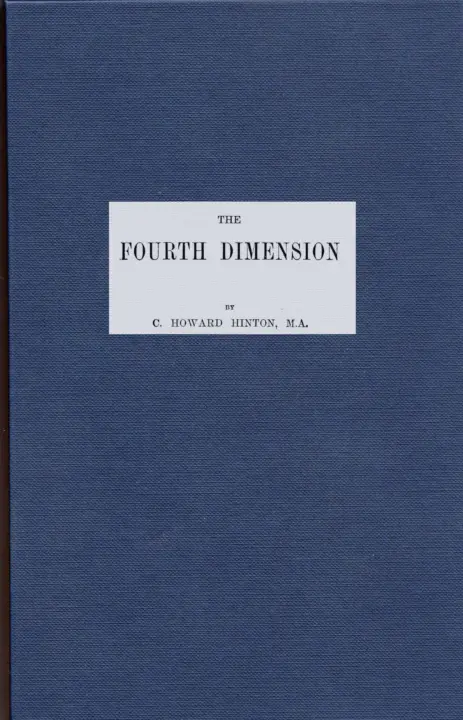
"The Fourth Dimension" by Charles Howard Hinton is a scientific treatise written in the late 19th century. The work explores the concept of higher dimensional space, specifically the fourth dimension, aiming to present the idea in a way that is accessible to readers without a strong mathematical background. The text delves into the implications and significance of a four-dimensional existence and its relationship with our three-dimensional perceptions. The opening of "The Fourth Dimension" introduces the central themes of the book by discussing the limitations of human perception and understanding in the context of higher dimensions. Hinton draws an analogy between our world and a hypothetical plane world to illustrate how beings in a two-dimensional existence might perceive their reality, unaware of the third dimension. He suggests that just as a being in a plane cannot fully comprehend the existence of height, we too might struggle to grasp the fourth spatial dimension. This sets the stage for exploring the properties, applications, and philosophical implications of four-dimensional space as Hinton aims to unravel the complexities surrounding this abstract concept.
Introduction adapted from the source catalogue; source summaries may be automatically generated.
Free to read · English · 76,056 words · No account needed
MAKE TIME FOR A GOOD BOOK
On by default. Untick to stop anonymous reading totals. Each page counts after 10 seconds in view. How this works.
Anonymous counting is on unless you have switched it off.
Here senat is the name for all of the line except its ends. Using “senat” in this way does not mean that the line is the whole of senat, but what there is of it is senat. It is a part of the senat region. Thus also the triangle, which has its three vertices in senin, senel, selen, is named thus:
Area: setat.
Sides: setan, senat, setet.
Vertices: senin, senel, sel.
The tetrahedron section of the tesseract can be thought of as a series of plane sections in the successive sections of the tesseract shown in fig. 114, p. 191. In b{0} the section is the one written above. In b{1} the section is made by a plane which cuts the three edges from sanen intermediate of their lengths and thus will be:
Area: satat.
Sides: satan, sanat, satet.
Vertices: sanan, sanet, sat.
The sections in b{2}, b{3} will be like the section in b_{1} but
smaller.
Finally in b_{4} the section plane simply passes through the corner
named sin.
Hence, putting these sections together in their right relation, from the face setat, surrounded by the lines and points mentioned above, there run:
3 faces: satan, sanat, satet
3 lines: sanan, sanet, sat
and these faces and lines run to the point sin. Thus the tetrahedron is
completely named.
The octahedron section of the tesseract, which can be traced from fig. 72, p. 129 by extending the lines there drawn, is named:
Front triangle selin, selat, selel, setal, senil, setit, selin with
area setat.
The sections between the front and rear triangle, of which one is shown in 1b, another in 2b, are thus named, points and lines, salan, salat, salet, satet, satel, satal, sanal, sanat, sanit, satit, satin, satan, salan.
The rear triangle found in 3b by producing lines is sil, sitet, sinel,
sinat, sinin, sitan, sil.
The assemblage of sections constitute the solid body of the octahedron satat with triangular faces. The one from the line selat to the point sil, for instance, is named selin, selat, selel, salet, salat, salan, sil. The whole interior is salat.
Shapes can easily be cut out of cardboard which, when folded together, form not only the tetrahedron and the octahedron, but also samples of all the sections of the tesseract taken as it passes cornerwise through our space. To name and visualise with appropriate colours a series of these sections is an admirable exercise for obtaining familiarity with the subject.
By extending the letter sequence it is of course possible to name a larger field. By using the limit names the corners of each square can be named.
Your reading position is saved on this browser. Take it to another device with a library code. Reading pages adapt to text, rather than matching a printed edition.
BEHIND THE BOOK
This eBook is for the use of anyone anywhere in the United States and most other parts of the world at no cost and with almost no restrictions whatsoever. You may copy it, give it away or re-use it under the terms of the Project Gutenberg License included with this eBook or online at www.gutenberg.org. If you are not located in the United States, you will have to check the laws of the country where you are located before using this eBook. Read the source licence.
The original source file, including credits and licence, is retained by this library. Request an original-format copy at no charge. Please include the book title and Project Gutenberg identifier #67153.
KEEP YOUR CURIOSITY GOING
David Patterson (Spirit) Hatch
Coulson Kernahan

Ralph Waldo Emerson
Frances Wright

Edwin Abbott Abbott

Joseph Droz